
In stock

CD
Taku SUGIMOTO
“Octet”
On this album, works composed in 2018 and '19 by Tokyo-based composer/guitarist Taku Sugimoto are performed by musicians based in Berlin. Sugimoto has in recent years been working on a series in which pieces written as scores for solo performance can also be played as ensembles, with each musician using their respective solo score. For example, a score for guitar solo and a score for cello solo can be played as a duo performance by a guitarist and a cellist using their respective scores. "Solo for Violoncello 1," one of the tracks on this CD, is the first work of this type composed by Sugimoto. It's also the first piece in the series he named "Solo for Strings," which is performed on bowed stringed instruments using only natural harmonics. In the pieces in this series, the lengths of tones and performances can be changed by the performers.
When he was asked by Berlin-based clarinetists Michiko Ogawa and Sam Dunscombe to write a composition for their ensemble, Sugimoto thought of using the pieces in the "Solo for Strings" series. He prepared one piece for wind instruments to be performed by the trio of Ogawa (clarinet), Dunscombe (bass clarinet) and Rebecca Lane (flute), and five solo pieces from "Solo for Strings"--one each for contrabass, cello, and guitar, and two for viola. These pieces were performed and recorded in Berlin. Also recorded was the 25-minute work "Octet," performed by an ensemble of eight musicians using all six scores. This album is comprised of these seven pieces.
In addition to Michiko Ogawa, Sam Dunscombe and Rebecca Lane, the performing musicians are Johnny Chang (viola), Catherine Lamb (viola), Lucy Railton (cello), Jon Heilbron (contrabass), and Fredrik Rasten (guitar).
11,00€
Out of stock
CD
Taku SUGIMOTO
“Guitars”
Performed by Andrey Popovsky: electric guitar (1), semi-acoustic guitar (2), Denis Sorokin: classical guitar (2), electric guitar (3), Alexander Markvart: acoustic guitar (2).
Taku Sugimoto is a Tokyo-based guitarist and composer. Improvisation is one aspect of his work, but currently his main activities are composing and performing composed pieces (including those of other composers). He continues his global and concentrated interaction with composers from around the world, particularly those closely connected with Wandelweiser. Ftarri had previously released two albums under Sugimoto's name alone—Septet (2015) and Quintets: Berlin, San Diego (2017). On both CDs, his compositions are performed by other musicians (on Septet, Sugimoto also participates in the performance).
The CD Guitars, also released under Sugimoto's name, is comprised of three pieces that he wrote for that instrument. The first and third are guitar solos around 20 minutes long; the second is a guitar trio of about 10 minutes. The performers are three guitarists from Russia, and the pieces were recorded in St. Petersburg in 2017 and 2018. The solo compositions were performed by Andrey Popovsky (track 1) and Denis Sorokin (track 3); and the trio was performed by these two plus Alexander Markvart. All the performances are extremely simple and concise, but convey a feeling of complexity and richness. Abounding in an incomparable feeling of depth within their simplicity and candor, these are truly Sugimoto-like works.
13,00€
Out of stock

CD
Taku SUGIMOTO
“h”
Cristián Alvear & Taku Sugimoto (guitars). Recorded live in concert at Ftarri, Tokyo, November 2017.
13,00€
In stock
CD
Taku SUGIMOTO
“13 & 14 for guitars”
Composed by Taku Sugimoto. Tetuzi Akiyama: guitar. Recorded live at Loop-Line on October 23, 2009. Recorded by Taku Sugimoto. Mastered by Taku Unami. Drawing by Taku Sugimoto.
12,00€
In stock
CD
Taku SUGIMOTO
“26 (2009) Electronic version”
Composition named “26” : different sequences of electronic sounds and silences on the left and right channels. Realized by Taku Unami, 2009 in Tokyo.
12,00€
Out of stock
CD
Taku SUGIMOTO
“Quintets: Berlin, San Diego”
In recent years, guitarist Taku Sugimoto has been active as a composer, providing works to musicians inside and outside Japan, and also as an improvisational musician. He often works with composers and musicians in the sphere of the Wandelweiser school, and gives many performances overseas. Sugimoto is also a member of the Suidobashi Chamber Ensemble, which is made up of five Japanese musicians.
This CD, Sugimoto’s first release since Septet (on Meenna) in 2015, is made up of two versions, both about 30 minutes long, of his 2017 composition “Quintet,” recorded in Berlin and San Diego (U.S.A.). It is performed by five musicians on flute, two clarinets, violin and cello. Track 1, the Berlin version, is a live performance that took place on August 6, 2017. Track 2, the San Diego version, was studio-recorded on March 15, 2017. Clarinetists Samuel Dunscombe, from Australia, and Michiko Ogawa performed on both tracks. Other performing musicians were Rebecca Lane (flute), Johnny Chang (violin), and Lucy Railton (cello) in Berlin; and Michael Matsuno (flute), Erik Carlson (violin), and Judith Hamann (cello) in San Diego. Sugimoto composed the work but did not participate in the performances. The frequently overlapping and interfering long tones and the short tones nonchalantly plucked on the strings continue throughout the performances. Simple structural beauty and a tranquil resonance pervade the performances. A masterpiece.
12,00€
Out of stock
CD
Taku SUGIMOTO
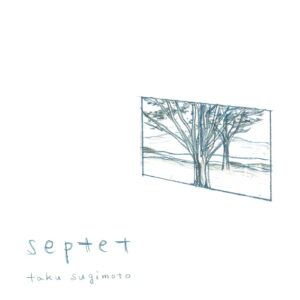
“Septet”
Guitarist Taku Sugimoto continues his long-term musical activities, with a focus on composing, and also collaborates closely with some of the composers in the Wandelweiser Group. This release is one of the summits of his recent work.
Septet is a work of just under 40 minutes, performed by seven musicians on clarinet, flute, viola, contrabass, cello, electric guitar and sine-tones. Throughout, numerous diffuse sound reverberations emerge and overlap, then fade away. The sound progression is simple and unhurried, but the work is permeated with tension from start to finish. A masterpiece. This is the live recording of the work's world premiere in Berlin in March 2015. The performers are Rebecca Lane (flute), Michael Thieke (clarinet), Johnny Chang (viola), Koen Nutters (contrabass), Derek Shirley (cello), Taku Sugimoto (electric guitar) and Bryan Eubanks (sine-tones).
“This composition is conceived of as a sort of double concertino for clarinet, flute, and small ensemble. However, the two main instruments, clarinet and flute, make no melody: the one tone is shared and repeated by them. I want to have the other instruments (viola, cello, contrabass, guitar, and sine-tone generator) work as if they are drawing several spectrums with the sound of the clarinet or flute, so each of these instruments has a specific set of microtones to play. In order to make it easier to produce those microtones, the stringed instruments are tuned anomalously; only harmonics or open strings are played. The very low frequencies are produced only by the sine-tone generator, since these frequencies are too low to play with any musical instrument except piano.” T. S.
13,00€
Out of stock

2 CD
Taku SUGIMOTO
“Live in Australia”
“Taku Sugimoto is an extremely restrained guitarist who produces very few sounds in performance, allowing silence to be the controlling force. As an improviser and composer, he’s garnered international acclaim, and also provoked strong reactions, both positive and negative. This two-CD set documents Sugimoto’s live performances, in Australia in September 2003, of two of his own compositions (one per CD): "Dot (73)" and "Music for Amplified Guitar." Environmental sounds-listeners’ coughs, footsteps, and chair scraping, as well as noises from outside-make their way clearly and naturally into Sugimoto’s live concerts. Occasionally there’s a sound from his guitar; it’s as if he were collaborating with the sounds around him. This is very much the case on Live in Australia, and particularly on Disc 1. As the performance began, so did a rain shower, which grew more intense, filling the space with a sound like white noise. Over this background noise, Sugimoto quietly plucked a handful of short sounds. The set includes a long (1,000+-word) essay by Sugimoto that sheds new light on his musical ideas.” All composed by Taku Sugimoto. Taku Sugimoto: guitar. Packaged in a cardboard jacket. Mastered by Taku Unami. Drawing by Taku Sugimoto. Design by che chat. Includes liner notes by Taku Sugimoto in Japanese, and English.
16,00€