
In stock

2 LP
SISSY SPACEK
“Entrance”
Entering its 26th year of activity, the morphing, Los Angeles based experimental outfit, Sissy Spacek, joins Shelter Press with Entrance, among the project’s most captivating outings to date. Encountering the duo of John Wiese and Charlie Mumma joined in various configurations by an incredible cast of collaborators - Tim Barnes, Marco Fusinato, Aaron Hemphill, Brad Laner, Katsura Mouri, Ralf Wehowsky, and C Spencer Yeh - collectively transformed into a series a deeply intimate and delicate gestures of musique concrète, Entrance radically repositions the possibilities presented by group improvisation outside of time and place.
Founded at the end of the last millennium, the Los Angeles based project, Sissy Spacek, initially emerged from the knotted, fiery context 1990s American noise and grindcore, producing sheets of visceral sonority that quickly set the scene on its head. Going through numerous evolutions, before eventually settling as a duo of John Wiese and Charlie Mumma - joined by a rotating and often recurring cast collaborators - over the last 25 years the band has continuously entered states of evolution that have defied the expectations of its own context, seeding the sonic extremes noise with subtle and sophisticated approaches to free improvisation and musique concrète.
Fiercely positioning its efforts within the outer reaches of contemporary experimental music, while resisting the constraints of a singular sound or proximity, Wiese regards Sissy Spacek as being primarily centred around the practice of musique concrète and the pursuit of extremes. From its earliest releases - collage treatments of material gathered from the band’s full throttle practice sessions - the project’s conceptual framework has continuously evolved within a deeply engaged process of experimentation, not only reworking tactical approaches, but also definitions and perception regarding the location and action of their work. In recent years, this has led to an increasingly varied and diverse output. Percolating within, is a thread marked by a striking sense of delicacy and intimacy, driving forward while doubling as an unexpected challenge, in real time, to perceptions connected to the band’s past. Entrance is the most recent of these.
Embarking upon the four compositions that comprise the finalized four sides of Entrance, Wiese and Mumma enlisted longstanding collaborators, Tim Barnes, Marco Fusinato, Aaron Hemphill, Brad Laner, Katsura Mouri, and C Spencer Yeh, as well as new initiate, Ralf Wehowsky (of the seminal German electronic noise collective P16.D4), requesting a contribution of sounds from each, determined by a general set guidelines that dictated certain qualities the given sonorities, while allowing for the expression of each player’s distinct creative voice. The sets of resulting recordings were then chopped, harvested, manipulated, and reassembled as the four tape compositions that make up the album - Web Of Unfolding Appearance, Figure Of Reflected Light, Trancher And The Inheritors, True Dimension (From The Opaque - Spike) - each blurring the lines of authorship and clear creative proximity in remarkable ways.
Where historical gestures of musique concrète tend to draw upon non-instrumental sound sources - regarding its sonorous material as raw elements, unburdened by inherent meaning or association, to be transformed and imbued with musicality - Sissy Spacek turns this position on its head. Entrance comprises works of musique concrète that not only draw upon instrumental sound sources, with all their possible meanings or associations, but also individual characters and personalities of their players, crediting each resulting piece to its respective configuration of contributors.
As such, Entrance is an effort of sound collage defined by a rare sense of intimacy and humanity: four pieces that often take on the resemblance of group improvisation, but have, in fact, been assembled outside of time and place. Bent under the ever-present hand of Wiese’s tape treatments and manipulation, each of the album’s four compositions unfurl startling states of sonic abstraction and percolating texture, marked by a striking sense of hard-shifting structure, that culminate as tense, driven manifestations of ambient music: scrapes, squeals, rattles feedback, rolling drums, bouncing tones, whispers, bent electronics, electric artefacts, and seemingly everything else under the sun, configured into immersive, sublime mediations in sound from the most improbable events.
33,00€
In stock
CD
SISSY SPACEK
“Entrance”
Entering its 26th year of activity, the morphing, Los Angeles based experimental outfit, Sissy Spacek, joins Shelter Press with Entrance, among the project’s most captivating outings to date. Encountering the duo of John Wiese and Charlie Mumma joined in various configurations by an incredible cast of collaborators - Tim Barnes, Marco Fusinato, Aaron Hemphill, Brad Laner, Katsura Mouri, Ralf Wehowsky, and C Spencer Yeh - collectively transformed into a series a deeply intimate and delicate gestures of musique concrète, Entrance radically repositions the possibilities presented by group improvisation outside of time and place.
Founded at the end of the last millennium, the Los Angeles based project, Sissy Spacek, initially emerged from the knotted, fiery context 1990s American noise and grindcore, producing sheets of visceral sonority that quickly set the scene on its head. Going through numerous evolutions, before eventually settling as a duo of John Wiese and Charlie Mumma - joined by a rotating and often recurring cast collaborators - over the last 25 years the band has continuously entered states of evolution that have defied the expectations of its own context, seeding the sonic extremes noise with subtle and sophisticated approaches to free improvisation and musique concrète.
Fiercely positioning its efforts within the outer reaches of contemporary experimental music, while resisting the constraints of a singular sound or proximity, Wiese regards Sissy Spacek as being primarily centred around the practice of musique concrète and the pursuit of extremes. From its earliest releases - collage treatments of material gathered from the band’s full throttle practice sessions - the project’s conceptual framework has continuously evolved within a deeply engaged process of experimentation, not only reworking tactical approaches, but also definitions and perception regarding the location and action of their work. In recent years, this has led to an increasingly varied and diverse output. Percolating within, is a thread marked by a striking sense of delicacy and intimacy, driving forward while doubling as an unexpected challenge, in real time, to perceptions connected to the band’s past. Entrance is the most recent of these.
Embarking upon the four compositions that comprise the finalized four sides of Entrance, Wiese and Mumma enlisted longstanding collaborators, Tim Barnes, Marco Fusinato, Aaron Hemphill, Brad Laner, Katsura Mouri, and C Spencer Yeh, as well as new initiate, Ralf Wehowsky (of the seminal German electronic noise collective P16.D4), requesting a contribution of sounds from each, determined by a general set guidelines that dictated certain qualities the given sonorities, while allowing for the expression of each player’s distinct creative voice. The sets of resulting recordings were then chopped, harvested, manipulated, and reassembled as the four tape compositions that make up the album - Web Of Unfolding Appearance, Figure Of Reflected Light, Trancher And The Inheritors, True Dimension (From The Opaque - Spike) - each blurring the lines of authorship and clear creative proximity in remarkable ways.
Where historical gestures of musique concrète tend to draw upon non-instrumental sound sources - regarding its sonorous material as raw elements, unburdened by inherent meaning or association, to be transformed and imbued with musicality - Sissy Spacek turns this position on its head. Entrance comprises works of musique concrète that not only draw upon instrumental sound sources, with all their possible meanings or associations, but also individual characters and personalities of their players, crediting each resulting piece to its respective configuration of contributors.
As such, Entrance is an effort of sound collage defined by a rare sense of intimacy and humanity: four pieces that often take on the resemblance of group improvisation, but have, in fact, been assembled outside of time and place. Bent under the ever-present hand of Wiese’s tape treatments and manipulation, each of the album’s four compositions unfurl startling states of sonic abstraction and percolating texture, marked by a striking sense of hard-shifting structure, that culminate as tense, driven manifestations of ambient music: scrapes, squeals, rattles feedback, rolling drums, bouncing tones, whispers, bent electronics, electric artefacts, and seemingly everything else under the sun, configured into immersive, sublime mediations in sound from the most improbable events.
17,00€
In stock
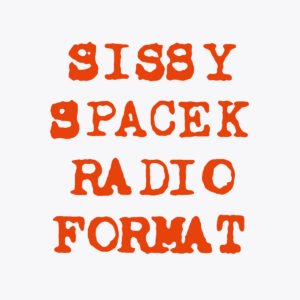
3 CD box
SISSY SPACEK
“Radio Format”
While we may live in an over saturated time of hi-definition, microwave-pulse paced images and video snippets, one format that has remained in play since the early 1900’s is that of radio. A format perhaps overlooked most in its ability to not only act as a conduit of audio, but also that of a uniquely non-visual live performance, facilitating a direct audio-only portal from performer to the imagination of the listener.
Radio is a place where live collaboration and conversation can occur not just between performers, but with that of the unseen and unheard. There is no immediately distinguishable audience reaction for the performer to intake or react upon. No other sounds or stimuli for the audio generator to realize other than that of which are produced from the point of broadcast. The listener however, collaborates deeply (and often unconsciously) in the listening experience dependent on their environment. A car radio stuck in loud honking Los Angeles traffic with the windows down. A live improv broadcast blasted on a boombox in the back room of a noisy, busy restaurant kitchen. A strange mix show heard only through an open window, intriguing a passerby with the small tidbit that is overheard, unaware of the content let alone the station or origin of the sound. This methodology forces new ways of listening as well as performing, and if there’s one unit evolving and dissecting audio that thrives in such an area of exploration, it is that of Sissy Spacek. The primary core of the ever morphing group here consists of John Wiese and Charlie Mumma, but as shown on these recordings and throughout their discography, Sissy Spacek not only includes, but more accurately incorporates a host of brilliant collaborators from many walks of life and realms. Here we find Sara Taylor (Youth Code) Sarah Bernat (Bad News, 16 Bitch Pile Up), GX Jupitter-Larsen (The Haters), and Damion Romero (Speculum Flight, Astromero) collaborating with the group on these utterly unique, live KXLU broadcasts (a Los Angeles station which Damion Romero himself hosts the decades long running Psychotechnics program that these very sessions appeared on).
Which brings us back back to perhaps one of the greatest tricks, traps, and aspects found in radio — What are we hearing? Who has made this sound and where does it come from? Do these sounds come from the radio room itself? Or are they a product of some crude tape recording forged in a bedroom and brought to be manipulated? Was the group together throughout these decisions or were they conjured individually? What was the vibe and time of day? Was the studio well lit, or draped in darkness for these mysterious sessions? Who is doing what and how? With the visual senses removed, and while simultaneously understanding that these were live radio performances, even a veteran listener is still left to be puzzled by the thoughts and sounds therein. May this collection mark a crucial chapter in the infinite sonic freedom that Sissy Spacek represents. An ability to wildly, freely, expertly navigate the ever changing waters of improvisation and experimental creativity. An appreciation for forms and formats new and old. A respect and reverence for the transmission of thought and sound in all forms, and for the powerful experiences that these methods evoke. (Brandon Hill)
32,00€
In stock
LP
SISSY SPACEK
“Blear”
Widening their scope from recent grindcore on Nuclear War Now! Productions, Sissy Spacek’s Blear LP explores a much more dynamic and spacious approach to sound—an entropic vortex of full-room tear-up texture. Duo lineup of Charlie Mumma and John Wiese, released in an edition of 300. The group’s 8th release on Gilgongo Records. —Label Description
16,00€
Out of stock
CD
SISSY SPACEK
“Besiege”
Deluxe CD reissue from Damien Records of the Helicopter release, originally a cassette in an edition of 33. Raging electronics from Mumma/Wiese assembled in April 2020. Six panel digipak with new and original artwork reproductions.
10,50€
In stock
CD
SISSY SPACEK
“BMW”
A screeching smash of searing grit and demolished shock from the trio of Blankenship / Mumma / Wiese, which can be identified as a distinct subgroup within the Sissy Spacek discography, responsible for such carnage as Wreck (2013), Basement (2014), and Slow Move (2017). BMW stands as a sharp-edged monument in the trio’s advancing decay, culled from a session at Blankenship's high-security Bronson studio and utilizing the equipment and environment that fueled sessions by LHD, White Gold, and The Cherry Point.
Limited edition, partially metalized CD housed in a 6-panel digipak, featuring a series of detailed collages by Wiese.
10,50€