
Out of stock
CD
Robert ASHLEY
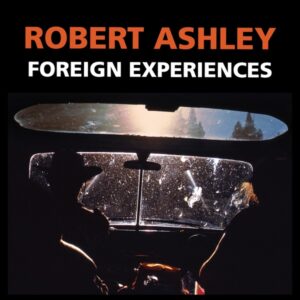
“Foreign Experiences”
This new release from Lovely Music features Robert Ashley's famous ensemble, the "band" who interpreted his work for 20 years, from 1992 through 2012. They included Sam Ashley, Thomas Buckner, Marghreta Cordero, Tom Hamilton, Jacqueline Humbert, Joan La Barbara, and Amy X Neuburg. This recording was made at the Hebbel Theater, Berlin on May 12, 1995. The opera was also heard live at the Festival d'Avignon, the Brooklyn Academy of Music, Musica Strasbourg, and Site Santa Fe. Foreign Experiences is one of the opera tetralogy that Ashley wrote in the early 1990s, following Perfect Lives (LCD 4917CD/LDVD 4917DVD) and Atalanta (Act of God) (LCD 3301CD, LCD 3303CD). He would give it the overall title (also the name of one of the component operas) Now Eleanor's Idea. These four operas would follow the stories of some of the characters who populated Perfect Lives a decade earlier. We met Don last year when Lovely Music released a CD of a new Ashley "band" performing Improvement (Don Leaves Linda) (LCD 5002CD) at the Kitchen, New York. In Foreign Experiences "Don gets a job at a small college in the southwest. Once there, against all expectations, everything goes wrong. He loses his family and friends, he loses his car, he fears that he will lose his mind." He comes to believe that he has been given a mission, to learn about premonitions and he embarks on a journey to find the wise man who will give him priceless information. Linda thinks he plan is foolish; Don thinks he has no choice. But is the opera really "about" Don and Linda? "Opera likes to simplify and enlarge its characters to make them fit grand themes. Mr. Ashley goes in the opposite direction and arrives at the cosmos just as easily. Mundane chitchat about good eating habits or car repair turns to metaphysics, ontology, epistemology, not to mention psychiatry, before we know it." -- Bernard Holland, The New York Times (November 21, 1994) The live recording was made by Tom Hamilton and Cas Boumans, and this release has been edited mixed by Tom Hamilton. A slipcase includes a jewel case with a four-page folder, and a 96-page booklet of the full libretto.
18,00€
In stock
LP
Robert ASHLEY
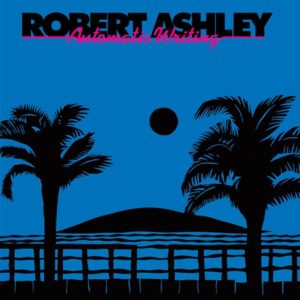
“Automatic Writing”
“Robert Ashley, Cynthia Liddell, Mary Ashley, Mary Lucier, and Barbara Lloyd,The Brandeis University Chamber Chorus, Alvin Lucier, Director. Three of Ashley’s landmark recordings, Automatic Writing (1979), Purposeful Lady Slow Afternoon (1971) and She Was A Visitor (1967). Composed in recorded form over a period of five years, Automatic Writing is the result of Robert Ashley’s fascination with involuntary speech. He has recorded and analyzed the repeated lines of his own mantra and extracted four musical characters. The result is quiet, mysterious, melancholy and an early form of ambient music. Purposeful Lady Slow Afternoon, and She Was a Visitor are excerpts from an opera entitled That Morning Thing that was composed in 1966-67, as a result of Ashley’s impulse to express something about the suicides of three friends, in particular the intellectual problem of the idea of suicide. The opera takes the form of an alternation of scenes of rationalizations (or explanations) and scenes of descriptions. Purposeful Lady Slow Afternoon is a woman’s description of a sexual experience. It is Ashley’s attempt "to demonstrate the dichotomy between the rational-whatever can be explained in words-and its opposite-which is not irrational or a-rational, but which cannot be explained in words." The lead voice, the processed back-up chorus, the recurring bell tone, and the pervading tape hiss, create an unsettling mood. She Was a Visitor is another form of description, it is intended to be understood as a form of rumor. The chorus is divided into groups, each headed by a leader. A lone speaker repeats the title sentence throughout the entire performance. The separate phonemes of this sentence are picked up freely by the group leaders and are relayed to the group members, who sustain them softly and for the duration of one natural breath. The time lag between the group leaders’ phoneme choices and those phonemes being picked up by members of the group produces a staggered, chant-like effect, with the sounds moving outward from the nearest performer to the farthest. Booklet notes by Robert Ashley.”
27,00€
In stock
2 CD
Robert ASHLEY
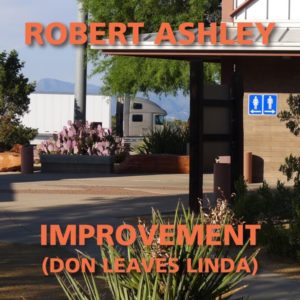
“Improvement (Don Leaves Linda)”
"Like John Bunyan's Pilgrim's Progress (1678), Improvement (Don Leaves Linda) is an allegory for an individual's self-realization. The opera takes its imagery from the history of the Jews --beginning with their expulsion from Spain in 1492 and ending 500 years later in the United States. Improvement (Don Leaves Linda) was first conceived as a recording for Nonesuch Records (1991). Ashley followed with three other operas, making up a quartet or tetralogy under the name Now Eleanor's Idea (LCD 1009CD), and all four operas were performed often during the first half of the 1990s. The opera was revived in 2018-19, with a new cast: Gelsey Bell as Linda; Brian McCorkle as Don, Mr. Payne, and Companion; Paul Pinto as Junior, Jr.; Aliza Simons as Now Eleanor; Dave Ruder as The Doctor; Amirtha Kidambi as Mr. Payne's Mother; Robert Ashley (on tape) as Narrator I; Amirtha Kidambi and Aliza Simons as Narrator II. Improvement (Don Leaves Linda) was presented by the Kitchen, February 7th through 16th, 2019. Live Sound and Processing: Tom Hamilton. Live cast recording by Eric Sherman and Tom Hamilton. CD mixed by Tom Hamilton."
27,00€
Out of stock
LP
Robert ASHLEY
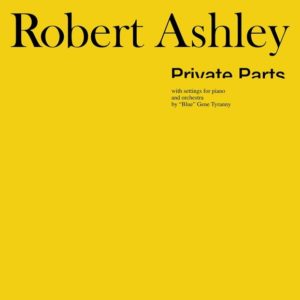
“Private parts”
Lovely Music presents a reissue of Robert Ashley's Private Parts, originally issued in 1978. This newly mastered LP release is a must-have for aficionados as well as a perfect introductory work to Ashley's oeuvre. Among Lovely Music's first six releases, it came to be known as "the yellow record". No one had ever heard anything like it; Ashley presented an unvarnished exposition of the inner workings of a man's mind. And on the other side, those of a woman. These two episodes were the foundation for Ashley's seven-part opera, Perfect Lives (LCD 4917CD, 2017), which was performed by his ensemble throughout the 1980s and was completed for television broadcast by Britain's Channel Four. New arrangements of Perfect Lives, notably Varispeed's site-specific version, continue to intrigue and enchant. Recorded at the Center for Contemporary Music, Mills College, Oakland, California, July 1977, produced by Ashley. Personnel: Robert Ashley - voice; "Blue" Gene Tyranny - keyboards; Kris - tablas. 180 gram vinyl, Stoughton Old Style sleeve, includes libretto.
25,00€
Out of stock
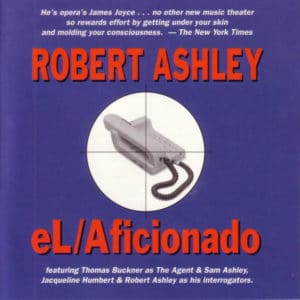
CD
Robert ASHLEY
“eL-Aficionado”
1994. Featuring Thomas Buckner as The Agent and Jacqueline Humbert, Sam Ashley and Robert Ashley as his interrogators. Orchestration by Robert Ashley. Engineering and mixing by Tom Hamilton. 1 CD + Booklet with full libretto. This is the fourth opera in Ashley’s Now Eleanor’s Idea tetralogy: Junior, Jr.’s story. A group of scenes from the life of an Agent. The scenes are a kind of debriefing to a jury of Interrogators, in which the Interrogators challenge the Agent in various forms of musical dialogue. The mood of the opera owes much to our fascination with espionage and with the character of those people who lead double lives.
14,00€
Out of stock
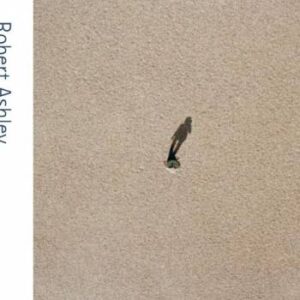
CD
Robert ASHLEY
“Tap dancing in the sand”
A selection of pieces by the great musical pioneer Robert Ashley performed by the Dutch Ensemble MAE. Some of the works were especially written for the Ensemble in the last few years, and have never been recorded before, namely the title work “Tap Dancing in the Sand” featuring Ashley’s voice and “Hidden Similarites”. Other works presented on the CD are “Outcome Inevitable”, “in memoriam Esteban Gomez” and “She was a Visitor”.
12,00€
Out of stock
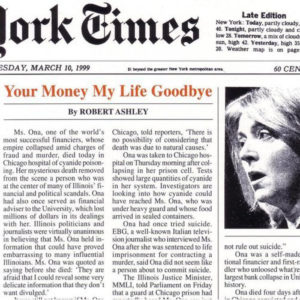
CD
Robert ASHLEY
“Your money my life goodbye”
An opera (1999) commissioned by Bayerisher Rundfunk Munich’s Hörspiel und Medienkunst department about an internationally renowned swindler, who almost took down the European and American banking system. Featuring the voices of Robert Ashley, Sam Ashley, Thomas Buckner, Jackie Humbert, and Joan La Barbara. Recorded and mixed by Tom Hamilton.
14,00€
In stock
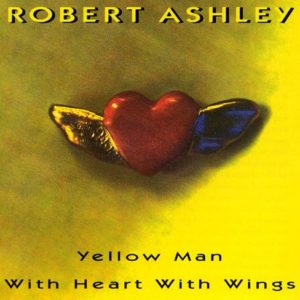
CD
Robert ASHLEY
“Yellow man with heart with wings”
1978. Robert Ashley, English voice and all instruments; except "Blue" Gene Tyranny, clavinet; Spanish voice, Guillermo Grenier.
“A two-part composition with narration (part one in Spanish and part two in heavily altered English) commissioned by public radio station KUNM in Albuquerque, this music has a plain, serene beauty. Part one is a narration by Guillermo Grenier in dreamy, flatly inflected Spanish, backed by a four-note synthesizer track, and punctuated by mysterious, heavily processed vocalizations. Ashley throws in extensive sound washes and other electronic figures which flutter in and out of the mix. The text, "Ideas from The Church," will later show up in the 1994 opera, Foreign Experiences. It is included in the liner notes. In part two, the four-note synthesizer line returns, this time backing an ethereal, sustained chord, and the vocals sound "like a distant rendering of the earth’s electromagnetic halo.”
12,00€
Out of stock
CD
Robert ASHLEY
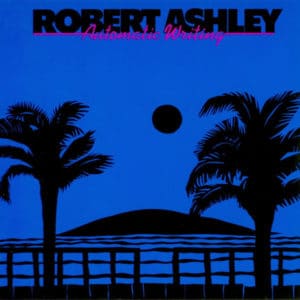
“Automatic writing”
“Robert Ashley; Cynthia Liddell, Mary Ashley, Mary Lucier, and Barbara Lloyd; The Brandeis University Chamber Chorus, Alvin Lucier, Director.
Three of Ashley’s landmark recordings, Automatic Writing (1979), Purposeful Lady Slow Afternoon (1971) and She Was A Visitor (1967). Composed in recorded form over a period of five years, Automatic Writing is the result of Robert Ashley’s fascination with involuntary speech. He has recorded and analyzed the repeated lines of his own mantra and extracted four musical characters. The result is quiet, mysterious, melancholy and an early form of ambient music. Purposeful Lady Slow Afternoon, and She Was a Visitor are excerpts from an opera entitled That Morning Thing that was composed in 1966-67, as a result of Ashley’s impulse to express something about the suicides of three friends, in particular the intellectual problem of the idea of suicide. The opera takes the form of an alternation of scenes of rationalizations (or explanations) and scenes of descriptions.
Purposeful Lady Slow Afternoon is a woman’s description of a sexual experience. It is Ashley’s attempt "to demonstrate the dichotomy between the rational-whatever can be explained in words-and its opposite-which is not irrational or a-rational, but which cannot be explained in words." The lead voice, the processed back-up chorus, the recurring bell tone, and the pervading tape hiss, create an unsettling mood. She Was a Visitor is another form of description, it is intended to be understood as a form of rumor. The chorus is divided into groups, each headed by a leader. A lone speaker repeats the title sentence throughout the entire performance. The separate phonemes of this sentence are picked up freely by the group leaders and are relayed to the group members, who sustain them softly and for the duration of one natural breath. The time lag between the group leaders’ phoneme choices and those phonemes being picked up by members of the group produces a staggered, chant-like effect, with the sounds moving outward from the nearest performer to the farthest. Booklet notes by Robert Ashley.”
12,00€
Out of stock
CD
Robert ASHLEY
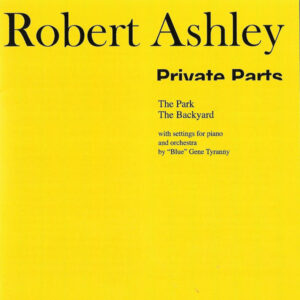
“Private parts (the record)”
1977. Robert Ashley: voice. “Blue” Gene Tyranny: keyboards. Kris: tablas.
“Centered around the mesmerizing voice of Robert Ashley, this early version (released on LP by Lovely Music in 1979) of The Park and The Backyard is a masterpiece in its simplicity of form and in the purity and intensity of its effect on the listener. These two pieces were later to become the opening and closing segments of the seven part opera for television, Perfect Lives.”
14,50€
Out of stock
CD
Robert ASHLEY
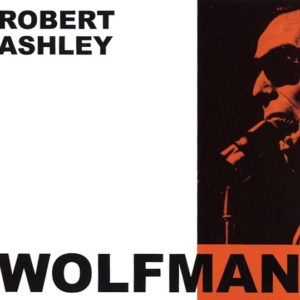
“The wolfman”
New remastered CD edition of Robert Ashley “The Wolfman”. This edition introduces us to the most extreme experimental side of the famous American composer.
The program starts with “The Fox” (1957), the first electronic music work by Robert Ashley which already displays the future electronic music theatre style. Dark atmospheres and primitive tape collage techniques recorded at home, mixing the electronic tape and the voice in a single ’live’ pass. The title track, ’The Wolfman’, was composed in early 1964 and first performed on Charlotte Moorman’s festival of the avant-garde in New York in the fall of the same year, gaining considerable reputation as a threat to the listener’s health. For the occasion instigated by Feldman, Robert Ashley composed a piece of tape music, “The Wolfman Tape”, to be played along with the vocal performance of “The Wolfman”. The idea of a tape composition, which is to come out of the same loudspeakers as the voice and the feedback (the main sound source for this composition), is to fill-in the ongoing performance sound and to transform the performance into an elaborate version of the ’drone’ under the influence of electronics. The choice of what sounds should be on the tape is determined by the need to have the whole range of frequencies brought into the feedback, but to give those sounds a short duration-in other words, a blizzard of very short sounds across the whole frequency range-so that the illusion of the sounds coming from all parts of the room is preserved. For the performance of ’The Wolfman’ recorded here, produced at the University of California at Davis, Robert Ashley used an earlier (1960) tape composition entitled ’The 4th of July’. That composition changes gradually from a parabolic-microphone documentation of a backyard party into a layering of tape loops and tape-head feedback. ’The Wolfman Tape’ (1964) is, as descibed above, a tape composition made for a short performance of ’The Wolfman’. It uses tape-speed manipulation and mixes of many layers of ’found’ sounds, both from AM radio and from recordings made using different kinds of microphones. ’The Bottleman’ was composed in 1960 as music for an experimental film by George Manupelli. The 40 minutes long version preseted here involves contact microphones on a surface that holds a loudspeaker some six feet away. The loudspeaker is broadcasting open-circuit ’hum’ (at the American standard of approximately 60 hertz). That pitch is raised slightly through tape manipulation and the result is mixed with vocal sounds and other ’found’ sounds played back at various tape speeds. All compositions previously unreleased. The digipak CD comes with a 12 pages booklet including liner notes written by the composer and the complete score of ’The Wolfman’, first issued in Source magazine."
The program starts with “The Fox” (1957), the first electronic music work by Robert Ashley which already displays the future electronic music theatre style. Dark atmospheres and primitive tape collage techniques recorded at home, mixing the electronic tape and the voice in a single ’live’ pass. The title track, ’The Wolfman’, was composed in early 1964 and first performed on Charlotte Moorman’s festival of the avant-garde in New York in the fall of the same year, gaining considerable reputation as a threat to the listener’s health. For the occasion instigated by Feldman, Robert Ashley composed a piece of tape music, “The Wolfman Tape”, to be played along with the vocal performance of “The Wolfman”. The idea of a tape composition, which is to come out of the same loudspeakers as the voice and the feedback (the main sound source for this composition), is to fill-in the ongoing performance sound and to transform the performance into an elaborate version of the ’drone’ under the influence of electronics. The choice of what sounds should be on the tape is determined by the need to have the whole range of frequencies brought into the feedback, but to give those sounds a short duration-in other words, a blizzard of very short sounds across the whole frequency range-so that the illusion of the sounds coming from all parts of the room is preserved. For the performance of ’The Wolfman’ recorded here, produced at the University of California at Davis, Robert Ashley used an earlier (1960) tape composition entitled ’The 4th of July’. That composition changes gradually from a parabolic-microphone documentation of a backyard party into a layering of tape loops and tape-head feedback. ’The Wolfman Tape’ (1964) is, as descibed above, a tape composition made for a short performance of ’The Wolfman’. It uses tape-speed manipulation and mixes of many layers of ’found’ sounds, both from AM radio and from recordings made using different kinds of microphones. ’The Bottleman’ was composed in 1960 as music for an experimental film by George Manupelli. The 40 minutes long version preseted here involves contact microphones on a surface that holds a loudspeaker some six feet away. The loudspeaker is broadcasting open-circuit ’hum’ (at the American standard of approximately 60 hertz). That pitch is raised slightly through tape manipulation and the result is mixed with vocal sounds and other ’found’ sounds played back at various tape speeds. All compositions previously unreleased. The digipak CD comes with a 12 pages booklet including liner notes written by the composer and the complete score of ’The Wolfman’, first issued in Source magazine."
15,00€
Out of stock
3 CD
Robert ASHLEY
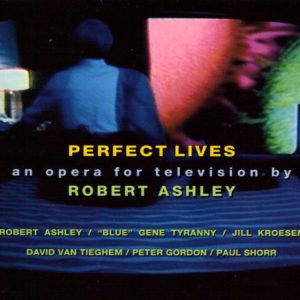
“Perfect lives”
Robert Ashley, solo voice; Jill Kroesen and David Van Tieghem, chorus; "Blue" Gene Tyranny, keyboards; David Van Tieghem, non-keyboard percussion; Peter Gordon, music producer; Paul Shorr, soundtrack producer. 3 CDs.
“Perfect Lives has been called "the most influential music/theater/literary work of the 1980s." At its center is the hypnotic voice of Robert Ashley. His continuous song narrates the events of the story and describes a 1980’s update of the mythology of small town America. Perfect Lives is populated with myriad characters revolving around two musicians --"R", the singer of myth and legend, and his friend, Buddy, "The World’s Greatest Piano Player". They have come to a small town in the Midwest to entertain at the Perfect Lives Lounge. As Robert Ashley describes in the opera synopsis, "they fall in with two locals to commit the perfect crime, a metaphor for something philosophical: in this case, to remove a sizable about of money from The Bank for one day (and one day only) and let the whole world know that it was missing."
The eloping couple, Ed and Gwyn, the old people at the home, the sheriff and his wife (Will and Ida) who finally unravel the mystery, and Isolde who watches the celebration of the changing of the light at sundown from the doorway of her mother’s house are some of the characters who journey through the seven episodes of the opera.
Derived from a colloquial idiom, Perfect Lives transforms familiar material into an elaborate metaphor for the rebirth of the human soul. It has been called a comic opera about reincarnation.”
“Perfect Lives has been called "the most influential music/theater/literary work of the 1980s." At its center is the hypnotic voice of Robert Ashley. His continuous song narrates the events of the story and describes a 1980’s update of the mythology of small town America. Perfect Lives is populated with myriad characters revolving around two musicians --"R", the singer of myth and legend, and his friend, Buddy, "The World’s Greatest Piano Player". They have come to a small town in the Midwest to entertain at the Perfect Lives Lounge. As Robert Ashley describes in the opera synopsis, "they fall in with two locals to commit the perfect crime, a metaphor for something philosophical: in this case, to remove a sizable about of money from The Bank for one day (and one day only) and let the whole world know that it was missing."
The eloping couple, Ed and Gwyn, the old people at the home, the sheriff and his wife (Will and Ida) who finally unravel the mystery, and Isolde who watches the celebration of the changing of the light at sundown from the doorway of her mother’s house are some of the characters who journey through the seven episodes of the opera.
Derived from a colloquial idiom, Perfect Lives transforms familiar material into an elaborate metaphor for the rebirth of the human soul. It has been called a comic opera about reincarnation.”
30,00€
Out of stock
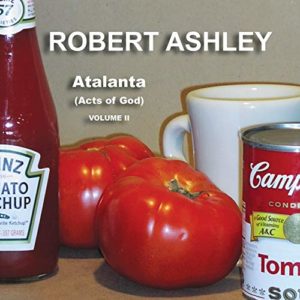
2 CD
Robert ASHLEY
“Atalanta (Acts of God) Volume II”
Robert Ashley, Jacqueline Humbert, voices; Tom Hamilton, mixing and electronics. Three of the satellite songs from Ashley’s opera Atalanta (Acts of God) - each inspired or revolving around one of the main characteris of the opera, Max, Willard and Bud. Atalanta (Acts of God) was written in the 1980s, begin while Ashley was still in production for the television opera, Perfect Lives. The many hours of material were performed throughout the world in many different configurations, but this is the first time these songs have been available on CD.
26,00€
Out of stock
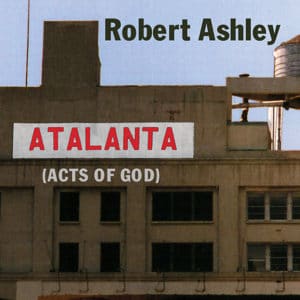
2 CD
Robert ASHLEY
“Atalanta (Acts of God)”
Robert Ashley, solo voice; with Thomas Buckner, Carla Tato, Jacqueline Humbert, voices; “Blue” Gene Tyranny, keyboards; Paul Shorr, mixing and electronics. Recorded live at the Teatro Olimpico in Rome. Sung in English and Italian. “Ashley makes use of the story of “Atalanta” - a royal princess, discarded by her family, who was raised by the animals to become the fastest-running human, and who was later reclaimed by her father to marry her off for dynastic purposes-to present the character aspects of the "successful suitor." These three aspects of character are presented in the opera as anecdotes about three extraordinary men of our times: Max Ernst (surrealist painter), Willard Reynolds (shaman storyteller) and Bud Powell (composer pianist). The genius of these three men can be taken to represent three aspects of the opera itself: image, narrative and music. In the imaginary setting of Atalanta (Acts of God), one companion (singer) reminds her of her excellence (the “Odalisque” arias); another recommends to her the characteristics of excellence in men (the “Character Reference” arias); and a third amuses her with anecdotes, as if told to her by each of the three men (the “Anecdotes”).”
26,00€
Out of stock
2 CD
Robert ASHLEY
“Now Eleanor’s idea”
Music and libretto by Robert Ashley. With Joan La Barbara, Amy X Neuberg, Marghreta Cordero, Robert Ashley, Sam Ashley, Thomas Buckner and Jacqueline Humbert. Performance Orchestra mixed and processed by Tom Hamilton. 2CD + 132 pages booklet. Robert Ashley’s Now Eleanor’s idea is a quartet of short operas based on the notion of a sequence of events seen from four different points of view. At the same time, each opera is an allegory, like Bunyan’s Pilgrim’s Progress, for an individual’s self-realization within the context of a major “religion” found in the United States. “Improvement” takes its imagery and plot from Judaism, “Foreign Experiences” from Pentecostal Evangelism, “eL-Aficionado” from corporate mysticism, and “Now Eleanor’s Idea” from (Spanish) Catholicism. As “versions” of a single series of events, the four libretti involve a common group of characters. But the continuation of the characters’ roles in the different versions is not dramatized and so the four operas can be heard (and described) as separate projects. They may be produced separately, or together, as a single performance work. The operas share principal characters and vocal techniques (including the relationship of the voice to instrumental settings.) The operas differ, principally, in the language style of the librettos and in the relationship of the music to the presentation of the visual imagery.Robert Ashley tells us that the inspiration for these works came specifically from four sources: the work of the historian, Frances A. Yates (1900-1983), whose specialty of interests included the influence of Kabalistic mysticism on the birth of modernism and scientific philosophy in Italy in the 16th century (as a result of the expulsion of Jews from Spain during the Inquisition); the writings of Carlos Castaneda (and the arguments about him as a writer and about the intentions of his work); “Low Rider Magazine,” the fan-cult magazine of the “Low Rider” movement in the Southwestern United States; and finally, “corporate vocabulary”-what it sounds like and how it is used in popular publications, like “The New York Times,” “The Wall Street Journal” or “Fortune Magazine.”
30,00€
Out of stock
2 CD
Robert ASHLEY
“Celestial excursions”
“Celestial Excursions delves into the wild intermingling of reminiscence, regret, love, nightmare, old sayings, and songs on the radio-all seemingly to no purpose, except for the operatic end of relentless speed and precision in ensemble singing and the possible stage magic inherent in illusion, hallucination, and a physically changed state of the senses. The opera’s originality lies in a use of a new vocal technique Ashley has built over the last 20 years, which enables several stories to be heard at the same time. In an intricate vocal system, a principal voice is “chased” by other voices whose parts rotate in sequence in a given order. The result of this technique creates a complex jungle of voices, delivered with an extraordinary rhythmic intensity rarely heard in ensemble singing.
As for all of Ashley’s latest works, the orchestra music of Celestial Excursions was composed in the computer-synthesizer studio. All the voices and the orchestra (on multi-track tape or on disc) are processed again during the concert in order to match the sound of the opera to the performance space. And for this CD release, Ashley went back to the studio with live recordings to rework the piece, extending the orchestra in the final act.
“With the exception of a few condescending and silly movies, “old” people are one of the few “minority” groups basically unrecognized in the arts. Not that they care, but among the “marginalized,” old people are the most marginalized, because, obviously, unlike racial or ethnic groups or the poor, they have no future. Or rather, in the most important sense, their future will never change for the better.” Robert Ashley
As for all of Ashley’s latest works, the orchestra music of Celestial Excursions was composed in the computer-synthesizer studio. All the voices and the orchestra (on multi-track tape or on disc) are processed again during the concert in order to match the sound of the opera to the performance space. And for this CD release, Ashley went back to the studio with live recordings to rework the piece, extending the orchestra in the final act.
“With the exception of a few condescending and silly movies, “old” people are one of the few “minority” groups basically unrecognized in the arts. Not that they care, but among the “marginalized,” old people are the most marginalized, because, obviously, unlike racial or ethnic groups or the poor, they have no future. Or rather, in the most important sense, their future will never change for the better.” Robert Ashley
30,00€
Out of stock
2 CD
Robert ASHLEY
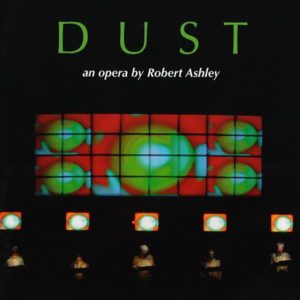
“Dust”
DUST, an opera by Robert Ashley and Yukihiro Yoshihara (video direction) whose imaginary setting is a street corner anywhere in the world, where those who live on the fringes of society gather to talk, to each other and to themselves, about life-changing Spotlight , missed opportunities, memory, loss and regret.
Five "street people" recount the memories and experiences of one of their group, a man who has lost his legs in some unnamed war. As part of the experience of losing his legs, he began a conversation with God, under the influence of the morphine he was given to ease his pain. Now he wishes that the conversation, which was interrupted when the morphine wore off, could be continued so that he could get the "secret word" that would stop all wars and suffering. (90 minutes)
Voices: Robert Ashley, Sam Ashley, Thomas Buckner, Jacqueline Humbert, Joan La Barbara; Musicians: "Blue" Gene Tyranny, synthesizer, Tom Hamilton, live mixing and sound processing; electronic orchestration by Robert Ashley, Tom Hamilton and "Blue" Gene Tyranny; sound effects for "Friends" composed by Tom Hamilton.
Five "street people" recount the memories and experiences of one of their group, a man who has lost his legs in some unnamed war. As part of the experience of losing his legs, he began a conversation with God, under the influence of the morphine he was given to ease his pain. Now he wishes that the conversation, which was interrupted when the morphine wore off, could be continued so that he could get the "secret word" that would stop all wars and suffering. (90 minutes)
Voices: Robert Ashley, Sam Ashley, Thomas Buckner, Jacqueline Humbert, Joan La Barbara; Musicians: "Blue" Gene Tyranny, synthesizer, Tom Hamilton, live mixing and sound processing; electronic orchestration by Robert Ashley, Tom Hamilton and "Blue" Gene Tyranny; sound effects for "Friends" composed by Tom Hamilton.
30,00€