
In stock

LP
Paul PANHUYSEN
“Twenty-Three Carillon Sudokus (Number Made Visible – Number Made Audible)”
“Carillon Sudokus” is the sonic counterpart to “Oog & Oor” (Eye & Ear), the last work that Dutch sound and visual artist Paul Panhuysen (1934–2015) realized. Oog & Oor was a design made with his daughter Sappho Panhuysen for a temporary installation in the lighted column of the Rietveld bus shelter next to the town hall of Eindhoven. It is a further development from “Eight Double Sudokus”, a series of large-scale prints exhibited at Museum De Pont in Tilburg in 2012. Both designs were created using sudoku puzzles and comprise various shapes of different colors whose structure was derived from the number sequences present in individual sudokus. Panhuysen used number systems such as magic squares, the Fibonacci series and the Golden Ratio in much of his art because he felt that instead of limiting his artistical freedom, such systems allowed him to make new discoveries and realize works that transcended his own imagination.
“A system is evidently at work behind the order of colours and shapes in these prints. On the other hand it is far from obvious what the underlying order actually is. Coloured bands and arcs converge in a rhythmic play of lines. Some originate from the same point, joining to form a right angle or part of a circle. Others touch only at the point or remain loose ends in a wave of motion. The orderliness of the structure and the erratic behaviour of the straight and curved lines strive for predominance in the series.” (from the liner notes by René van Peer).
These principles can also be applied to pitch and musical phrases. For Eight Double Sudokus, Panhuysen composed eight pieces for piano that were heard during the exhibition. For Oog & Oor, he envisioned music for the carillon on the roof of the Eindhoven town hall. The original idea was to generate 365 sudoku-based pieces, one for each day of the year that the installation was to be shown. In the end, around 50 pieces were realized in collaboration with town carillonneur Rosemarie Seuntiëns. Side A of this LP contains 11 pieces played live by Seuntiëns on the ceremonial ending of Oog & Oor on August 28, 2015. Side B features 12 pieces played mechanically by the carillon. Edition of 300 in full-color gatefold sleeve with printed inner sleeve. Liner notes by René van Peer.
“A system is evidently at work behind the order of colours and shapes in these prints. On the other hand it is far from obvious what the underlying order actually is. Coloured bands and arcs converge in a rhythmic play of lines. Some originate from the same point, joining to form a right angle or part of a circle. Others touch only at the point or remain loose ends in a wave of motion. The orderliness of the structure and the erratic behaviour of the straight and curved lines strive for predominance in the series.” (from the liner notes by René van Peer).
These principles can also be applied to pitch and musical phrases. For Eight Double Sudokus, Panhuysen composed eight pieces for piano that were heard during the exhibition. For Oog & Oor, he envisioned music for the carillon on the roof of the Eindhoven town hall. The original idea was to generate 365 sudoku-based pieces, one for each day of the year that the installation was to be shown. In the end, around 50 pieces were realized in collaboration with town carillonneur Rosemarie Seuntiëns. Side A of this LP contains 11 pieces played live by Seuntiëns on the ceremonial ending of Oog & Oor on August 28, 2015. Side B features 12 pieces played mechanically by the carillon. Edition of 300 in full-color gatefold sleeve with printed inner sleeve. Liner notes by René van Peer.
Original price was: 21,00€.14,00€Current price is: 14,00€.
In stock

3 LP
Paul PANHUYSEN
“Long String Installations”
After two LPs in 2014 and 2017, Edition Telemark now turns to the group of works that is probably the most well-known within the vast oeuvre of Dutch sound and visual artist Paul Panhuysen (1934–2015): his long string installations. Using this term, he referred to all of his works involving strings and sounds. They were realized all around the world between 1982 and 2012 – until 1991 mostly together with Johan Goedhart –, each installation made specifically for the site where it was displayed.Unlike other artists working with long strings around the same time, e.g. Ellen Fullman and Terry Fox, Panhuysen’s strings were instruments or performative material only secondarily. Rather, his installations can be considered sculptural and sounding events in space, operating in between two lines of tradition, constructivism and situationism, that are evident also in many other parts of his oeuvre.The first recordings of Panhuysen’s long string installations were published in the 1980s, most famously on a 3-LP box set edited on Apollo Records in 1986.This new 3-LP set includes solely unreleased recordings made between 1982 and 2012, with one recording added posthumously in 2017. It is presented in a triple gate-fold sleeve with printed inner sleeves containing liner notes by Rolf Sachsse and Stephan Wunderlich as well as various high-resolution photos.Regular edition of 250.
60,00€
In stock
CD
Paul PANHUYSEN
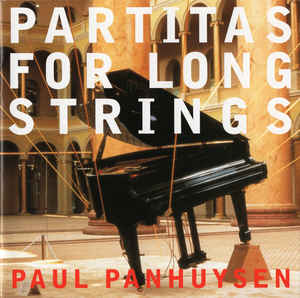
“Partitas for long strings”
The basic ingredients of Paul Panhuysen’s art, both visual and aural, are all here, and I think that can be fairly well summarized with three words: minimal, rational and libertarian. The partitas are minimal, because there is really only one idea - playing unamplified long strings. They are rational, because as always, Panhuysen has found a way to place a rational structure on top of his work - in this case a form and a tuning system. It is libertarian, because like John Cage, and so many since John Cage, he lets the music do what it wants to do - in this case the wires vibrate however they need to.
Included with the CD is a 32-page booklet which details the history of Paul Panhuysen’s work with installations through pictures and text.
12,00€