
In stock
LP
PAPIRO
“La finestra dentata”
Papiro’s approach to music is never technical, but always personal. Since the mid-Nineties, he has released a handful of noteworthy albums, each carefully put together and seemingly self-contained, yet all sharing an unmistakable musical language and a certain escapist aura.
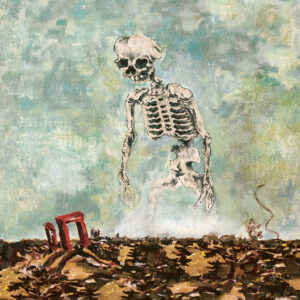
La finestra dentata (The Toothed Window), is no exception. It includes both studio and concert recordings from 2016–2020. The sounds on this album appear infinite and full of marvels, ingenious in portraying imaginary creatures and environments.
The title track and Anelli take up most of the first side and include live outtakes. Papiro likes to describe his performances as therapeutic. These swirly symphonies are specifically intended as immersive deep-listening experiences for concert venues, and have been edited for this album to meet the physical demands of vinyl and domestic use. Imagine the younger cousins of Laurie Spiegel’s Concerto Generator performance, or Terry Riley’s Shri Camel.
However, those who know Papiro only from the stage might be unaware of a different side to his oeuvre; starry-eyed miniatures that may appear frivolous in comparison to the more heady tracks, but are nonetheless well worth discovering. Each piece adds a chapter to a phantasmagoric world populated by such characters as "Giant Duckling", "King Hard-Beard", or the "Bodulator". Tracks like the opener Odilon or Il triciclo nascosto, meanwhile, emanate a candor rarely found in the domain of serious music, and revisit Papiro’s early days of instrumental storytelling.
24,00€
In stock
LP
PAPIRO
“Teopatia”
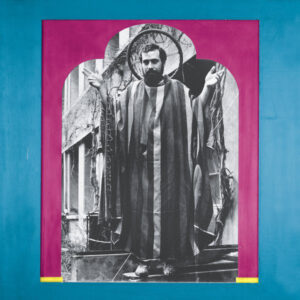
The subtitle of this album describes it as “Messa in scena arcaica per strumenti elettronici e voci ingannevoli” - a play of words which could be translated as “Mass in an archaic scene (or archaic enactment) for electronic instruments and deceptive voices”. The italian graphic designer and musician Marco Papiro deliberately plays with different forms of religious music, and loosely oscillates between the spiritual and the illusory world, starting on the cover where we can see a self-portrait of his father disguised as a saint with a steering wheel in place of the halo. As for the voices, they are deceptive in a double sense... Not only because they seem to promise eternal bliss, but also because they are completely artificial, and have been masterfully created - like everything here - from scratch with an array of aged modular synthesizers. It’s the thin line between the human warmth and the eeriness of its simulation that makes up the fascination of the music on “Teopatia”, which by the way is the term used to describe an indirect divine contact. Though this record might be too odd to become a religious classic, it might very well help future generations understand the turmoil of an early 21st-century youth converting to synthesizers after growing up with catholicism. First pressing limited to 300 copies of which only the half are available for distribution outside Switzerland.
19,00€