
Out of stock

2 LP
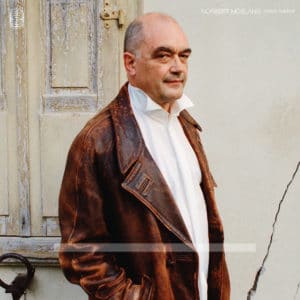
Norbert MÖSLANG
“Patterns”
With Sascha Armbruster, sopranosax. Kelsey Maiorano, oboe. Toshiko Sakakibara, clarinet. Jens Bracher, trompet. Stephen Menotti, trombone, Janne Jakobsen, tuba.
Mastering + recording: Pierre Bendel. Artwork: Albert Oehlen. Recorded November 10, 2018.
"Sonoristic experiments, strange timbres, extended playing techniques, exotic or unusual instrumental compilations, home-made resonators and innovative ways of improvising – the music of “Patterns” is fundamentally based on free improvisation and has many relations to experimental, spectral and contemporary academical music. Saxophone, clarinet, oboe and trumpet are the leading instruments. They contain the basic of the melody line which is driving filled with stunning passages, furious growls and full blasts. Vivid, elegant or intriguing and aggressive saxophone, expressive moving clarinet brings the basics of avant-garde jazz – free improvisation, spontaneous solos, sudden jumps from the one mood to another, strange, eclectic and exclusive musical decisions, dizzy passages and gorgeous ornaments are the main elements of saxophone improvisations. The improvisers get on shrieky exclamations, tremendous culminations with persecuting hysteric sequences, repetitive series and intriguing turns. More compounds related to avant-garde and modern jazz, and free improvisation, as well, are brought in by trumpet. It’s rigorous, bright and wild fullfilled with full blasts, hot growls, bursts of energy, thrilling, breaking, waining and vital solos, transcendental passages which are suddenly passing to subtle, silent and minimalistic mood. Here repetitive series, monotonous tunes, deep harsh sounds and haunted pieces make a great combo with trombone. A trombone keeps a stable basement of melody line – its deep bass line passing to bright cracking solos and reaching tremendous, luminous and vibrant culminations gives more stable, deep and solemn sound to the compositions. On the contrary, an oboe is more related to contemporary academical music and academic avant-garde – sonoristic experiments, evocative ideas, extravagant decisions, modern expressions and original instrumentation based on extended playing techniques related to contemporary academical music. That makes an effort to suggestive, inspiring and evocative sound. Deep heavy tuba’s solos form a stable bass line. As a result, a nice compilation is made by mixing up reeds and brasses of various ranges – oboe and tuba makes a strong relation to contemporary academical music, trumpet, trombone, saxophone and clarinet are completely based on free improvisation and avant-garde jazz. That makes an evocative and original sound." (from https://avantscena)
28,00€
Out of stock
LP
Norbert MÖSLANG
“Indoor_outdoor”
A: indoor_outdoor (2005). Recording and processing by Norbert Möslang.
Mixed by Norbert Möslang at zackstudio. Mastered by Pierre Bendel at zackstudio.
B: hot_cold_shield (2012). Toshimaru Nakamura: no-input mixing board. Norbert Möslang: cracked everyday-electronics. Recorded by Eric Mattson at “Manif d’art” at Espace 400e Bell, Québec 12 May 2012. Mastered by Toshimaru Nakamura. Vinyl cut by Rashad Becker at Dubplates & Mastering, Berlin October 2012.
“Absolute deep electric-rain-forest sound atmosphere that the listener will hear on this record is the tip of the iceberg of a same rich and elaborate work process. For over 30 years, Norbert Möslang is making the world sounding. He does not play with things, but he allows things’ sounding. His art installations, sound performances and music records are deeply involved in the hidden world of vibrations to convert them into loud sounds and thick textures. Living simultaneously in spheres of inside/outside, micro-vibrations, spacial structures, underground music venues, art galleries, underwater, glass windows, body movement, precise equalizers, insects microcosm and electronic devices; Möslang constructs fascinating untrammeled worlds of both philosophical and physical power. Möslang’s music meet clearly Brian Eno’s words about : “the idea of music as a highly physical, sensual entity - music free of narrative and literary structures, free to be pure sonic experience. And the idea of music as a highly intellectual, spiritual experience.” But this does not mean to be earnest.
The “Everyday Cracked-Electronics” are a kind of poetry, a celebration of the banality in all of his greatness, which link Voice Crack to the other amazing Swiss duo Fischli/Weiss. In the movie “The Way the Things Go”, also made in the mid-80s, you see a chain reaction of every day objects that activate each others in a kind of huge fresco of absurdity. The film was shoot without sound. The sound track was added in post production by a Foley artist. Thus again the sound was made by the use of other everyday objects. In the mid 80s, without knowing each others, both Voice Crack and Fischli/Weiss made the banality meeting with the marvelous. Instead of having historically unified art and musical movements, Switzerland generated very idiosyncratic bands or individuals as key figures. Think of Celtic Frost, The Young Gods, Samael, Günter Müller, Grauzone, Yello, Lilliput, Les Reines Prochaines, Christian Marclay or Braintickets, among others. Voice Crack are certainly part of this dream list! This country is like an fractured and exploded megapolis scattered in many small parts. Here you find as many underground venues and music festivals in industrial buildings of urban areas as ancient castles basements and old vineyard cellars of peripheries of urban cities.
In this context, I attempted to a Voice Crack gig when I was 21 in a city of 35000; in the Middle Ages bulwark of the city of Fribourg existed the annual experimental arts festival. The concert was a path-clearing musical experience. Möslang and Voice Crack opened to me both the ways to experimental noise music as well as sound art performance. These doors never closed and allowed to drift again and again into a continually larger and deeper endlessness; worlds of sounds and noises. But the Swissness stops here. Voice Crack and Möslang belong to a international underground current. When looking through the rear-view mirror it’s clear that in late 70s and early 80s there weren’t many artists working with harsh noise, a list which now read as “classics” : The New Blockaders, Whitehouse and Throbbing Gristle in UK; Hijokaidan, Merzbow, Incapacitants in Japan; NON, The Haters in the states, among only few others.
Since the break up of Voice Crack in 2002, Norbert Möslang enlarged his practice to cover all noise and experimental practices, from lo-fi Everyday-Cracked-Electronics”, saturation/overdrive work, performance and improvisation, field recordings and multi layered ambientnoise composition. Through interconnecting heterogeneous everyday objects; linking the outside sound environment into a quiet art museum by fixing microphones to its windows; filming the underwater Venice’s canal in order to set off never ending imagery flux; allowing a movie to play its own sound track by triggering photo-sensors; Möslang proves to our entire nervous system that the world we inhabit is no more than infinite continuum. To talk about “indoor_outdoor” specifically, again Möslang music drives us from nothing to everything. A field recording in the water of a swiss harbour close from his house is then processed and composed these files in a studio. The second track “hot_cold_shield” is a collaborative duo with Toshimaru Nakamura, the influential member of the Onkyokei scene in Japan, a brutal live improvisation recorded at “Manif d’art” in Québec this year.” Balthazar Lovay. Deborence, September 2012.
Mixed by Norbert Möslang at zackstudio. Mastered by Pierre Bendel at zackstudio.
B: hot_cold_shield (2012). Toshimaru Nakamura: no-input mixing board. Norbert Möslang: cracked everyday-electronics. Recorded by Eric Mattson at “Manif d’art” at Espace 400e Bell, Québec 12 May 2012. Mastered by Toshimaru Nakamura. Vinyl cut by Rashad Becker at Dubplates & Mastering, Berlin October 2012.
“Absolute deep electric-rain-forest sound atmosphere that the listener will hear on this record is the tip of the iceberg of a same rich and elaborate work process. For over 30 years, Norbert Möslang is making the world sounding. He does not play with things, but he allows things’ sounding. His art installations, sound performances and music records are deeply involved in the hidden world of vibrations to convert them into loud sounds and thick textures. Living simultaneously in spheres of inside/outside, micro-vibrations, spacial structures, underground music venues, art galleries, underwater, glass windows, body movement, precise equalizers, insects microcosm and electronic devices; Möslang constructs fascinating untrammeled worlds of both philosophical and physical power. Möslang’s music meet clearly Brian Eno’s words about : “the idea of music as a highly physical, sensual entity - music free of narrative and literary structures, free to be pure sonic experience. And the idea of music as a highly intellectual, spiritual experience.” But this does not mean to be earnest.
The “Everyday Cracked-Electronics” are a kind of poetry, a celebration of the banality in all of his greatness, which link Voice Crack to the other amazing Swiss duo Fischli/Weiss. In the movie “The Way the Things Go”, also made in the mid-80s, you see a chain reaction of every day objects that activate each others in a kind of huge fresco of absurdity. The film was shoot without sound. The sound track was added in post production by a Foley artist. Thus again the sound was made by the use of other everyday objects. In the mid 80s, without knowing each others, both Voice Crack and Fischli/Weiss made the banality meeting with the marvelous. Instead of having historically unified art and musical movements, Switzerland generated very idiosyncratic bands or individuals as key figures. Think of Celtic Frost, The Young Gods, Samael, Günter Müller, Grauzone, Yello, Lilliput, Les Reines Prochaines, Christian Marclay or Braintickets, among others. Voice Crack are certainly part of this dream list! This country is like an fractured and exploded megapolis scattered in many small parts. Here you find as many underground venues and music festivals in industrial buildings of urban areas as ancient castles basements and old vineyard cellars of peripheries of urban cities.
In this context, I attempted to a Voice Crack gig when I was 21 in a city of 35000; in the Middle Ages bulwark of the city of Fribourg existed the annual experimental arts festival. The concert was a path-clearing musical experience. Möslang and Voice Crack opened to me both the ways to experimental noise music as well as sound art performance. These doors never closed and allowed to drift again and again into a continually larger and deeper endlessness; worlds of sounds and noises. But the Swissness stops here. Voice Crack and Möslang belong to a international underground current. When looking through the rear-view mirror it’s clear that in late 70s and early 80s there weren’t many artists working with harsh noise, a list which now read as “classics” : The New Blockaders, Whitehouse and Throbbing Gristle in UK; Hijokaidan, Merzbow, Incapacitants in Japan; NON, The Haters in the states, among only few others.
Since the break up of Voice Crack in 2002, Norbert Möslang enlarged his practice to cover all noise and experimental practices, from lo-fi Everyday-Cracked-Electronics”, saturation/overdrive work, performance and improvisation, field recordings and multi layered ambientnoise composition. Through interconnecting heterogeneous everyday objects; linking the outside sound environment into a quiet art museum by fixing microphones to its windows; filming the underwater Venice’s canal in order to set off never ending imagery flux; allowing a movie to play its own sound track by triggering photo-sensors; Möslang proves to our entire nervous system that the world we inhabit is no more than infinite continuum. To talk about “indoor_outdoor” specifically, again Möslang music drives us from nothing to everything. A field recording in the water of a swiss harbour close from his house is then processed and composed these files in a studio. The second track “hot_cold_shield” is a collaborative duo with Toshimaru Nakamura, the influential member of the Onkyokei scene in Japan, a brutal live improvisation recorded at “Manif d’art” in Québec this year.” Balthazar Lovay. Deborence, September 2012.
15,00€