
In stock
LP
MUSICA ELETTRONICA VIVA
“Symphony No. 107 – The Bard”
Black Truffle is pleased to announce Symphony No. 107 –The Bard, a previously unheard archival recording of the legendary improvising ensemble MEV (Musica Elettronica Viva), captured in concert at Bard College, New York in 2012. Formed by a group of American expat composers in Rome in 1966, the MEV ensemble played an important role in the development of free improvisation, bridging the live electronics tradition begun by Cage and Tudor and the high-energy squall of free jazz. Early recordings like Spacecraft or The Sound Pool unleash volleys of metal and glass amplified with contact microphones, howling winds, primitive synthesizer bleep and raucous audience participation, the intensity of which puts much later ‘noise’ to shame. In later decades, the ensemble would go through many iterations, often including legendary free players like Steve Lacy and George Lewis. In its final years, MEV settled into the core trio of founding members heard here: Alvin Curran, Frederic Rzewski, and Richard Teitelbaum, using piano, electronics, and small instruments.
Curran, Rzewski, and Teitelbaum were life-long friends blessed, as Curran says, with ‘incompatible personalities’: major figures in the post-Cagean experimental tradition, they explored countless divergent and even contradictory paths as composers and performers, from agitprop songs to brainwave-controlled synthesis. MEV is the sound of these three personalities coming together, their contributions radically individual yet attaining a state of ‘fundamental unity’ that Rzewski, in a text written in the collective’s earliest years, defined as the ‘final goal of improvisation’. Of course, listeners familiar with aspect of the trio’s individual works might hazard some guesses about who is doing what: the crisp piano figures are probably Rzewski’s, the cut-up hip-hop samples most likely Curran’s, the sliding, squelching synth possibly Teitelbaum’s. But often these identities are dissolved in a constantly shifting hall of mirrors, the listener unable to tell which of these pianos is live and which is a sample of a past virtuoso, or whether a horn blast derives from ethnographic documentation or Curran cutting loose on Shofar.
The two side-long sets here occupy a similar terrain of constantly shifting texture and instrumentation, unexpected interruptions, and moments of sudden beauty. The first set is sparser, at times almost ominous, as a bell repeatedly sounds across wheezing harmonica, seasick orchestral textures, and creaking wood, making room for episodes of yodelling and delicate prepared piano before exploding into a storm of buzzing synth and piano fragments. The second set is more frenetic, moving rapidly across centuries and continents: cars crash into post-serial piano pointillism, wailing voices collide with chopped and screwed hip-hop samples, Hollywood strings are buried under layers of electronic gurgles. The performance slows in its final moments, making way for a sampled voice repeating the phrase ‘protest and the good of the world’, reminding us that MEV’s idea of freedom was always more than musical.
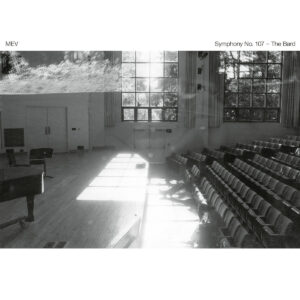
Symphony No. 107 –The Bard is a beautifully recorded example of the endlessly multi-layered later MEV sound, accompanied by new liner notes by Alvin Curran (now the only surviving member of the group) and a selection of previously unseen photographs from across the many decades of the group’s activity. Arriving in an elegant sleeve bearing a beautiful photograph by Francis Zhou of the Olin Hall at Bard College where the concert was recorded, this is an essential document from a major group in the history of experimental music. As Rzewski wrote, this music is ‘like life, unpredictable, sometimes making sense, mostly not’.
28,00€
In stock

LP
MUSICA ELETTRONICA VIVA
“Spacecraft”
Musica Elettronica Viva, or MEV for short, was formed in 1966 in Rome by Allan Bryant, Alvin Curran, Jon Phetteplace, Carol Plantamura, Frederic Rzweski, Richard Teitelbaum and Ivan Vandor. From the very beginning the group was based on musical freedom and the shunning of convention. Using contact microphones to record and manipulate sound wherever it could be found – from box springs to vibrators – and improvisationally combining those recordings with tenor sax, homemade synths and the very first Moog to trek cross the Atlantic, MEV made some of the most imaginative and abrasive sounds of the time.
Recorded in live performance at the Academy of Arts (Akademie der Künste) in Berlin on October 5, 1967, Spacecraft is made up of a single piece of the same name – a slow building, jarring and disquieting work that reveals the entire MEV ethos in its lone half hour. As group member Alvin Curran put it “The music could go anywhere, gliding into self-regenerating unity or lurching into irrevocable chaos - both were valuable goals. In the general euphoria of the times, MEV thought it had re-invented music; in any case it had certainly rediscovered it.” Our Swimmer is pleased to present this first ever vinyl issue of MEV’s Spacecraft, an early piece from the most free-spirited group of the 20th century avant-garde.
22,50€
Out of stock

CD
MUSICA ELETTRONICA VIVA
“Spacecraft – Unified patchwork theory”
The MEV group was formed in September 1966 by Alvin Curran, Richard Teitelbaum, Frederic Rzewski, Allan Bryant, Carol Plantamura, Ivan Vandor, and Jon Phetteplace. In the beginning they performed compositions by themselves and others which involved the use of electronic sound produced in real time, or "live" electronic music. In the summer of 1967 they began to work more with improvisation and less with determinate structures. MEV focus more on interpreting the moment, rather than constructing repeatable programs; creating meaningful rituals, not images; becoming involved with the process, the operation, and not with the result of it, or its effects on people. MEV music is highly eclectic, resisting ready classification by combining elements of improvised music, computer music, world music, jazz and classical composition, without being clearly definable as any one of them. For the realization of "Spacecraft", recorded in Koln in 1967, MEV were Frederic Rzewski (amplified glass and springs), Alvin Curran (electric percussion, trumpet, voice), Richard Teitelbaum (moog synthesizer), Allen Bryant (homemade synthesizer), Ivan Vandor (alto saxophone). In the collective work of MEV "Spacecraft" it was stereotypes that formed the material for the improvisation. The player imagined himself as trapped within a labyrinth, whose corridors were lined with images, learned formulas, taken from the past. This was the space which he occupied, and it was indeed a trap, but then it was also all that he had. It was occupied space, he was in it, but didn’t identify with it, and the work was to transform it into created space,
to make it his. He had to penetrate through the walls of the labyrinth, through the images, whether by magic, all at once, or over a longer duration, by work, in order to come out into the open, to discover a new space which was neither his nor another’s, but everybody’s. The secret of the labyrinth is that the way out is not left, right, forwards, or backwards, but up: to get free one must fly. To fly is to risk falling, to acept this risk. As long as you are afraid to take this risk, you’ll never get off the ground, you’ll run around bashing into walls and going through the movements of flight, uselessly flapping and flopping. You will fall into stereotypes. If you accept this, however, if you open yourself to whatever is happening, suspend judgement and fall into it completely and with grace, then you will fly, and it will be transformed. "Spacecraft" is a composition, in the sense that it is based on a particular combination of ideas. In order to play "Spacecraft" it was necessary to be more or less familiar with these ideas. The performers all knew each other. Every performance was the moment of a continuous process. This process then came to an end, as it were, and the rather esoteric techniques used in the maintaining it were abandoned in favour of others which were more open, more accessible to the casual visitor or listener. This CD also includes " Unified Patchwork Theory ", recorded in
Zurich at Rote Frabrik by MEV including Frederic Rzewski (piano), Alvin Curran (sampler, synths), Richard Teitelbaum (synths), Steve Lacy (soprano sax), Garrett List (trombone, voice, electronics). This CD is included in a beatiful digipack black and white sleeve with photos and liner notes. Also included is a 8 page booklet with an essay by Frederic Rzewski titled "Plan for Spacecraft", as well as “Some MEV Memories" by Richard Teitelbaum and the chronology the “Spacecraft” performances in Europe in 1967. New edition remastered by Giuseppe Ielasi.
to make it his. He had to penetrate through the walls of the labyrinth, through the images, whether by magic, all at once, or over a longer duration, by work, in order to come out into the open, to discover a new space which was neither his nor another’s, but everybody’s. The secret of the labyrinth is that the way out is not left, right, forwards, or backwards, but up: to get free one must fly. To fly is to risk falling, to acept this risk. As long as you are afraid to take this risk, you’ll never get off the ground, you’ll run around bashing into walls and going through the movements of flight, uselessly flapping and flopping. You will fall into stereotypes. If you accept this, however, if you open yourself to whatever is happening, suspend judgement and fall into it completely and with grace, then you will fly, and it will be transformed. "Spacecraft" is a composition, in the sense that it is based on a particular combination of ideas. In order to play "Spacecraft" it was necessary to be more or less familiar with these ideas. The performers all knew each other. Every performance was the moment of a continuous process. This process then came to an end, as it were, and the rather esoteric techniques used in the maintaining it were abandoned in favour of others which were more open, more accessible to the casual visitor or listener. This CD also includes " Unified Patchwork Theory ", recorded in
Zurich at Rote Frabrik by MEV including Frederic Rzewski (piano), Alvin Curran (sampler, synths), Richard Teitelbaum (synths), Steve Lacy (soprano sax), Garrett List (trombone, voice, electronics). This CD is included in a beatiful digipack black and white sleeve with photos and liner notes. Also included is a 8 page booklet with an essay by Frederic Rzewski titled "Plan for Spacecraft", as well as “Some MEV Memories" by Richard Teitelbaum and the chronology the “Spacecraft” performances in Europe in 1967. New edition remastered by Giuseppe Ielasi.
15,00€
Out of stock

4 CD
MUSICA ELETTRONICA VIVA
“Mev 40”
This 4-CD set, covering the years 1967-2007, comprises the best surviving recorded documents from four decades of performances, personally curated by its three core members - Alvin Curran, Frederic Rzewski, and Richard Teitelbaum. As such, it is an invaluable historical anthology of one of the pioneering and truly legendary exponents of live-electronic music. With Alvin Curran, Frederic Rzewski, Richard Teitelbaum, Karl Berger, Allan Bryant, Steve Lacy, George Lewis, Garrett List, Carol Plantamura, Gregory Reeve, Ivan Vandor… “Musica Elettronica Viva (MEV) was begun one evening in the spring of 1966 by Allan Bryant, Alvin Curran, Jon Phetteplace, Carol Plantamura, Frederic Rzweski, Richard Teitelbaum and Ivan Vandor in a room in Rome overlooking the Pantheon. MEV’s music right from the start was also totally open, allowing all and everything to come in and seeking in every way to get out beyond the heartless conventions of contemporary music. Taking its cue from Tudor and Cage, MEV began sticking contact mics to anything that sounded and amplified their raw sounds: bed springs, sheets of glass, tin cans, rubber bands, toy pianos, sex vibrators, and assorted metal junk; a crushed old trumpet, cello and tenor sax kept us within musical credibility, while a home-made synthesizer of some 48 oscillators along with the first Moog synthesizer in Europe gave our otherwise neo-primitive sound an inimitable edge. In the name of the collectivity, the group abandoned both written scores and leadership and replaced them with improvisation and critical listening. Rehearsals and concerts were begun at the appropriate time by a kind of spontaneous combustion and continued until total exhaustion set in. It mattered little who played what when or how, but the fragile bond of human trust that linked us all in every moment remained unbroken. The music could go anywhere, gliding into self-regenerating unity or lurching into irrevocable chaos-both were valuable goals. In the general euphoria of the times, MEV thought it had re-invented music; in any case it had certainly rediscovered it”. Alvin Curran.
49,00€