
In stock

LP
Jon GIBSON
“Visitations”
Back in stock.
Since the mid-1960s, Jon Gibson has played a key role in the development of American avant-garde music. No other artist has performed in the world premieres of Terry Riley's “In C,” Steve Reich’s “Drumming,” and Philip Glass’ “Einstein on the Beach,” three major works that changed the course of musical history. While his expertise on woodwind instruments made Gibson a go-to collaborator in Reich’s, Glass’, and La Monte Young’s ensembles, less known are his remarkable contributions as a composer and visual artist.
Visitations, Gibson’s first release under his own name, originally appeared on the Chatham Square imprint in 1973. Inspired by the books of Carlos Castaneda, Gibson departs from the structured repetition of his minimalist peers and takes the listener on an aural journey – spanning organic field recordings, ambient flutes and synthesizers, and free-flowing textures. Visitations’ two side-long tracks are at once solemn and unsettling, making this an astonishing debut that firmly establishes Gibson as a pioneer in his own right.
18,00€
In stock
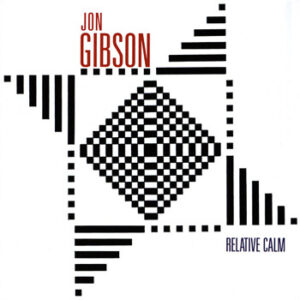
CD
Jon GIBSON
“Relative Calm”
Jon Gibson, saxophone, soprano saxophones (overlaid), winds, keyboards, autoharp, ambient recording; Joseph Kubera, keyboards; David Van Tieghem, percussion.
Relative Calm (Rise) (1981), Q-Music (Race) (1981), Extensions RC (Reach) (1981), Return (Return) (1981)
“Gibson stakes out a small but verdant territory more satisfying than the concrete landscapes of many more ambitious minimalist oeuvres.” Kyle Gann
“In Relative Calm, I am very much involved with texture and collage, and it is mainly intuitive. I don’t want to be compulsive about the concepts that may inspire a piece. An idea may look wonderful on paper, and may feature an exciting and innovative formula, but the music must sound. Some composers care only about the idea … but I care only about the actual sound of the music”.Jon Gibson
“Some of the harmonies in Gibson’s music—its ringing organ tones rising, smearing, melting, tumbling above the piano’s hammered rhythms—make me think of fine old hymn tunes, now iced by repetition into components of an intergalactic anthem.” Deborah Jowitt, Village Voice (1981)
“[Jon] uncovered some multitracks of four pieces he recorded in 1980 and 1981 and I am honored to be mixing them now. These tapes are like a time capsule of the late 1970s New York Minimalist movement: dense, claustrophobic and yet so open. Sculptural in composition and texture, they reveal an entirely different way of seeing music, and are possibly more effective today in their stark contrast than they would have been had they been released 34 years ago.” Chuck Zwicky
Jon Gibson (b. 1940) is one of the less frequently mentioned pioneering composers of minimal music and is probably best known as a founding member of the Philip Glass Ensemble. Gibson also holds the unique distinction of having performed with Steve Reich, Terry Riley, and La Monte Young (as a member of the Theatre of Eternal Music), in addition to Glass, the four composers widely regarded as the founding fathers of minimal music. Gibson also has a track record of composing for modern and post-modern dance and Relative Calm (1981) is the fruit of one of his numerous collaborations with well known choreographers, in this case Lucinda Childs, who commissioned the work. The rediscovery of Relative Calm, one of Gibson’s major works, is cause for rejoicing among aficionados of minimalist music.
14,00€