
Out of stock

CD
Joan LA BARBARA
“The Early Immersive Music of Joan La Barbara”
“as lightning comes in flashes” (1981) for 8 track tape. New 2017 stereo mix. “Autumn Signal” (1978) for 8 track tape, mixed to 4 channels. “Cyclone” (1976-77) for 16 track tape.
Joan La Barbara is a long recognized pioneer of extended vocal techniques and a champion of new music. She emerged from the New York Downtown scene to perform in the ensembles of Steve Reich and Philip Glass, including the premiere of Glass’ Einstein on the Beach. She has performed and recorded works by composers including John Cage, Robert Ashley, Morton Feldman, Philip Glass, Alvin Lucier, and her husband Morton Subotnick. Composer/Vocalist Joan La Barbara has created a rich body of experimental works, many initially produced on analog tape. This collection includes a first release of the award-winning “Cyclone”, first presented at a the ISCM World Music Days festival in Bonn, Germany in 1977. The other two works were initially issued on LP on the Wizard label, but now in new mixes. The reissues offered here remixed to her original surround concept: as lightning comes, in flashes explores a vast array of La Barbara’s signature extended vocal techniques. “Autumn Signal” is a rare example of the composer’s work with Buchla synthesizer, which she utilized for spatialization as well as modification of vocals.
For this release, fresh 96khz/24-bit transfers were made from the original multi-track analog tapes. Then all new stereo and surround mixes were then created under the supervision of the composer.
Liner notes by Bernard Gendron trace La Barbara’s beginnings in the New Music world from the early 1970s Downtown Scene and her evolution as an avant-garde vocalist and composer. In addition, La Barbara contributes detailed notes on the works.
16,50€
In stock
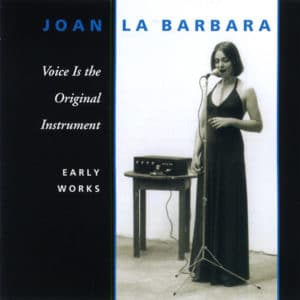
2 CD
Joan LA BARBARA
“Voice is the original instrument”
Collection of early works and her first vocal compositions, originally released on LPs in the 1970s and early 1980s on her own Wizard Records. “One of my earliest pieces, ‘Hear What I Feel’, was a self-exploratory, sensory-deprivation experimental work, designed to help me discover new sounds, delve into psychological aspects, as well as communicate with the audience on a pre-verbal level of awareness. After spending an hour in isolation with my eyes taped shut and not touching anything with my hands, I was led our into the performance space where my assistant had placed a variety of substances in six small glass dishes. As I touched the material, I tried to give an immediate vocal response to what I felt both emotionally and physically, without the benefit of visual information. I expected the shock of bringing a solitary state of mind into the heightened awareness of a performance situation to intensify my experience, and the poignancy of my ‘prepared’ state to affect the audience. The sounds are presented here in their raw state; it is truly an experimental work with no intentional musical implications or designs. ‘Voice Piece: One-Note Internal Resonance Investigation’ explores the color spectrum of a single pitch. Circular Song was inspired by the circular breathing technique of horn players. ‘Des Accords pour Teeny’, an exploration of multi-phonic technique or choral singing, was dedicated to Teeny Duchamp. In much of my early work I dealt with sound as a physical presence, sculpting it, building up layers in complex constructions, letting the flow of thought and the visualization of sonic gestures direct my studio art. Voice Is the Original Instrument was both a statement of purpose and a manifesto as, through various experiments and explorations, I tried to rediscover the basic function of the voice as the first means of expression as well as to release untapped sonic material. As I gave my classically trained voice its freedom, letting it direct me toward new places and ideas, I developed what was a unique vocabulary and used those sounds to score an orchestra of layered voices.”
23,50€