
In stock
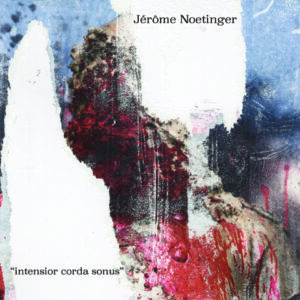
CD
Jérôme NOETINGER
“Intensior corda sonus”
"In 2019, I was invited by Dylan Nyoukis and Karen Constance to play at the Colour out of Space festival in Brighton. A unique moment of incongruous music in a friendly international gathering of freaks of all kinds. Unforgettable. I played a solo on Revox B77 and then Dylan asked me to do a CD for his Chocolate Monk label. After some thought, I decided to offer three compositions rather than try to reproduce the past moment of an improvised concert. I'm talking here about the composition of fixed sounds (to quote Michel Chion) or musique concrète to use Pierre Schaeffer's original terminology. I think I've spent more time in my life improvising than composing, and no one has ever reproached me for it.
The Latin title refers to the equivalence between the tension of a string and the elevation of the sound, but also to the link between the intensity of the lived and of the musical. Will the intensity of the former influence that of the latter? But it's also the tension on the trigger and the intensity of the reaction to it. The tension-release form is one of the most classic in musique concrète, and even more so since the advent of computer-assisted music. In Les objets inaudibles [2018], I decided to politicise this form, to create a struggle between these elements. In Erase my head [2019], it is the accumulation, erasure and diversion of random fragments that is at play. Then in Eloge des ruines [2020], it's a return to the founding gesture of musique concrète, that of sampling existing material, in this case records from my personal record library.
This CD is dedicated to the memory of Kiko C. Esseiva."
- Jérôme Noetinger
“Les objets inaudibles”
Commissioned by INA-GRM, first played on 19th January 2019. Musique concrète in four parts composed in 2018 in the composer’s studio.
Starting with, a GRM commission received on 25th June 2018, and the urgent need to find a title. Ending with, a discursive journey through the art of concealment, with the discovery of unexpected voices in some of Pierre Schaeffer's Études aux Objets read at reduced speed, the use of Matthieu Saladin's application La Capture de l'Inaudible, an app which keeps only the frequencies removed by MP3 encoding (i.e. the inaudible, according to the ideology that governs this technology), the increase in police violence, the impact of a 357 Magnum, and not to mention the intense pleasure of destroying a piano.
“Erase my head”
A live-to-air performance originally commissioned for Radiophrenia, created in Glasgow on 19th May 2019.
30 minutes = 1 800 seconds and at the speed of 38 centimeters per second = 684 meters.
A loop of 570 cm, so that’s 15 seconds at the speed of 38 centimeters per second, i.e. a length of 2.85 meters. A mixing desk with several inputs like CD players, cassette players, radio… each played randomly. And then recording, processing, layering, erasing, hiss and tape delay on the live loop.
“Eloge des ruines”
Commissioned by Radio-France for Alla Breve by Anne Montaron. First broadcast on 30th August 2020. Musique concrète composed in the composer’s studio between January and May 2020. Dedicated to Sean Baxter (1970 - 2020).
A suite of five miniatures, each two minutes long, based on the idea of slowing down and collapsing, using sound samples taken from vinyl records, with the playback speed changed from 78 to 0 rpm, as well as accelerated playback of old magnetic tapes. The work on this material is the result of the accumulation, editing, mixing and filtering of all these materials.
Edition of 150
"Jérôme Noetinger delivers a haunting and immersive listening experience with this album, showcasing his expressive prowess with the humble Revox B77 reel-to-reel tape recorder. The album’s Latin title, which roughly translates to the sound of the heart becomes more intense, foregrounds the tensions and intensities contained on the three compositions featured on this release, blending musique concrète composition and improvisation via live tape manipulation.
It begins with “Les Objets Inaudibles”, a four-part suite that feels like a descent into a sonic abyss. Drawing from Pierre Schaeffer’s Études Aux Objets, Noetinger collages tape effects, gunshots and the violent destruction of a piano into a disquieting assemblage. Ghostly voices, filtered through an app that isolates the frequencies lost during MP3 encoding, mingle with slack piano wires and animalistic cries. Each movement ends with jarring gunshots, punctuating the chaos with a sense of finality. “Erase My Head” is a live performance from 2019, where Noetinger manipulates a tape loop in real time. Over 30 minutes, layers of sound accumulate, transform and are erased, creating a dynamic interplay of repetition and mutation. The piece shifts from violent, saturated noise to more spacious, delay-heavy textures, demonstrating Noetinger’s ability to craft effective structure from seeming randomness.
The album closes with “Eloge Des Ruines”, a suite of five two minute miniatures crafted from samples taken from vinyl records in Noetinger’s collection, often with the playback speed altered. Combined with the variable speed of the magnetic tape, these pieces revel in cacophonous jumble and temporal chaos. Across all three works, Noetinger creates evocative worlds as thought-provoking as they are sonically rich. “Les Objets Inaudibles” in particular, is a potent example of musique concrète at its most poetic and visceral."
- Leah Kardos, The Wire Magazine
16,00€
Out of stock

CD
Jérôme NOETINGER
“Outside Supercolor”
A note from Jérôme Noetinger
Lionel Palun and I met in 2003 in a context of social struggle. Aware of an inevitable downfall, we decided to discuss our respective practices. Sound for me and image for him.
Then there were the basic questions: "What does it do if you connect a video output to a sound input?"; "What does a sound output do to a video input?" Then the tinkering that goes with it, like opening a SCART socket and plugging directly into it. And to finish, we discovered that as always, everything has already been done!
But in the end it's like rock music, it's always the same, and what counts is how to appropriate it, how to live it.
These discussions and first experiences led Lionel to develop his own video feedback software. He has a scientific background and a taste for computers which helps!
In this record, I wanted to draw inspiration from this work with Supercolor Palunar, the name of our duo, to better examine CRT parasites and virtual instruments whose purpose I still don't quite understand.
I dedicate this record to Lionel Palun who, afterwards, made two videos echoing the two pieces.
14,00€
In stock

2 LP
Jérôme NOETINGER
“Sur quelques mondes étranges”
The music on this long-awaited solo vinyl album by legendary tape artist Jérôme Noetinger was recorded live in the studio with no overdubs. Signals were sent through tube broadcast monitors and picked up with room microphones. Produced by Tobias Levin. Cover by Meeuw.
--
Long-time touchstone of international experimental music presents his monolithic (and first) solo vinyl Sur quelques mondes étranges on Felix Kubin’s Gagarin Records. Jérôme Noetinger is known to most for the audio-visual trio Cellule d’Intervention Metamkine, alongside his countless recorded & live collaborations, compositions for radio & stage, and breathtaking multi-channel diffusions in the acousmatic tradition.
Discovering the ReVox B77 tape machine as his tool for live electro-acoustic music in 1987, Noetinger has doggedly investigated his instrument over 35 years, establishing him as a vital contemporary composer/performer of the medium. His work is radical and interrogatory, using a pan-historical array of analogue devices to construct soundworlds which sidestep digital monochrome, landing in a galaxy of simmering malfunction, dynamic physicality & rhythmic debris. Programming Le 102 in Grenoble for over a decade, as well as directing Metamkine distribution for over three, his encyclopaedic knowledge of manifold sonic traditions is on display here; unified by a staunch discipline, impressive dedication and flat rejection of empty trends.
The results synthesise his tireless timbral research into 11 striking sonic investigations which combine modern studio possibilities with years of performance experience worldwide. An ominous malaise hovers over proceedings; yet it never feels nihilistic, presenting solutions which electrify the listener with ecstatic discovery. The perceptual orchestration therein - from throwing our ears right against the body of the tape machine to flinging them into cavernous space alive with the aurally strange - is both delirious & calming. Noetinger is all too aware things are bad, but his drive for discovery and joyous belief in music somehow coruscates brilliantly through contemporary gloom.
Meticulously recorded & produced with Tobias Levin in Hamburg, Sur quelques mondes étranges presents a detailed & rich vocabulary both real & unreal: gesture & repetition, structure & collapse, familiar & uncanny all dance with each in the most pumping discothèque concrète in this universe. This is a powerful and exacting statement from an elegant composer & extraordinary musician who has humbly dedicated his life to his practice.
– Anthony Pateras
30,00€
Out of stock

CD
Jérôme NOETINGER
“dR”
Jérôme Noetinger, tape recorder Revox B77, microphones, radios, objects, synthesizer Korg MS20, piano frame…
Recorded January 2017 at PiedNu, Le Havre, by Emmanuel Lalande. Edited and mixed June 2017. Mastered by Giuseppe Ielasi, September 2017.
“All the pieces on this CD were realised on one or two Revox B77s and recorded directly to hard disc. They represent a panorama of my practice on a range of devices (reel-to-reel tape recorders, contact microphones, radios, small electronics, voice and microphone, pick-up microphones, objects...).
I discovered the reel-to-reel tape recorder in 1983 and started to work with it on arriving in Grenoble in 1986 in the studios of COREAM (école de musique de Fontaine). Initially used principally as a player to reproduce pre-recorded sounds, the tape recorder became my instrument.
I use it with loops to play with repetitions, delay and accumulations. Or with spools, taking off the pinch roller to manually control the speed. The magnetic tape – a surface of inscription of a sound being made – is a malleable support, where crayonnés, scratches and magnetisation excite the polarisation of the magnetic particles.
The possibilities of reinjection, that is, recording from the left channel to the right while at the same time from the right to the left, simultaneously controlling the speed, transforms this tape recorder into a sound generator.” JN
10,00€