
In stock

CD
Jacques LEJEUNE
“Fragments gourmands”
“Fragments gourmands”, for tape, voice and saxophones.“L’Eau primesautière” for tape and sopranino sax. With Daniel Kientzy (saxophones).
15,00€
Out of stock

CD
Jacques LEJEUNE
“Messe aux oiseaux”
“Messe aux oiseaux” (1986) new version (1999), “Ave Maria” (1987).
15,00€
Out of stock

In stock
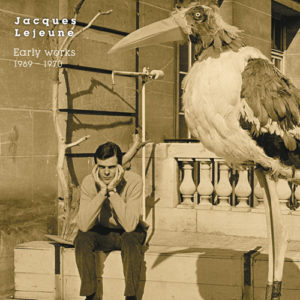
LP
Jacques LEJEUNE
“Early Works 1969-1970”
This LP of early compositions by Jacques Lejeune features three seminal works: “D’une Multitude En Fête” and “Petite Suite”, originally released on the Perspective Musicales series in 1970, and a previously unpublished composition, “Géodes”, from the same period. These three pieces (not included in the recent Parages and other electroacoustic works 3CD set) are some of Lejeune's earliest music for tape and may be considered a "prequel" to his later, more thematic works. Still, his concise musical narrative is ever-present in these first recordings. The sidelong D'une Multitude En Fête (1969) refers to multitude, number, celebration and any crowd situation as a form of ceremony—all evoking a circular gaze, as topics of the different aural events and their anecdotal development emerge, leading to the dream, as a story we tell to ourselves. Géodes (1970) features percussion improvisations by Lauréat Dionne with Jacques' tapework inflecting prisms deep into its thundering, rhythmic core. This concert version appears on vinyl for the first time. Concluding the album is Petite Suite (1970), with each section referencing a traditional musical form using both anecdotal as well as instrumental flourishes. The original drum and guitar elements performed here by Michel Foudrinoy and Jean-Pierre Vassout. These pieces have been compared to Pierre Henry's bold rock themes in Messe Pour Le Temps Present and also recall the peculiar atmospheres of some of the great, early Nurse With Wound records that would follow. In contrast, Lejeune's early approach was heavily steeped in sonic narratives, combining unusual and ambiguous events to create a sound world uniquely his own. Early Works 1969-1970 explores the first precision splices by one of the true visionaries in musique concrète.
25,00€
Out of stock

CD
Jacques LEJEUNE
“Cantus tenebrarum”
Cantus tenebrarum (1984), "Portrait de jeune fille au miroir ou Étude aux silences" (1998), "Le cantique de la résonance" (1985).
12,00€
Out of stock
CD
Jacques LEJEUNE
“L’invitation au départ”
“L’invitation au départ” (1983), “Symphonie romantique ou Étude d’après Berlioz” (1982).
12,00€
In stock
CD
Jacques LEJEUNE
“Pour entrer et sortir d’un conte”
“Pour entrer et sortir d’un conte” (1990), “L’église oubliée” (1997).
15,00€
In stock
CD
Jacques LEJEUNE
“Éloge de la bêtise ou les péripéties des Ubu”
“Éloge de la bêtise ou les péripéties des Ubu” (2004), for voices, saxophones and tape around “Pere Ubu” from Alfred Jarry.
15,00€
Out of stock
3 CD
Jacques LEJEUNE
“Parages and other electroacoustic works”
Born (1940) in Talence, France, Jacques Lejeune studied music at the Schola Cantorum with Daniel Lesur, at the Conservatoire National Supérieur of Paris with Pierre Schaeffer, and at the Groupe de Recherches Musicales with François Bayle. He entered the GRM (Musical Research Group) in 1968 and directed the Cellule de la Musique pour L’Image (Music for Images Department) in which various productions for stage and television were produced. In 1978, in partnership between the National Audiovisual Institute, GRM, and the ADAC (City of Paris), Lejeune launched the Ateliers de Musique Électroacoustique (Studios for Electroacoustic Music) designing both its curriculum and program.
Six of Lejeune’s compositions are featured in this 3CD retrospective totaling near three-and-a-half hours of music. Presented chronologically, these works for tape represent a stunning array of themes, images, and destinations covering the years 1971-1985. Throughout Lejeune’s compositional development, the informal content of dreams, reflections on the written fable, and the mythological thinking of our ancestors - all reappear.
Originally released on LP by INA-GRM, both Parages and Symphonie au bord d’un paysage have been remastered and re-released here for the first time on CD. Parages (1973) is a work exploring distances (or vicinities), cycles, and the transparency of the sky. A deep undercurrent of perpetual movement, altitude - flight and fall - is ever-present in the piece, encompassing a procession of auditory colors, places, and events. These elements multiply, uniting beyond their individual musical processes, further immersing the listener within an increasing auditory field. Symphonie au bord d’un paysage (1981) is a composition concerned with motion, panoramas, and geographical relationships - all as if being at the edge of a vast chasm. This expanse projects the listener onto an audio compass, traversing specific territories, while contemplating the path and its spatial trajectories along the way. Also included is Lejeune’s masterwork, Blanche-Neige (1975). This has been regarded as one of the most peculiar and elusive recordings in the whole GRM-related canon. This early LP, also known as Fantasmes, was originally recorded for a theatre/ballet production of the same name. Loosely based on the text by the Brothers Grimm with its narrative symbolism and tale of the deep forest, Blanche-Neige is one of the finest compositions of cinéma pour l’oreille (cinema for the ear) for tape and electronics from the period. Cri (1971) is the earliest piece featured in the set, with an emphasis on the very nature of vocal expression. Integrating mixed landscapes and a spacious use of cyclical elements, this work offers a fantastic prelude to Lejeune’s evolution as a composer. Additionally featured are Entre terre et ciel (1979) and Les palpitations de la forêt (1985). These two works are concerned with the natural world, labyrinths, clusters, and intermingled morphologies of the Earth.
For Lejeune, his methods are always galvanized through tangible images. It is expressed in an acoustic research based on an ambiguity between the anecdotal and the musical. This follows the work of Luc Ferrari, with his notion of anecdotal music; bringing into relation the sounds of everyday reality and the musical narrative. Lejeune’s pieces may be further described as a “character passing through a series of landscapes.”
The boxed set includes a 28 page bilingual booklet (in English/French) with detailed program notes as well as a 32 page booklet of interpretive stanzas surrounding these bizarre and evocative works. Meticulously translated and collected for the first time in print, these writings offer a rare insight into Lejeune’s creative process. Parages and other electroacoustic works 1971-1985 is an essential overview of one of the seminal figures in musique concrète.
32,00€