
Out of stock
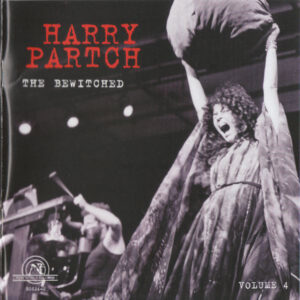
CD
Harry PARTCH
“Volume four”
2005 remaster, from original mono master tapes (recorded in 1957). The Bewitched was Partch’s first work solely intended for dance (and mime-dance at that; he was not overly enamored in his lifetime of so-called ’modern dance’). Drawing heavily from his deep affection for the music-theatrical performance traditions of Greek theater, as well as those from Africa, Bali, and Chinese opera, Partch conceived of a contemporary American music ritual-theater where musicians not only play, but also function at times as movers-singers-actors. Such is the case of The Bewitched, where the instruments are the set, in front of (and around) which dancers ’dance,’ but where the onstage musicians also move and sing. Partch’s masterpiece has been lovingly remastered from the original mono masters and the 24-page booklet includes never-before-published photographs from productions of The Bewitched. This is the definitive document of this very important work." "The Bewitched is in the tradition of world-wide ritual theatre. It is the opposite of specialized. I conceived and wrote it in California in the period 1952-55, following the several performances of my version of Sophocles’ Oedipus. In spirit, if not wholly in content, it is a satyr-play. It is a seeking for release -through satire, whimsy, magic, ribaldry -- from the catharsis of tragedy. It is an essay toward a miraculous abeyance of civilized rigidity, in the feeling that the modern spirit might thereby find some ancient and magical sense of rebirth. Each of the 12 scenes is a theatrical unfolding of nakedness, a psychological strip-tease, or - a diametric reversal, which has the effect of underlining the complementary character, the strange affinity, of seeming opposites." Harry Partch.
13,00€
Out of stock

CD
Harry PARTCH
“Volume three”
“The four works on this newly remastered are eloquent testimony to Harry Partch’s aesthetic of corporeality. The music he composed for “The Dreamer That Remains” (1972), for “Rotate the Body in All its Planes” (1961), for “Windsong” (1958),and for“Water! Water!” (1961), was intended as only one component in the total artistic experience. In this works music joins with drama, with film, with dance, even gymnastics, as integral parts of the composer’s vision.”
13,00€
Out of stock
CD
Harry PARTCH
“Volume two”
The Harry Partch Collection, Volume 2 : “The Wayward”: “US Highball” (1943, rev. 1955), “San Francisco” (1943, rev. 1955), “The Letter” (1943, rev. 1972), “Barstow” (1941, rev. 1968); “And on The Seventh Day…” (1963-64, rev. 1966).
Harry Partch’s compositions of the 1940s-and to some extent his work in general-have remained until recently an unwritten chapter in the history of American music. And yet it was these very pieces-the collection of four works he would later collectively entitle The Wayward-that brought him to the attention of the New York musical world. His concert of these pieces for the League of Composers (April 22, 1944) established for him a small but permanent reputation as a musical maverick who had wandered off well-worn tracks and had developed a sort of lateral extension of his art, independently of any of the main circles of American music.
The musical starting point of the compositions of The Wayward is the inflections and rhythms of everyday American speech. From the beginnings of his mature output in 1930 Partch had been devoted to what he called “the intrinsic music of spoken words,” and these four works capture something of the spontaneous musicality of the conversations of the hoboes he befriended during the Depression. In their original form these pieces used only the small collection of instruments Partch had built or customized by 1943: Adapted Viola, Adapted Guitar, Chromelodeon, and Kithara. The versions recorded here are all later reworkings, sometimes with only small changes (as in the case of San Francisco), and sometimes involving a substantial amount of recomposition (as in the case of U.S. Highball).
The final work on this disc dates from twenty years later than the compositions of The Wayward, and represents one of the high points of Partch’s later instrumental idiom. And on the Seventh Day Petals Fell in Petaluma was composed in Petaluma, California, in March-April 1964, and revised at various times and places until the completion of the final copy of the score in San Diego in October 1966. It marks a radical departure from the theater works he had written at the University of Illinois in the early 1960s, and shows a renewed concentration on technical innovation and on fusing his activities as composer and instrument-builder within the context of a single composition. Newly remastered.
Harry Partch’s compositions of the 1940s-and to some extent his work in general-have remained until recently an unwritten chapter in the history of American music. And yet it was these very pieces-the collection of four works he would later collectively entitle The Wayward-that brought him to the attention of the New York musical world. His concert of these pieces for the League of Composers (April 22, 1944) established for him a small but permanent reputation as a musical maverick who had wandered off well-worn tracks and had developed a sort of lateral extension of his art, independently of any of the main circles of American music.
The musical starting point of the compositions of The Wayward is the inflections and rhythms of everyday American speech. From the beginnings of his mature output in 1930 Partch had been devoted to what he called “the intrinsic music of spoken words,” and these four works capture something of the spontaneous musicality of the conversations of the hoboes he befriended during the Depression. In their original form these pieces used only the small collection of instruments Partch had built or customized by 1943: Adapted Viola, Adapted Guitar, Chromelodeon, and Kithara. The versions recorded here are all later reworkings, sometimes with only small changes (as in the case of San Francisco), and sometimes involving a substantial amount of recomposition (as in the case of U.S. Highball).
The final work on this disc dates from twenty years later than the compositions of The Wayward, and represents one of the high points of Partch’s later instrumental idiom. And on the Seventh Day Petals Fell in Petaluma was composed in Petaluma, California, in March-April 1964, and revised at various times and places until the completion of the final copy of the score in San Diego in October 1966. It marks a radical departure from the theater works he had written at the University of Illinois in the early 1960s, and shows a renewed concentration on technical innovation and on fusing his activities as composer and instrument-builder within the context of a single composition. Newly remastered.
14,00€
Out of stock
CD
Harry PARTCH
“Volume one”
The Harry Partch Collection: Volume 1 : “Eleven Intrusions” (1949-50), “Plectra & Percussion Dances” (1952), Ulysses at the Edge” (1955). This newly remastered reissue marks a welcome return to the catalog of the first volume of the classic 4-CD collection that was formerly available on the CRI label. The works recorded on this disc span the first six years of what Harry Partch (1901-1974), slightly tongue-in-cheek, called the “third period” of his creative life. They show him moving away from the obsession with “the intrinsic music of spoken words” that had characterized his earlier output (the vocal works of 1930-33 and 1941-45) and towards an instrumental idiom, predominantly percussive in nature. This path was to take him through the “music-dance drama” King Oedipus (1951)-the culmination of his “spoken word” manner-to the “dance satire” The Bewitched (1954-55), in which his new percussive idiom manifests itself. The three works on this disc show Partch before, during, and after this period of transition. In their quiet, forlorn way, the Eleven Intrusions are among the most compelling and beautiful of Partch’s works. The individual pieces were composed at various times between August 1949 and December 1950, and only later gathered together as a cycle. Nonetheless they form a unified whole, with a nucleus of eight songs framed by two instrumental preludes and an essentially instrumental postlude. Although foreshadowed by the dance sequences of King Oedipus, the Plectra and Percussion Dances (1952) are the first of Partch’s major works to be wholly instrumental in conception. They stand in relation to Oedipus as a satyr play in relation to a Greek tragedy-hence the work’s subtitle, “Satyr-Play Music for Dance Theater.” He felt that after the prolonged period of composition and production of Oedipus it was “almost a necessity to give vent to feelings and ideas, whims and caprices, even nonsense, that seem to have no place in tragedy.”
The final work on this disc is Ulysses at the Edge, written at Partch’s studio at Gate 5 in July 1955. Ulysses, which Partch describes as a “minor adventure in rhythm,” is unique among his mature compositions in that, in its original form, it did not call for any of his own instruments. The version recorded here, for alto and baritone saxophones, Diamond Marimba, Boo, Cloud-Chamber Bowls, and speaking voice, is considered the third version of the piece.
The final work on this disc is Ulysses at the Edge, written at Partch’s studio at Gate 5 in July 1955. Ulysses, which Partch describes as a “minor adventure in rhythm,” is unique among his mature compositions in that, in its original form, it did not call for any of his own instruments. The version recorded here, for alto and baritone saxophones, Diamond Marimba, Boo, Cloud-Chamber Bowls, and speaking voice, is considered the third version of the piece.
15,00€