
In stock
CD
Francis DHOMONT
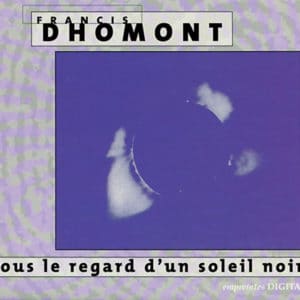
“Sous le regard d’un soleil noir” (1979-81)
“Francis Dhomont is among the foremost composers in the acousmatic tradition. Since 1963, he has produced several dozens of works for tape. Sous le regard d’un soleil noir (Under the glare of a black sun) was done between 1979 and 1981. Its CD release dates from 1996. This is the first work of a trilogy inspired by psychoanalytic thought.
According to Dhomont, this work proposes a meeting of the imagination (‘psychology of depths’) with the mental images produced by the acousmatic treatment of sounds. Dhomont uses texts by psychiatrist - psychoanalyst Ronald D. Laing (among other authors) to describe the journey of a schizophrenic mind from the ‘incarcerated self’ to the catatonic state. The piece is structured in eight sections lasting four to eight minutes each. Dhomont uses three strategies to achieve formal unity: (1) The text is delivered almost without inflections and it is clearly articulated to keep it comprehensible. Little processing is applied. (2) Material from previous sections is recycled achieving an impressive economy of means. (3) The pitch class B natural is employed as a pivot and as a recurring motive throughout the piece.
Dhomont shows his compositional craftsmanship by keeping the pace of the sections masterly balanced. Sound objects are carefully designed to keep sources’ identities hidden. When these can be identified, they are meant to fulfill a specific formal function. For example, after the listener has been exposed to several minutes of abstract sound, the sudden appearance of a talking crowd (Inner Citadel, at 1:10) provides a striking contrast. The voice of the narrator is usually kept as a layer separate from the musical material. After twenty years of its conception, Sous le regard d’un soleil noir starts to feel the weight of time. Some of the sound processing techniques employed may sound a bit artificial today, e.g., the low pass and high pass filtering of the voice. The use of amplitude envelopes on natural time varying sounds eliminates important temporal cues. Thus, the spectral characteristics of these sounds do not fit their temporal structure creating a perceptual paradox. Check, for example, the articulation on the B natural in the section titled Implosion.
Keeping in mind the year of its realization and the concepts underlying its formal plan, Sous le regard d’un soleil noir stands as a landmark of acousmatic composition.”
According to Dhomont, this work proposes a meeting of the imagination (‘psychology of depths’) with the mental images produced by the acousmatic treatment of sounds. Dhomont uses texts by psychiatrist - psychoanalyst Ronald D. Laing (among other authors) to describe the journey of a schizophrenic mind from the ‘incarcerated self’ to the catatonic state. The piece is structured in eight sections lasting four to eight minutes each. Dhomont uses three strategies to achieve formal unity: (1) The text is delivered almost without inflections and it is clearly articulated to keep it comprehensible. Little processing is applied. (2) Material from previous sections is recycled achieving an impressive economy of means. (3) The pitch class B natural is employed as a pivot and as a recurring motive throughout the piece.
Dhomont shows his compositional craftsmanship by keeping the pace of the sections masterly balanced. Sound objects are carefully designed to keep sources’ identities hidden. When these can be identified, they are meant to fulfill a specific formal function. For example, after the listener has been exposed to several minutes of abstract sound, the sudden appearance of a talking crowd (Inner Citadel, at 1:10) provides a striking contrast. The voice of the narrator is usually kept as a layer separate from the musical material. After twenty years of its conception, Sous le regard d’un soleil noir starts to feel the weight of time. Some of the sound processing techniques employed may sound a bit artificial today, e.g., the low pass and high pass filtering of the voice. The use of amplitude envelopes on natural time varying sounds eliminates important temporal cues. Thus, the spectral characteristics of these sounds do not fit their temporal structure creating a perceptual paradox. Check, for example, the articulation on the B natural in the section titled Implosion.
Keeping in mind the year of its realization and the concepts underlying its formal plan, Sous le regard d’un soleil noir stands as a landmark of acousmatic composition.”
13,00€
Out of stock
CD
Francis DHOMONT
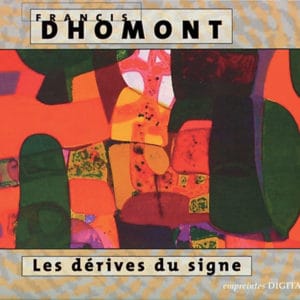
“Les dérives du signe”
“Mobility here is that of quicksand. One believes one holds the image but it sifts between the fingers, or allows itself to be covered, engulfed by a new image closing in upon it.Ubiquity and ambiguity of signs inform us and lead us astray. These four works play with diversion. The diversion: of musical discourse in Novars, of sound sources in Chiaroscuro, of sensory perception (synesthesia) in Météores (Meteors), and of nature in Signé Dionysos. Under the title Mouvances~Métaphores (Mobility~Metaphors), seven works are united around the common theme of movement as with virtual displacement of sound in geometric space, or metaphorical transferences of meaning into the realms of imagination.” Francis Dhomont
“Novars” (1989), “Chiaroscuro” (1987), “Météores” (1989), “Signé Dionysos” (1986-91). (Disque 2 du coffret double-CD “Mouvances ~ Métaphores” de 1991 (IMED 9107/08).)
“Novars” (1989), “Chiaroscuro” (1987), “Météores” (1989), “Signé Dionysos” (1986-91). (Disque 2 du coffret double-CD “Mouvances ~ Métaphores” de 1991 (IMED 9107/08).)
12,00€
Out of stock
CD
Francis DHOMONT
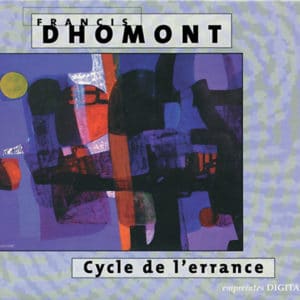
“Cycle de l’errance”
“Francis Dhomont’s ’Cycle de l’errance (Mouvances-Metaphores, 1)’, includes several of his important works, including ’Points de fuite’ (1982), ’. . . mourir un peu’ (1987), and an excerpt from ’Espace/Escape’ (1989). Dhomont is distinguished not only as a composer but also as a professor at the University of Montreal whose thoughts on sound and approach to composing electronic music have been influential in creating the rich spectrums of the so-called ’Montreal sound’.”
12,00€
Out of stock
CD
Francis DHOMONT
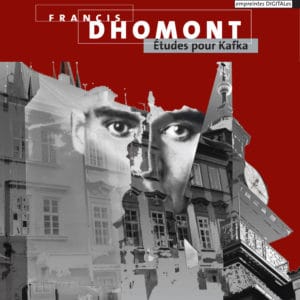
“Études pour Kafka”
Behind major works of the scope of “mourir un peu”, “Sous le regard d’un soleil noir”, and “Forêt profonde”, is a long period of thinking - sometimes years - and several studies where I experiment with the themes, try out sound materials, and unveil glimpses of the final work. These etudes are the work’s prolegomena. However, with their finished form, the studies presented here have gone beyond that stage, beyond the sketch. They are self-standing compositions prefiguring Le cri du Choucas, a long work on the world and character of Franz Kafka initiated twelve years ago. So here are three of these self-standing sketches, these pieces of sonic research and impressionistic approaches of Kafkaian themes guided by the enlightening analysis by Marthe Robert (1914-1996) (Seul, comme Franz Kafka Calmann-Lévy: Paris, 1979). Francis Dhomont [English translation: François Couture, x-09]
“Premières traces du Choucas” (Dhomont) (2006). “Brief an den Vater” (Dhomont-Kafka) (2005-06). “À propos de K” (Dhomont) (2006).
“Premières traces du Choucas” (Dhomont) (2006). “Brief an den Vater” (Dhomont-Kafka) (2005-06). “À propos de K” (Dhomont) (2006).
12,00€
Out of stock
CD
Francis DHOMONT
“… et autres utopies”
“Utopian, these aural mirages surely are - not in the political sense of the Ideal City, but in the etymological sense of ou-topos: belonging to no specific location, except for imaginary territories; creatures of illusion and, in this case, sound. These aural “non-lieux,” these chimeras of perception, resulting from treatments and made from unlikely parts that are loosing their identity, stripped off of any audible source, are fictional beings born out of a dreamer’s nomadic invention.Also utopian are - haven’t it been said often enough? - these sonic structures attempting to avoid traditional music codes, disregarding their imperatives, and offering a stream of mental images to our psyche. However, do we really have to be reminded of all these things that we know so well? Certainly, for in these cybernetic times, is there anything more necessary than the reality of utopia? So, here are five fantasies to be listened to with eyes closed; in sequence, they dream up sound in space, mankind’s revolt against its own nature, a few light phenomena, a symbolic journey, and the tumultuous manifestations of exaltation.” “Here and There” (2003), “Je te salue, vieil océan!” (1998, 2000-04), “Chroniques de la lumière” (1989, 2005), “Voyage-miroir” (2004), “Corps et âme” (2001-02).
12,00€
Out of stock
CD
Francis DHOMONT
“Jalons”
“Vol d’Arondes” (1999), “En cuerdas” (1998), “Les moirures du temps” (1999-2000), “Studio de nuit” (1992), “Lettre de Sarajevo” (1995-96), “Un autre printemps” (2000), “Drôles d’oiseaux” (1985-2001), “L’électro” (1990).
12,00€
Out of stock
CD
Francis DHOMONT
“Le cri du Choucas”
“Le cri du Choucas” (2014, 15) stereo tape.
Conceived in 1997 and left to mature slowly, Le cri du Choucas is the third and final instalment in my “Cycle des profondeurs” [Cycle of Depths], the first two parts of this long triptych (about three hours) being Sous le regard d’un soleil noir (1981) and Forêt profonde (1994-96), of which a few reminders are included in this instalment. All three are “electroacoustic melodramas” (Michel Chion) inspired by a psychoanalytic approach — Marthe Robert’s in this case, especially an insightful essay by this literary critic, translator, and psychoanalyst entitled As Lonely as Franz Kafka (1979). As Pierre Schaeffer said, “[…] how could we not wonder about the development of music itself, which mysteriously seems to build a bridge between psychology of perceptions and psychology of depths?” and, a fortiori, about the origins of this perceptive music that is acousmatic music, “psychology of depths” being just another name for psychoanalysis.
About the title Le cri du choucas, which means “The Jackdaw’s Call”… Kavka is the Czech word for jackdaw, a bird akin to a crow whose effigy Hermann Kafka, Franz’s father, used for his store sign. Kafka himself wrote “I am a jackdaw, a helpless kavka.” This match and this title are inspired by the animal symbolism found in Kafka’s works: the deep call, the solitary, unusual, often-choked, never-emphasized cry that you can hear in every single tale, however fragmentary, by this author.
Before the Law, a famous section of The Trial, serves as the red thread of my piece, the Law being a metaphoric representation of the impenetrable realms the human mind hits, and not — as what the Vulgate and the adjective “Kafkaesque” usually reduce Kafka’s complex thoughts to — a portrait of bureaucratic aberrations. It is mostly “what you cannot possibly escape from”: a doorway to knowledge is open especially for the man who gets to it, although he is also forbidden to pass through it. Which means that his — metaphysical — question remains unanswered. Symmetrically, a crucial message is addressed to him, although it will never reach him. “In The Penal Colony,” writes Marthe Robert, Kafka “reduces the law to nothing more than an inordinate power of coercion whose sole function is to automatically enforce punishment” [our translation].
Before this long piece, there were four Études pour Kafka which form, alongside new elements, the musical materials of this melodrama. However, these materials are assembled in a different order to fit a script highlighted by texts by and about Kafka told by multiple voices, some of them known, unknown, or transformed.
These are some of the themes covered in this work: the Law, guilt, the father, solitude, dreams, impossible messages, and death. You will hear, by order of appearance, excerpts from The Trial, The Penal Colony, Letter to His Father, The Verdict, Diary, Letters to Felice, The Burrow, A Message from the Emperor, and The Metamorphosis.
Conceived in 1997 and left to mature slowly, Le cri du Choucas is the third and final instalment in my “Cycle des profondeurs” [Cycle of Depths], the first two parts of this long triptych (about three hours) being Sous le regard d’un soleil noir (1981) and Forêt profonde (1994-96), of which a few reminders are included in this instalment. All three are “electroacoustic melodramas” (Michel Chion) inspired by a psychoanalytic approach — Marthe Robert’s in this case, especially an insightful essay by this literary critic, translator, and psychoanalyst entitled As Lonely as Franz Kafka (1979). As Pierre Schaeffer said, “[…] how could we not wonder about the development of music itself, which mysteriously seems to build a bridge between psychology of perceptions and psychology of depths?” and, a fortiori, about the origins of this perceptive music that is acousmatic music, “psychology of depths” being just another name for psychoanalysis.
About the title Le cri du choucas, which means “The Jackdaw’s Call”… Kavka is the Czech word for jackdaw, a bird akin to a crow whose effigy Hermann Kafka, Franz’s father, used for his store sign. Kafka himself wrote “I am a jackdaw, a helpless kavka.” This match and this title are inspired by the animal symbolism found in Kafka’s works: the deep call, the solitary, unusual, often-choked, never-emphasized cry that you can hear in every single tale, however fragmentary, by this author.
Before the Law, a famous section of The Trial, serves as the red thread of my piece, the Law being a metaphoric representation of the impenetrable realms the human mind hits, and not — as what the Vulgate and the adjective “Kafkaesque” usually reduce Kafka’s complex thoughts to — a portrait of bureaucratic aberrations. It is mostly “what you cannot possibly escape from”: a doorway to knowledge is open especially for the man who gets to it, although he is also forbidden to pass through it. Which means that his — metaphysical — question remains unanswered. Symmetrically, a crucial message is addressed to him, although it will never reach him. “In The Penal Colony,” writes Marthe Robert, Kafka “reduces the law to nothing more than an inordinate power of coercion whose sole function is to automatically enforce punishment” [our translation].
Before this long piece, there were four Études pour Kafka which form, alongside new elements, the musical materials of this melodrama. However, these materials are assembled in a different order to fit a script highlighted by texts by and about Kafka told by multiple voices, some of them known, unknown, or transformed.
These are some of the themes covered in this work: the Law, guilt, the father, solitude, dreams, impossible messages, and death. You will hear, by order of appearance, excerpts from The Trial, The Penal Colony, Letter to His Father, The Verdict, Diary, Letters to Felice, The Burrow, A Message from the Emperor, and The Metamorphosis.
13,00€
Out of stock
CD
Francis DHOMONT
“Cycle du son”
“This Cycle celebrates sound (a major discovery of the twentieth century) and concrete music. It is a fiftieth-anniversary homage to the inventiveness of Pierre Schaeffer, who clearly created an upheaval in the world of music that has had no precedent. Drawing on the same sound material which was forged from the first movement of Schaeffer’s Étude aux objets, as well as from a personal collection of sounds that have been stored away over the years, these four pieces go through a process where they develop out of each other, question each other, echo each other, and complete each other through allusions, commentaries, metonymies, and continuations. With poetic freedom they both evoke a historic journey and propose a connection between the object of sage Schaefferian observation and the wildest “metamorphologies” of sound art. Years after its composition, Novars, the third part of this cycle but the first to be composed, remains the section around which the entire work turns. Cycle du son (Cycle of Sound) premiered on November 22nd, 1998 as part of the 5th L’espace du son Festival acousmatique international in Brussels (Belgium).” Francis Dhomont
13,00€