
In stock

In stock

CD
Christian ZANÉSI
“Le paradoxe de la femme poisson”
Electroacoustic pieces composed in 1998 for a dance company in Marseille.
15,00€
Out of stock

LP
Christian ZANÉSI
“Grand Bruit – Stop! l’horizon”
“Grand Bruit” (1991).
The great mobile sound bodies have an ordinary yet amazing ability to place the listener-traveller within, as if he or she was inside a giant double bass, in this case a train stroked by a double bow: the rails and the air.
In 1991, I explored this phenomenon during my daily commute from the studio to my home. I used only a 21 minutes recording and treated it as a single sound object. I then processed and enhanced it as a photographer would have done, immersing it in successive 'baths'. The title I chose for this singular form was Grand Bruit.
“Stop ! l’horizon” (1983).
Saturday morning, nine o’clock as I reach the studio. No one here. I only turn on the spotlights as the fluorescent tubes are too noisy. I switch the power on, shut the door, unplug the telephone. I then switch the mixing desk on, which sends an electronic impulse into the amps. The four speakers react individually with a very brief and low hiss. A kind of presence. I haven’t listened to anything since the evening before and my ear is refreshed by a night’s sleep.
I feed the original mix into the master recorder and sit down in the centre.
Remote control: PLAY. With the first sound I close my eyes. The studio instantly vanishes. Another place, a much larger space opens up. I enter it. I have the very distinct feeling that music is merely a “great noise”, chiselled inside with a thousand details. It opens up like a living organism to let my hearing wander across it. A magnetic relation quickly occur and all the sounds that constitute this great noise draw me towards the East. I accept this direction. Later, much later, I reach a distant point on the horizon which pulls me towards it.
The great mobile sound bodies have an ordinary yet amazing ability to place the listener-traveller within, as if he or she was inside a giant double bass, in this case a train stroked by a double bow: the rails and the air.
In 1991, I explored this phenomenon during my daily commute from the studio to my home. I used only a 21 minutes recording and treated it as a single sound object. I then processed and enhanced it as a photographer would have done, immersing it in successive 'baths'. The title I chose for this singular form was Grand Bruit.
“Stop ! l’horizon” (1983).
Saturday morning, nine o’clock as I reach the studio. No one here. I only turn on the spotlights as the fluorescent tubes are too noisy. I switch the power on, shut the door, unplug the telephone. I then switch the mixing desk on, which sends an electronic impulse into the amps. The four speakers react individually with a very brief and low hiss. A kind of presence. I haven’t listened to anything since the evening before and my ear is refreshed by a night’s sleep.
I feed the original mix into the master recorder and sit down in the centre.
Remote control: PLAY. With the first sound I close my eyes. The studio instantly vanishes. Another place, a much larger space opens up. I enter it. I have the very distinct feeling that music is merely a “great noise”, chiselled inside with a thousand details. It opens up like a living organism to let my hearing wander across it. A magnetic relation quickly occur and all the sounds that constitute this great noise draw me towards the East. I accept this direction. Later, much later, I reach a distant point on the horizon which pulls me towards it.
15,50€
In stock
CD
Christian ZANÉSI
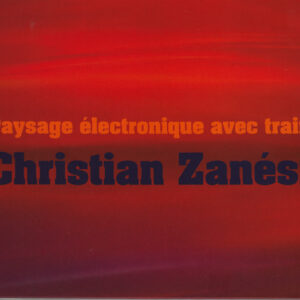
“Paysage électronique avec train”
“Audio visage” (2004). “Ambiance Matisse” (2010-12). “Paysage électronique avec train” (2006-14).
“My current artistic propensity has been drawn to electronic sound. Far from being soft and appeasing, it is a rather tense sound; almost acidic: the sound of an alert. I reached it thanks to a very old synthesiser; build at the GRM in the sixties by the engineer Francis Coupigny. A modular synthesiser with its own audio matrix – it might have been the first of its kind – discarded (forgotten) in a basement, but still fully operational. I have shaped this ‘today’ sound by combining it with materials charged with emotions: train noises and signals, blasts, breaths, etc, the very sonorities that have been lingering inside me as available memories. The original title of the piece was «2006, l’aube rouge» (2006, Red Dawn) because when I finished this work, a few hours before the 2006 New Year, I might have wanted to talk about a world that had become terribly disquieting and dangerous: a red dawn was rising. Eight years later, around the same period, towards the end of the year, I worked again on the piece by simplifying it, only keeping (I hope) its essential elements.”
Former student of Guy Maneveau and Marie-Françoise Lacaze at the Pau University (South of France) (1974-1975), of Pierre Schaeffer and Guy Reibel at the Paris Conservatory (1976-1977), he joined the Groupe de Recherches Musicales (GRM) in 1977. There, he learnt and practised all the technical skills linked to sound, thanks to a wide range of experiences, productions and encounters. He has initiated many projects in the field of radio, publications and musical events.
20,00€
In stock
CD
Christian ZANÉSI
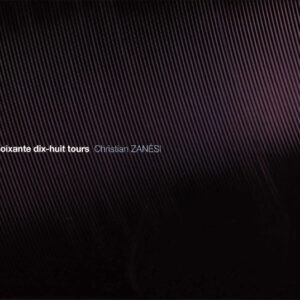
“Soixante dix-huit tours”
“Sémaphores” (2009). “Music commission from the Eole studio in Toulouse. For Yann Geslin. The choice of title became obvious towards the end of the compositional work, when a whole series of electronic signals, initially in the background, appeared as essential elements of the piece. Even though they are heard in the distance, or very eroded, the presence of these sounds is sustained. To come through the noise is part of the very nature of a signal. The title is therefore to be understood as a metaphor for the signal as matter. There is another layer in this work, linked to old sounds I dug up and that were made in the ‘80s on the "non-real-time" computer of the GRM. These sounds considerably renewed the materials of electroacoustic music at the time, giving new impetus to composers working in the studio. “Tours et détours en 78 tours” (2009). It is down to chance, (so convenient at times), that in spring 2007 a famous 78 rpm record fell into my hands: pressed by Pierre Schaeffer in 1949, it is essentially made up of basic instrumental sounds (including oboes, flutes, metallic percussions, "radio" voice...) presented as closed grooves, that is to say identically repeated over a short time span. This is one of the two records containing basic material used for composing the « Suite Pour 14 Instruments » heard for the first time on the radio station Paris Inter in November 1949. I was impressed by the tenuous softness emanating from these sounds and I felt like a child, discovering a very old family film in a forgotten box. I took just a few of these fragments, and I worked on them by associating electronic materials relevant to me today. I also kept - whilst slightly altering it - this famous 78 rpm beat (78 at the black) which I believe is one of the keys of the success of concrete music in its early days. Gradually, I understood that I was working on the idea of fragility with the feeling of the ineluctable passing away of things and beings.” “Christian Zanési currently is the artistic director of the Ina GRM. He has initiated many projects in the field of radio, publications and musical events including: the Electromania radio show on France Musique, the festival Présences électronique and the CD box sets “Archives GRM”, “Bernard Parmegiani, l’œuvre musicale”, “Luc Ferrari, l’œuvre électronique”.”
13,00€