
In stock
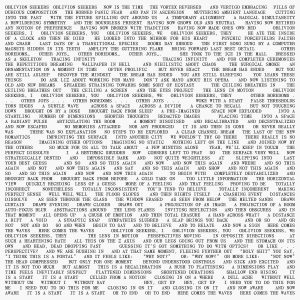
CD
Ben VIDA
“Oblivion Seekers”
To be an attentive listener to the world as it stands is to be saturated with language. Speech resounds through nearly every space that features human beings, whether unwanted or desired, mundane or profound. Words sit on the page and in the ear, proliferating endlessly. This superabundance has long been a point of fascination for composer and musician Ben Vida, but over the past several years it has led to a new method of music making that simultaneously exalts and interrogates the primacy of language in our sonic and cultural environments. Gently, playfully, Vida breaks down language’s hierarchy of meaning and sound until they exist in egalitarian harmony.
Oblivion Seekers is Vida’s newest album in this mode of composition, following 2023’s collaboration with new music ensemble Yarn/Wire The Beat My Head Hit. Like its predecessor, the music’s focus is on coordinated duets of spoken word in a neutral tone, the variable cadences of the words in motion creating complex internal rhythmic structures. He is joined by the voices of Nina Dante, Christina Vantzou, John Also Bennett, and Félicia Atkinson, creating a singular tone that is neither theirs nor his, fluid in its gender presentation, accent, and diction. The instrumental compositions that form the album’s understory have the casual flow of dialogue, conversational but subdued, rarely the agent of change. Here, Vida likewise called upon an accomplished community of players to accompany him: Dante on harp, Bennett on bass flute, Matt Bauder and Will Epstein on saxophones, Henry Fraser on bass, Cleek Schrey on violin, and Booker Stardrum on percussion.
Performed By:
Ben Vida - Voice, Keyboards, Vibraphone, Guitar, etc
Nina Dante - Voice and Harp
Christina Vantzou - Voice
Felicia Atkinson - Voice
John Also Bennett - Voice and Bass Flute
Matt Bauder - Tenor and Alto Saxophone
Will Epstein - Soprano and Alto Saxophone
Henry Fraser - Acoustic Bass
Cleek Schrey - Violin
Booker Stardrum - Percussion
17,00€
In stock
LP
Ben VIDA
“Oblivion Seekers”
To be an attentive listener to the world as it stands is to be saturated with language. Speech resounds through nearly every space that features human beings, whether unwanted or desired, mundane or profound. Words sit on the page and in the ear, proliferating endlessly. This superabundance has long been a point of fascination for composer and musician Ben Vida, but over the past several years it has led to a new method of music making that simultaneously exalts and interrogates the primacy of language in our sonic and cultural environments. Gently, playfully, Vida breaks down language’s hierarchy of meaning and sound until they exist in egalitarian harmony.
Oblivion Seekers is Vida’s newest album in this mode of composition, following 2023’s collaboration with new music ensemble Yarn/Wire The Beat My Head Hit. Like its predecessor, the music’s focus is on coordinated duets of spoken word in a neutral tone, the variable cadences of the words in motion creating complex internal rhythmic structures. He is joined by the voices of Nina Dante, Christina Vantzou, John Also Bennett, and Félicia Atkinson, creating a singular tone that is neither theirs nor his, fluid in its gender presentation, accent, and diction. The instrumental compositions that form the album’s understory have the casual flow of dialogue, conversational but subdued, rarely the agent of change. Here, Vida likewise called upon an accomplished community of players to accompany him: Dante on harp, Bennett on bass flute, Matt Bauder and Will Epstein on saxophones, Henry Fraser on bass, Cleek Schrey on violin, and Booker Stardrum on percussion.
Performed By:
Ben Vida - Voice, Keyboards, Vibraphone, Guitar, etc
Nina Dante - Voice and Harp
Christina Vantzou - Voice
Felicia Atkinson - Voice
John Also Bennett - Voice and Bass Flute
Matt Bauder - Tenor and Alto Saxophone
Will Epstein - Soprano and Alto Saxophone
Henry Fraser - Acoustic Bass
Cleek Schrey - Violin
Booker Stardrum - Percussion
28,00€
In stock

LP
Ben VIDA
“Vocal Trio”
Ben Vida first emerged during the mid 1990s within a loose constellation of experimental musicians, centred around a performance series of improvised workshops at the Myopic Bookstore in Chicago, alongside Jim O'Rourke, Kevin Drumm, Chad Taylor, and the other future members of Town and Country - Jim Dorling, Joshua Abrams, and Liz Payne - the band within which he would gain widespread recognition over the following years. Like many other members of that scene, Vida remains a restless product of a fleeting context - Chicago during the 1990s and early 2000s - continuously undermining concrete notions of idiom and signifier within a practice that witnessed him rendering bristling abstractions within Pillow, glacial melodies with Town and Country, the art-rock mayhem of Bird Show Band, and the angular, driving indie rock of Joan of Arc, before becoming immersed in a practice of systems based synthesis, beginning in the 2010s, that guided much of his first decade of output as a solo performer and composer.
As early as 2013, he began to incorporate acoustic sound sources - specifically the human voice - into his work. It was this shift, evolving and refining itself over the last decade, that underscores radically the leap in his practice represented by “Vocal Trio”, a work that encounters Vida composing for the human voice with the ideas that allow for synthesis - transferring the underlying concepts and structures of both subtractive and additive synthesis to the acoustic realm - without using a synthesiser.
During the Spring of 2022 Vida was in Bremen, Germany, collaborating on a dance piece with the choreographer Fay Driscoll, when the production fell into delays. Finding himself with time on his hands, a space at his disposal, and the company of two dancers - Amy Gernux and Lotte Rudhart - who were also singers, the idea for the piece - to utilising the larynx as audio paths (multi-harmonic or harmonically pure) while conceptualising each person’s mouth as a filter to sculpt the timbre and resonance of a given tone - began to take shape in his mind. Considering how typographical scores might be developed into a non-linguistic social framework, Vida drafted a single page of text - what became the score for “Vocal Trio” - accompanied by a set of harmonic suggestion and loose parameters, seeking a core meaning from each word's phonic make-up by each of the three singers (Vida, Gernux and Rudhart) singing as slowly as possible.
At the core of the pulsing vocal drones - intoxicating, harmonically rich long-tones - that make up the duration abstraction of “Vocal Trio”, is Vida’s regard for music as a social space. It is an experiment that seeks liberation through the act of collective music making, by challenging the terms through which the act of composing is perceived and then relinquishing control. The piece’s rehearsals were simply the three performers hanging out, allowing their knowing each other and natural dynamics to contribute to its form as the score, before recording during a single afternoon at the end of a number of days sharing company and space.
Creatively visionary and groundbreaking on numerous terms, as well as being intoxicatingly beautiful and remarkably listenable, Ben Vida’s “Vocal Trio” represents a striking step forward for one of the most ambitious and outstanding sonic artists working in the United States today. Issued by Blume in a highly limited vinyl edition of 200 copies mastered by Stephan Mathieu, featuring specially commissioned liner notes by Bradford Bailey and a leporello insert offering the piece visual score, this is hands down one of the most important contemporary records we’re likely to encounter in 2024.
25,00€
Out of stock

LP
Ben VIDA
“Slipping control”
Slipping Control derives from the text piece “Tztztztzt Î Í Í…” wrote last year by Ben Vida (and published as a book by Shelter Press).
Composed to act as a score, a sound piece and as raw data for electronic control source, Tztztztzt Î Í Í… became the intrinsic element that tied some different pieces of art made by Ben Vida and presented at the eponymous show at AVA Gallery (NY, USA) in april 2013.
“I was interested in the rhythm of speaking, interested in using the voice to create rhythmic patterns that would inevitably break out of time and become asymmetrical and awkward. I wanted to create one set of control sources (the text) and run them through a bunch of different systems (the video, the book, the record etc) and see how the original source material morphed and changed as it manifested in these different modalities. The process of developing each unique work involved setting of control paths for the text to be processed though. In terms of this path the first step after writing the text was to find the primary filter of interpretation and translation that would start this process of slipping control - and this is where Tyondai and Sara come in…”
A Control Path may look something like this: Text > Performer/Vocalist > Voiced Recording > Electronic Analysis > Reconfigured
Text > Audio Synthesis > LP Record.
Or maybe like this: Text > Performer/Vocalist > Video/Audio Recording > Electronic Analysis > Audio Synthesis > Video Editing > Color Synthesis > Video Installation.
Or this: Text > Performer/Vocalist > Video/Audio Recording > Electronic Analysis > Audio Synthesis > Video Editing > Color Synthesis > Video Installation > Color Field Panel Display.
Or more simply: Text > Poster.
All music by Ben Vida, with Tyondai Braxton, and Sara Magenheimer. Mastered and cut by mastered by Helmut Erler at Dubplates & Mastering, Berlin. First edition of 500 copies, color cover + printed inner sleeve + double sided insert, 140gr black vinyl.
Original price was: 16,50€.10,00€Current price is: 10,00€.