
In stock
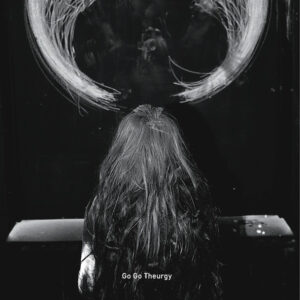
LP
Anna ZARADNY
“Go Go Theurgy”
Composed and recorded by Anna Zaradny in 2015. Electronics, analogue and digital synthesizers. Photo by Magda Wunsche. Drawing by Anna Zaradny. Design by Lasse Marhaug. Mastering an Cut by Rashad Becker at D&M Berlin. Produced by Musica Genera. Coproduction Bocian & Musica Genera.
“Go Go Theurgy”, the first Anna Zaradny’s album in eight years, consists of two majestic compositions. Strikingly charismatic and intense, they teem with sensuality and anxiety, while their palpably dense and detailed texture is constantly filled with tension and sense of urgency. The crystal-clear narration of these structurally complex pieces creates a framework for Zaradny's uniquely intricate and emotional sound. This music celebrates performativity and defies genre limitations. Although bravely experimental, it is precisely structured at the same time, and sometimes builds a momentum usually connotated with pop music. “Go Go Theurgy” recalls the primordial but also cultural references, creating its own idiosyncratic value.
-----------------------------------
“ “Go Go Theurgy” is an intricately woven tangle of synthetic and natural textures and modulations; the next step for the Zaradny's unique sound; very organic, and somewhat seductive. The idea of sound sculpture, found in her earlier pieces, is particularly significant for “Go Go Theurgy” . Its loops and cycles create a specific rhythm completely without percussion, based solely on the pulse and dynamics of the composition itself. A high intensity of intersecting layers of sound and repetitions refers directly to the title, a kind of ritual suspended between dance and performance, and the concepts of rebellion and power, purification and liberation by the movement of the body.
Zaradny's works have often included a theme of a ritual stripped of mystical aura, reduced to the tension between cultural roles and their phantasms (e.g. in “Castration class” (2010), “The sweetest sound of circulating firmament” (2011), “GEN IUS” (2014), “Punctus Contra Punctum” (2014)), but for the first time it takes the form of a sound composition.
“Go Go Theurgy” has a clear sonic architecture and contains echoes of the space where the sound resonates and returns in subsequent cycles. The composition becomes not only a reflection of the ritual documented on the photos, but also a metaphor of the resounding open space. Elements that we hear in the initial parts of the composition return in a processed form, an effect of a redefined echo which becomes an independent sound object detached from its source. This physical multidimensionality of sound is another step towards a sound sculpture. An attempt at stopping the moment, experiencing trance, looping movement and gesture.” Daniel Bro ek
17,00€
In stock
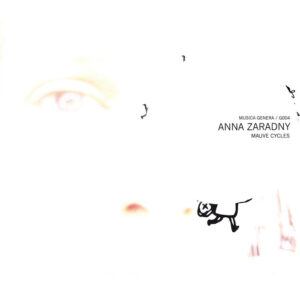
CD
Anna ZARADNY
“Mauve cycles”
“Mauve Cycles by Anny Zaradny is a significant release. It is the first solo CD by the artist with already considerable output including improvised music, composing for theatres, collaborations with visual artists and sound installations. Also, the involvement of women in the contemporary experimental music still seems to be perceived as unusual (hence the compilation releases such as “Women in Electronic Music” from 1977 or “Her Noise” exhibition from 2005) and in Poland it is a marginal phenomena. What immediately captures attention in Anna’s music is the diversity of colour and texture: noisy, harsh, prepared, digitally manipulated. The unusual thing is the almost baroque ornamentation. The production of the recording, emphasising the dynamics of sound, reveals the remarkable abundance of textural detail, especially at high volume. The rich arrangements make one think of orchestral momentum, which is not surprising in the context of Zaradny’s classical music education. Sensitivity rooted in the aesthetics of ’60 sonoristic avant-garde Pauline Oliveros, David Tudor, Gordon Mumma), combined with years of experience and collaborations with world’s leading free-improv and sound artists (Tony Buck, Burkhard Stangl, Cor Fuhler, Zbigniew Karkowski) result in the two parts of “Mauve Cycles”. At structural level, Anna’s music is built of interweaving, constantly evolving sound and rhythm blocks, organised into the title cycles.
Even if the elements of this sound mosaic can be categorised (drone, field recordings, extreme sonoristics, oscillator rhythms), every now and then the order is shattered by violent, out of context sound intrusions. The feeling of constant unease, both at compositional and sound levels, is one thing that makes the record stand out. The other
is the focus on compositional aspect of the music, which distinguishes Anna’s ideas from many other recordings in similar sound convention. The multilayer, spatial nature of the recordings resemble sound sculptures of Harry Bertoia, Christina Kubisch or Kaffe Matthews. “Mauve Cycles” seems to correspond with the output of these artists as well as Eliane Radigue’s or Delia Debyshire’s, contributing to women’s voice in the field of electronic preparations. Anna is also responsible for the cover design, including the
surprisingly romantic contribution from famous Polish graphic artist Marek Raczkowski. Recent musical activities indicated Anna’s growing sensibility in the field of sound art, and this latest recording is the full expression of her experiences. It is another gem in the
compositional series of Musica Genera label.” Daniel Brozek
12,00€