
In stock

LP
Abul MOGARD
“Quiet Pieces”
'Quiet Pieces' initiates Abul Mogard’s personal imprint Soft Echoes with a definitive self-portrait of calm, contemplative, and discreet inner landscapes made audible. It is the first solo album on vinyl in four years. RIYL Alessandro Cortini, William Basinski, The Caretaker.
While sifting through archived material left idle from earlier projects, a chance encounter with a late uncle’s trove of beloved 78rpm classical and opera records prompted the reworking and completion of what would eventually become the album. Spinning dusty records at 33 and 45rpm, Abul Mogard recombined their enduring spectres with unfinished sketches from his archive. The resulting soundscape blurs distinctions between his memories and those of another, exquisitely short-circuiting the senses with its waking, dream-like lucidity.
This was a process I hadn’t explored in my earlier works. I began sampling brief moments from these records, altering them with studio effects and playing them at slower speeds. In many cases, I wasn’t entirely sure how the original music sounded. These fragments, once further processed, became a source of inspiration for my new compositions. Over time, I realised that the old pieces from the archive and the new material derived from the samples naturally complemented each other.”
The resulting pieces hover over a threshold, a liminal space that harmonises the old and older material. Voluminous waves of quiet and loud undulate between consonance and dissonance, conjuring imagery of a decaying grandeur that humanity’s decadence has surrendered to the elements. Abul Mogard’s seemingly abandoned yet vast landscapes are nevertheless intimate with timbral frissons of red-lined distortion. Elusive, yet as tangible as sea spray or smog, they affect the olfactory senses with a rarified, synesthetic quality that modestly engages one’s emotional register – a hypnotic, distinguishing feature long hailed as one of the hallmarks of his work. A fidelity to memory and dream recall is sensitively probed in the journey from the stately symphonic stasis of 'Following a dream' to the almost industrial, untethered brutality evoked by a looming silhouette that’s never fully visible in 'Constantly slipping away', culminating in the foreboding coda of 'Like a bird'. Those pieces appear to shield the album’s sentimental core, where the tempestuous play of light and shadow of 'In a studded procession' escalates to breathtaking, panoramic climax, while 'Through whispers' evokes an out-of-body-like experience encountered with visceral poignancy.
Looking back, Mogard notes an unexpected influence: “I realise being inspired by Phill Niblock, whose work I had barely known at the time but explored after his passing in 2024. His album 'Boston Tenor Index' changed the way I approached dissonance. It encouraged me to push my sound further, to the edge of a space where I began to feel uncomfortable.”
The album artwork, created by longtime collaborator Marja de Sanctis, features a photograph taken at the Temple of Jupiter Anxur, an archaeological site overlooking the Mediterranean Sea. Captured with an iPhone, the image traces the residual presence of construction techniques and architectural forms of the Romans, where material history is transcribed through contemporary tools. The convergence of ancient and modern technology aims to reverberate the site’s lasting spiritual presence – an echo persisting in what is now perceived as a quiet, emptied space. The spiral gestures towards infinity and light. Past and present dissolve into one another, reflecting 'Quiet Pieces' meditation on sound, memory, and time.
26,00€
In stock
LP
Abul MOGARD
“Kimberlin (Original Soundtrack)” (clear)
Clear vinyl edition.
Visionary synthesist Abul Mogard renders a darkly sublime soundtrack for ‘Kimberlin’ , an experimental film about the Isle of Portland on the English south coast, which coincidentally doubles up as metaphor for the mood of an increasingly inward-looking UK.
Taking its name from the local word for an outsider or “foreigner”, the short film ‘Kimberlin’ was filmed on location during the months following the advisory referendum of 2016 which lead to the current, purgatory state of “Brexit”. Combining mostly wordless, lingering shots of the Isle of Portland’s bleak and rugged landscape with Abul Mogard’s washed out but richly evocative music, made with manipulated field recordings, modular synth and layered Farfisa organ, the project came to reflect a sense of (be)longing, loneliness and outsiderness that also perhaps uncannily mirrors the putative collective feeling since that darkly historic vote, over three years ago.
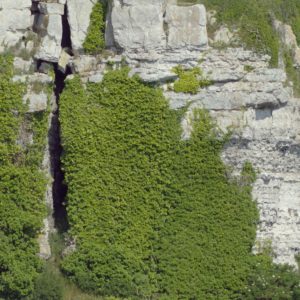
Taking cues from the evocative poetry of lifelong islander, stonemason and poet Cecil “Skylark” Durston (1910-1996), as well as a news report on the discovery of a mysterious cinema found interred by foliage in the Isle’s cave systems, the merging of image and sound speak to their subject in an organic, impressionistic manner that leaves billowing room for imagination.
Mogard’s soundtrack opens out with a slow-burning, greyscale iridescence, tenderly manipulating the sound of fog horns and bird calls in briny modular spray and gloaming Farfisa organ swells that, when combined with song titles such as ‘Flooding Tide’ and ‘Playing On The Stones’, serve to evocatively connote the film’s subject matter.
The results can be heard as echoes in the digital future of an England that’s now difficult to grasp, most hauntingly transposing the meaning of Cecil “Skylark” Durston’s description of the Isle of Portland as a place where “quarry bells no longer ring, except in old men’s dreams” to the ever-present, never-ending riddle of Brexit and its generationally devastating bleakness.
23,00€
In stock
LP
Abul MOGARD
“Kimberlin (Original Soundtrack)” (black)
Black vinyl.
Visionary synthesist Abul Mogard renders a darkly sublime soundtrack for ‘Kimberlin’ , an experimental film about the Isle of Portland on the English south coast, which coincidentally doubles up as metaphor for the mood of an increasingly inward-looking UK.
Taking its name from the local word for an outsider or “foreigner”, the short film ‘Kimberlin’ was filmed on location during the months following the advisory referendum of 2016 which lead to the current, purgatory state of “Brexit”. Combining mostly wordless, lingering shots of the Isle of Portland’s bleak and rugged landscape with Abul Mogard’s washed out but richly evocative music, made with manipulated field recordings, modular synth and layered Farfisa organ, the project came to reflect a sense of (be)longing, loneliness and outsiderness that also perhaps uncannily mirrors the putative collective feeling since that darkly historic vote, over three years ago.
Taking cues from the evocative poetry of lifelong islander, stonemason and poet Cecil “Skylark” Durston (1910-1996), as well as a news report on the discovery of a mysterious cinema found interred by foliage in the Isle’s cave systems, the merging of image and sound speak to their subject in an organic, impressionistic manner that leaves billowing room for imagination.
Mogard’s soundtrack opens out with a slow-burning, greyscale iridescence, tenderly manipulating the sound of fog horns and bird calls in briny modular spray and gloaming Farfisa organ swells that, when combined with song titles such as ‘Flooding Tide’ and ‘Playing On The Stones’, serve to evocatively connote the film’s subject matter.
The results can be heard as echoes in the digital future of an England that’s now difficult to grasp, most hauntingly transposing the meaning of Cecil “Skylark” Durston’s description of the Isle of Portland as a place where “quarry bells no longer ring, except in old men’s dreams” to the ever-present, never-ending riddle of Brexit and its generationally devastating bleakness.
20,50€