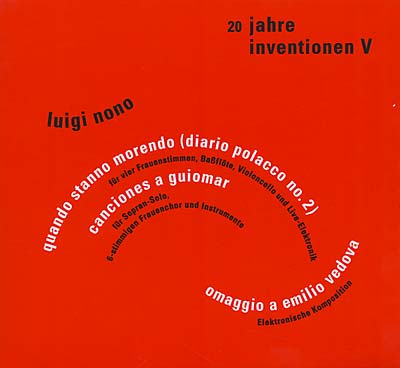
Luigi NONO
“20 Jahre Inventionen V”
14,00€
Out of stock
“Quando Stanno morendo (diario polacco no. 2)” (1982) for female voices, bass flute, cello, live electronics. “Canciones a Guiomar” (1962-63) for soprano solo, chor and instruments. “Omaggio a Emilio Vedova” (1960), electronic music. Interpreters : Ingrid Ade, Monika Bair-Ivenz, Bernadette Manca di Nissa, Halina Nieckarz, Roberto Fabbriciani, Frances-Marie Uitti, Arturo Tamayo, Experimentalstudio der Heinrich-Strobel-Stiftung des SWF, Ars nova ensemble Berlin, Edelgard Neubert-Imm, Peter Schwarz. “The live electronics that Nono worked with for the first time in the early 1980’s at the Freiburg Experimental Studio also serves the musical displacement: the music moves away from clear spatial and timbral assignations. Due to electronic processing, the sonic characteristics of both instruments, bass flute and cello, can hardly be recognized. Tones and gestures are lengthened into seeming infinity and move in space.” Lydia Jeschke
“Quando Stanno morendo (diario polacco no. 2)” (1982) pour quatre voix de femmes, flûte basse, violoncelle et électroniques. “Canciones a Guiomar” (1962-63) pour soprano solo, chœur et instruments. “Omaggio a Emilio Vedova” (1960), musique électronique. Interprètes : Ingrid Ade, Monika Bair-Ivenz, Bernadette Manca di Nissa, Halina Nieckarz, Roberto Fabbriciani, Frances-Marie Uitti, Arturo Tamayo, Experimentalstudio der Heinrich-Strobel-Stiftung des SWF, Ars nova ensemble Berlin, Edelgard Neubert-Imm, Peter Schwarz. Trois pièces de Luigi Nono données lors du festival Inventionen à Berlin en 1983 et 1991. Pièces instrumentales et électronique pour découvrir le travail de ce grand compositeur disparu en 1990 et dont le travail essayait de répondre à la question “que peut faire l’art face à la catastrophe ?”.
Related products
Out of stock

Out of stock

Out of stock

Out of stock

In stock