
In stock
CD
Antoine BEUGER – Anastassis PHILIPPAKOPOULOS
“Floating”
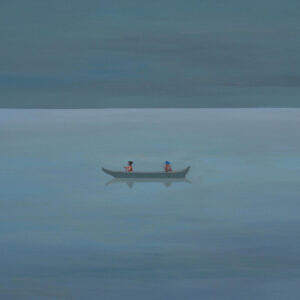
A 74-minute collaboration piece by Antoine Beuger and Anastassis Philippakopoulos. Cover painting by Maria Filippakopoulou. 6-panel digipak. Mastered by taku unami
15,00€
In stock
CD
Clara de ASIS – Ryoko AKAMA
“Sisbiosis”
Clara de Asís - electronics, percussion, field recordings
Ryoko Akama - amplified objects, field recordings
Track 1, 2: recorded and mixed by Clara de Asís in Leymen, France in May 2022
Track 3, 4, 5: materials recorded by Ryoko Akama and Clara de Asís in Leymen, France and Hofstetten-Flüh, Switzerland in March 2022, assembled and mixed by Ryoko Akama
Track 6: materials recorded by Clara de Asís and Ryoko Akama in Leymen, France and Hofstetten-Flüh, Switzerland in March 2022, assembled and mixed by Clara de Asís
Mastered by Taku Unami
15,00€
In stock
2 CD
Vanessa ROSSETTO
“The Actress”
Vanessa Rossetto's solo album. Mastered by Giuseppe Ielasi
Designed by Matthew Revert. Double CD, six-panel digipak.
24,00€
In stock
CD
STATISCHE MUSEN (Asmus TIETCHENS)
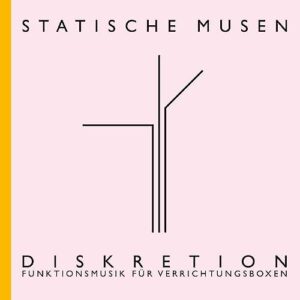
“Diskretion. Funktionsmusik für Verrichtungsboxen”
TATISCHE MUSEN – New follow-up project to Hematic Sunsets by Asmus Tietchens
Hematic Sunsets are gone - here come the Statische Musen. A new outlet by Asmus Tietchens for musical endeavors that are more formular or genre based. The four long-form tracks of Diskretion explore "ambient" in the broadest sense of the term. Dense layers, slow dynamic progression, moody atmospheres.
Asmus Tietchens
Tietchens was born in Hamburg in 1947. Since 1975 he has been working as an independent musician; in 1980 he released his first solo record Nachtstücke. After producing a series of rhythmic and harmonic albums for the Sky label in the early 1980s he released his first industrial record Formen letzter Hausmusik in 1984 on United Dairies. Here Tietchens articulated his musical interests clearly: everyday noises were treated and at times deformed beyond recognition and placed into new contexts. Until now Asmus Tietchens has released more than 80 albums on international labels where he continues to explore the posibilities presented to him by specific sound sources (ranging from water sounds to pure sine wave tones). He has a more rhythm-oriented fake band project called Hematic Sunsets. Tietchens’ work is rooted in a deeply sceptic gesture, marked by frequent quotes from the works of philosopher E.M. Cioran on his album covers. Asmus Tietchens has been awarded with the prestigious Karl Sczuka Prize of the Südwestrundfunk (SWR) twice: in 2003 for his work Heidelberger Studien 1-6 and in 2006 for Trois Dryades. He lives and works in Hamburg.
14,00€
Out of stock
10CD box
COMPILATION
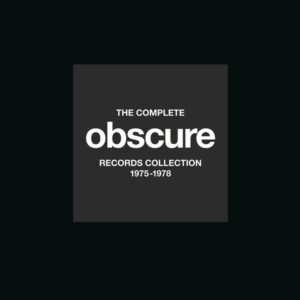
“The Complete Obscure Records Collection 1975-1978”
Over the last few years, the Italian imprint, Dialogo, has showed a remarkable dedication to the history of experimental music via reissues of seminal artefacts from the Cramps catalog, and important albums by Piero Umiliani, Ennio Morricone, Bruno Nicolai, Enrico Rava, and others. This initiative now takes on a towering scale with the first ever box set gathering the entire ten album collection of Brian Eno's Obscure Records, originally issued between 1975 and 1978. A truly groundbreaking body of recordings - many of which have remained out of print and difficult to find for decades - it contains some of the most important, influential, and enduring music to emerge during the second half of the 20th Century, which collectively reconfigured the terms of minimalism and laid the groundwork for the emerging movement of ambient music over its short, three-year run. Issued in a deluxe CD edition of 1,000 copies, each box set contains all of Obscure's albums, completely remastered by Andrea Marutti and housed in faithful mini-replicas of their original covers and liner notes, as well as a 130-page booklet, this historic collection marks the first time such a seminal series has received a complete repress. This is certainly one of the year's most interesting, essential, and widely anticipated releases, stunningly produced with the complete involvement of all the artists or their estates. When viewed collectively, the Obscure catalog reveals a remarkable, and previously unexplored counterpoint -- bridging the United Kingdom and the American West Coast -- to the dominant threads of minimal and experimental music, centered in New York that had long dominated the public consciousness. This historic collection marks the first time the seminal Obscure catalog has received a complete repress; simply a dream come true. Featuring Gavin Bryars, Christopher Hobbs, John Adams, Brian Eno, David Toop, Max Eastley, Jan Steele, John Cage, Michael Nyman, The Penguin Café Orchestra, John White, Tom Phillips, Gavin Bryars, Fred Orton, and Harold Budd.
140,00€
Out of stock
CD
Phill NIBLOCK
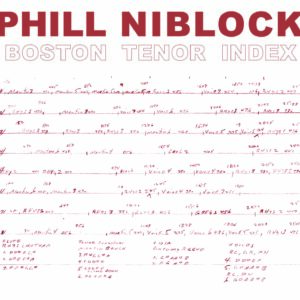
“Boston Tenor Index”
Phill Niblock "Boston / Tenor / Index", presents for the first time some of the earliest works by the American composer, inluding the three never before released "Index" (1969), "Tenor" and "Boston III" (both from 1972), thus making it possible to discover Niblock's starting point as a composer.
A filmmaker and photographer, Niblock began composing in the late 60s, while collaborating with the Judson Dance Theater in NY. As a composer his interest and field of research was connected to the layering of pre-recorded acoustic instruments into microtonal drones, which eventually led him to create some of the most unique tape collages in the second half of the 20th century minimal music. His earliest records, "Nothin To Look At Just A Record" and "Niblock For Celli / Celli Plays Niblock" were both issued by India Navigation in the first half of the 80s. Until now, it's been impossible to encounter Niblock's compositions from earlier than that period, a reality thankfully rectified by the long overdue publication of this "Boston / Tenor / Index" now on CD on alga marghen.
"Tenor" (1972) represents the first evolution of Niblock's musical thought towards the aesthetics of microtones, overtones, and drones which the composer would develop in following decades. The piece was recorded by the photographer Martin Bough on tenor saxophone and gradually dubbed back and forth by the composer in his New York studio. The sounds by the performer are submitted to the composer's techno-imaginative "acoustic optics" and deconstructed on behalf of structure, time and loudness. These specific aspects started to play an extremely important role in the artist's path as a composer.
The audio materials activated in "Tenor" through technologically de- and re-composed sounding textures, became a vehicle for those sound anomalies that would determine Niblock's audio poetics. Performing gestures are deconstructed though disseminating and editing processes by the imperceptible gestures of the composer. With its smooth flowing structure, "Boston III" (1972) stands at the very beginning of this illusion. It was recorded at the Intermedia Sound studio in Boston with Rhys Chatham (flute, voice), Martin Bough (tenor saxophone), Gregory Reeve (viola, voice); the composer himself also contributed with his voice. Using a 16-track Ampex tape recorder, at that time the world's newest recording device, Niblock was able to superimpose the recorded tones obtaining the desired aesthetic result which finally led him to a mesmerizing, immersive sound, a "very big, fat sound at fairly large volumes".
"Index" (1969) is an improvised sound performance by the composer himself. The listener is lucky to listen to (and imagine) the movements of the artist's fingers hitting a guitar string and the soundboard in breathtaking tempo. The piece itself represents early minimalism in its virgin state, untouched by distancing technology. Persistent percussive rhythm and corresponding resonances are irregular, the finger beats suffer natural dysrhythmia. Niblock's way of playing is very muscular here. It is more devoted to pure sensuality than to an intelligible order. This music is inscribed in the performer's body, it is a "body in a state of music". Guitar (both its body and strings), fingers and fingering fuse in a vehement action around which barely listenable sounds and resonances vibrate. Considering the extended pulsation as an organic blend of impulse, rhythm, drive, strength, vitality and passion, the end of this sole solo in Niblock's complete oeuvre is not defined by the fixed duration of the piece but as the consequence of the tiredness of the performer.
The CD also includes "Boston I" (1972), or the first chapter of the "Boston" series. This 25 minute bonus track is less massive than "Boston III"; still this version is much richer in dynamics and presents a more recognizable voice of each instrument.
As Niblock stated "This music is architectural. The intent is to fill the space. It's non-frontal music, non-proscenium space, anti-stage, not about an ensemble sitting in front of an audience, not about a single sound source. At least four speakers systems are desirable, arrayed around the periphery of the room, saturating the total space, engaging the air".
The music changes according to the loudness of playback. The interaction of the upper harmonics changes especially, with much richer overtone patterns being produced at louder levels.
Edition of 300 copies in digipak sleeve, including an 8-page booklet with photos and liner notes.
16,00€
In stock

CD
ILLUSION OF SAFETY
“Pastoral”
While Korm Plastics publishes books these days, this is a surprise CD only release. We sent him this demo in 2011 & we all forgot about it. Pastoral is a welcome edition to the catalog showcasing a less aggressive stance from the project, a more organic subdued presentation, sounds to make a clearing, & open space. The recordings history is a bit blurred now but it is very likely tracks 1, 2, 3, & 5 are Kurt Griesch and Daniel Burke, post 1995 tour work. Track four uses an instance of Reaktor 5 VCS-3 software emulation.
Illusion of Safety
Since 1983, Daniel Burke and his many conspirators under the Illusion Of Safety banner have over the course of 40+ full length releases traversed most every facet of the avant sound plane, from early industrial pop deconstruction to blindingly minimal sound art to densely surreal found-sound collage, each unique approach bending and reconstituting the expectations and possibilities of each realm, creating uneasy music that is dense and dystopian and yet also beautiful. Performing over 300 live concerts throughout Europe and the states included No Fun 2008, the Wroclaw Industrial Music Festival 2009, Sonic Circuits in 2010, with Shen Wei Dance Arts in 2011 at the Metropolitan Museum of Art in NYC, and at the Crisis Data Transfer Pre-Party October 2023. Outside of IOS Burke has collaborated with Jim O'Rourke, Jon Mueller, Randy Greif, Darin Gray, Z'EV, Cheer-Accident, Thomas Dimuzio, Kevin Drumm, Bill Horist, and others.
10,00€
Out of stock

CD
MUZIEKKAMER
“I – Kamermuziek”
Originally a private release in 1982 by two brothers, Martin and Cees van den Oever and a friend, Martin Keuning on guitars and synthesizer, working along Brian Eno's 'tape delay' system, as explained on his 'Discreet Music'. Arguably the best ambient cassette released in The Netherlands in the 1980s. Remastered from the original master by Peter van Vliet (Mekanik Kommando) and Raymond Steeg.
10,00€
Out of stock

2 CD
NURSE WITH WOUND
“The Sylvie And Babs Hi-Fi Companion”
Re-press of the long sold out deluxe re-issue of this 80’s classic from NWW. Expertly re-mastered by Denis Blackham. Now packaged in 6 panel matt laminated digipac, with special matt 12 page booklet with artwork by Babs Santini.
Includes a bonus disc of outtakes, unreleased material and remixes.
18,50€
In stock

CD
Colin POTTER
“We Couldn’t Agree on a Total”
This is the 100th release by ICR. The first was the compilation LP ‘We Couldn’t Agree on a Title’ in 1981. Back in those days, I never imagined – no, wait – that’s so long ago, I really can’t remember what I imagined. I know that I did think Integrated Circuit Records was a good name for a label that was ‘integrated’ (?!) and vaguely electronic. Which is why it’s now called ICR, much less of a mouthful. But it is slightly surprising to have made it to 100 releases, although I doubt we’ll make it to 200, which partly explains the title of this CD.
3 tracks totalling over 74 minutes, 2 were recorded live at London's Cafe Oto. The third is a studio mix of the music I played live a number of times, but never managed to get a decent recording.
Colin Potter, London 2023
Cover artwork of performance confusion by Jonathan Coleclough,
Review by Frans de Waard, Vital Weekly :
In 1981, Colin Potter released a compilation LP, 'We Couldn't Agree on a Title', the inaugural release on Integrated Circuit Records. 'We Couldn't Agree On A Total' is the 100th release, but it's not a compilation. To celebrate this milestone, Potter selected two live recordings from his concerts at Cafe Oto in 2018 and 2016 and one studio piece of something he played live a couple of times but never managed to get a great recording of. The cover shows Potter and a plethora of instruments; I am sure this photo is some construction of various images, but it's an impressive display of gear. Next to playing as a musician, solo and with Nurse With Wound, Potter runs the ICR studio, so I am sure he knows all about gear, cobbling these together and making them sound simultaneously, with Captain Potter at the controls. The mixing board is the big audio canvas to paint sounds, add effects, change frequencies, and do whatever people do behind big mixing consoles to produce great music. In the April 2018 concert, Potter goes for a take on cosmic music, with arpeggios and rhythm in slow motion, and once that train leaves the station, it majestically rolls about. It has that cosmic Krautrock idea, and it works very well. In 2016, he did something similar, but the arpeggios come in later here, and it takes some time to get there. Potter needs some time to get his stuff brewing from below the surface, but it erupts like a volcano with clockwork precision. In the studio construction, none of these arpeggios are rolling about but a slow melodic touch over drone-like synthesiser tapestries. Maybe also a bit on the cosmic side, but less urgent and more ambient. To me, it seems Potter exercises more control in this piece, whereas in the live pieces, he's wilder and lets things run wild. Two sides of the master, and while I slightly prefer the controlled constructions, it's a great release.
13,00€
In stock

CD
CHOEUR TAC-TIL
“Blind ecosystem”
« We are nine voices, sighted and blind, who have been singing and exploring together for 11 years. Our practice consists of listening to and imitating sound ecosystems. We become the sounds of biotopes, machines, endangered species, humans and non- humans. Our songs blend ancestral and experimental vocal practices. We are the stumbling blocks of a memory populated by tunes, buried melodies that emerge and carry us away for hybridizations, mutations. »
In 2012, Natacha Muslera (vocalist, improviser, composer, researcher) breathes life into a choir of sighted and blind people. Choeur tac-til is a choir without a conductor, wherein Natacha proposes a composition mode far from the visual field, developped in partnership in an ever-changing practice of free improvisation.
This album retraces ten years of shared practice in which vocal explorations indoors (in residence at The Gmem, National centre for music creation) and outdoors are intertwined, with the sound ecosystems of the Calanques massif, the city of Marseille and the Sainte-Baume forest.
12,00€
In stock

Book, miniCD
Renée VIVIEN – NURSE WITH WOUND
“Le Christ”
The story of Jesus, or that of a fin-de-siècle anarchist, by the sapphic poet Renée Vivien, accompanied by a new piece by Nurse With Wound on CD.
Renée Vivien (born Pauline Mary Tarn, 1877-1909), alias "Sapho 1900", is a British poetess of French language. Prolific despite her short life, she is the author of more than five hundred poems of autobiographical nature singing lesbian love, translations of Greek poetesses including Sappho, several volumes of prose and a dozen novels, and correspondence with Colette, Natalie Clifford Barney, Kérimé Turkhan Pacha, Amédée Moullé and Jean Charles-Brun.
A British music project formed in 1978 by Steven Stapleton, John Fothergill and Heman Pathak, Nurse With Wound (now Stapleton's variable geometry project) is an essential figure of English experimental and industrial music since the early 80's. With more than 150 releases, alone or with other musicians, Stapleton has swept widely different musical styles, from industrial music to mambo, through electronics, improvisation, electroacoustics, with a lot of humor.
14,00€
Out of stock
Book, miniCD
Jean LORRAIN – NURSE WITH WOUND
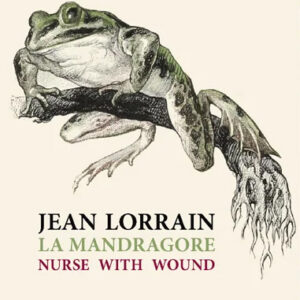
“La Mandragore”
The most accomplished tale of Jean Lorrain (1855-1906), decadent dandy, ardent erotomaniac and corrosive pen, accompanied by a new piece by Nurse With Wound.
Jean Lorrain (Paul Alexandre Martin Duval, 1855-1906) was a French writer, parnassian poet and art critic, a flamboyant and scandalous figure of the Belle Époque and of "decadent" literature.
A British music project formed in 1978 by Steven Stapleton, John Fothergill and Heman Pathak, Nurse With Wound (now Stapleton's variable geometry project) is an essential figure of English experimental and industrial music since the early 80's. With more than 150 releases, alone or with other musicians, Stapleton has swept widely different musical styles, from industrial music to mambo, through electronics, improvisation, electroacoustics, with a lot of humor.
13,00€
In stock
Book, miniCD
Alphonse RABBE – NURSE WITH WOUND
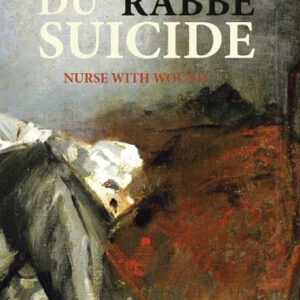
“Du suicide”
An excerpt from the Album of a Pessimist by the suicidal writer Alphonse Rabbe, whose exaltation and licentiousness were made for Nurse With Wound, who musically accompanies the text.
Alphonse Rabbe (1784-1829) was a French journalist, historian, biographer, romantic writer and poet.
A British music project formed in 1978 by Steven Stapleton, John Fothergill and Heman Pathak, Nurse With Wound (now Stapleton's variable geometry project) is an essential figure of English experimental and industrial music since the early 80's. With more than 150 releases, alone or with other musicians, Stapleton has swept widely different musical styles, from industrial music to mambo, through electronics, improvisation, electroacoustics, with a lot of humor.
12,00€
Out of stock

2 CD, book
Stefan ROIGK
“de—COMPOSED”
An artist's book by Berlin-based sound artist Stefan Roigk, documenting acousmatic compositions, sound installations, musical graphics and text-sound compositions of the years 2005 to 2023 on 144 pages and 2 audio CDs.
Sound as a mark to place ephemeral splinters in the surroundings—Sound as a gesture to draw with invisible lines and pervasions (forms)—Sound as a color to paint environments with transparent atmospheres—Sound as a volume to determine or fill space in time.
A complex assemblage, composed of documentation photos, texts and drawings, becomes an interlocking whole in its dynamic flows and fields and animates the paper as a vibrantly structured visual composition. A piece of music for the eyes, in which the boundaries between documentation, draft and work become blurred in a surreal mesh of the concrete and fictional. Here, the reader generates their own individual temporal axis based on their speed of observation and focus on the optical elements, thus becoming a mixing board for a composition realized as a catalogue. Three text pieces give a deeper insight into Roigk's understanding of sound as material and the translation of sound events into other media.
As an equivalent to the visual approach of the catalogue and in order to adequately convey the sonic dimension of the artistic work, (sound) fragments of all the works covered in the catalogue were transferred into a dynamic collage-like arrangement with Roigk's typical aesthetics and are included with the catalogue as an independent listening experience in the form of two audio CDs.
The catalogue is published in the format 21 x 26 cm with gatefold softcover and includes 180 color illustrations on a total of 144 pages. Besides the catalogue itself, the publication contains 2 audio CDs with 33 tracks and a total playing time of 141 minutes, 2 A5 postcards and a bandcamp download code to enjoy the release also digitally.
Stefan Roigk (born 1974) is a sound artist based in Berlin. He studied fine art with a focus on sound art in Hannover under Professor Ulrich Eller. In his work, Roigk pursues the intermedial interweaving of sound collage, installation, musical graphics and text-sound composition. The resulting works approach sound as a field for artistic and aesthetic research, taking it as both their departure point and central medium. Roigk's artistic focus lies on the dynamic staging of context-related fragments of everyday existence, which he imbues, in the sense of visual music, with an extraordinarily developed, visually poetic formal language. In realizing these aims, Roigk uses compositional and deconstructivist techniques of collage and assemblage for the development of stage-like spatial compositions with an implicit underlying narrative sense, in which the diverse media blend together like the instruments of an orchestra. In his work, Roigk reflects on his own living and production conditions, while investigating the political potential of aurality and tracing the subjective construction of reality. Since 2010, he has worked regularly in co-operation with visual artist Daniela Fromberg on intermedial installations and compositions.
28,00€
Out of stock

CD, Book
eRikm
“Douze horizons”
A sound postcard by eRikm: an instant composition recorded on CD, somewhere between sound performance and radio creation, accompanied by a booklet of photographs.
Since 1992, eRikm, a Marseilles based artist, has extended the field of artistic experimentation on the international scene.
Maintaining a constant fusion between thought, instinct and sensitivity, he pursues a simultaneity of practices and addresses the interplay between various compositional modes, relating to and using all languages.
From his early experience as a guitarist through to his later visual work, he is a maverick genre-bender who breaks down anyone's attempts to conveniently classify him.
Quickly recognised as a virtuoso turntablist and sound artist (1996), eRikm has made a longlife habit of crossing all territories and “world-systems” deemed “independent”, “institutional”.
12,00€
Out of stock

CD
Sam DUNSCOMBE & Michiko OGAWA
“Expended Desert”
Ferns Recordings presents Expended Desert, a collaboration between Sam Dunscombe and Michiko Ogawa.
Sam Dunscombe (field recordings, synthesis)
Michiko Ogawa (shō, hammond organ)
December 2022
Locations:
Roadside, Joshua Tree National Park
Railway siding, Ludlow
North Shore Yacht Club, Salton Sea
Soundwalk, Slab City
Adelanto Solar Park, Victorville
11,00€
Out of stock

CD
David JACKMAN
“Sekihi Oidori”
Organum ‘Raven’ CD, which was released by Siren Records in 2018 was the last piece that Jackman released under the name Organum. He changed the name Organum to Organum Electronics in 2019 and has released five volumes of the albums on Siren Records since then. ‘Sekihi Oidori’ is a development of the quiet nature of earlier Organum works and Jackman decided to release the album under his own name because of a very personal essence. ‘Sekihi Oidori’ is composed of low-key church organ drones, airy tanpura sounds, occasional church bell chimes and chirping birds. It is the most minimal, the most quiet and the most powerful composition Jackman has ever created. The drones continue uninterrupted and you may feel little change in partial listening, but you’ll appreciate the increasing internal dynamic energy that Jackman infused with mindful listening. ‘Sekihi Oidori’ means ‘Stone Tomb Old Bird’ in English translation but the piece is neither an elegy nor a lamentation.
15,00€

CD
Mark VERNON
“Sheet Erosion”
Audio Archaeology Series Volume 3: Brest
Sheet Erosion is the third episode in a series of works based around ideas of audio archaeology and found sounds. The setting this time is the city of Brest in France.
It is composed of field recordings made in early 2020 during the storms Ciara and Desmond plus a batch of found open-reel tape recordings dating from the 70s and 80s. The tapes include domestic home recordings but mostly document the recordist, Michel's tastes in music and radio programmes of the time. Daily life bleeds into these lo-fi recordings of radio and TV shows. Captured with a mic in front of a speaker rather than directly cabled, ambiguous activities can be heard in the background; babies crying, feedback, chairs scraping and muffled conversations.
In the composition family histories and musical tastes are transposed over a more contemporary soundscape of Brest. Over-saturated tape distorts time as well as sounds. Speeds change. Chronologies become confused. Different instances in time are blended and fused. What seeps through these chronological crevices are events and incidents unmoored from linear time taking place in a chimerical non-space.
***
Mark Vernon is a Glasgow based artist who explores concepts of audio archaeology, magnetic memory and nostalgia through his sound works. At the core of his practice lies a fascination with the intimacy of the radio voice, environmental sound, obsolete media and the reappropriation of found recordings. A rich collection of domestic tape recordings; audio letters, dictated notes, answer-phone messages and other lost voices often find their way into his unorthodox soundworlds. These diverse elements are distilled into radiophonic compositions for broadcast, multi-channel diffusion, fixed media and live performances.
His solo music projects have been published through labels including Kye, Glistening Examples, Flaming Pines, Discrepant, Entr’acte, 3Leaves, Misanthropic Agenda, Canti Magnetici, Granny, Calling Cards Publishing, Psyché Tropes, Persistence of Sound and Gagarin Records, as well as a series of small CDR and LP editions on his own Meagre Resource imprint.
12,00€

CD
Ralf WEHOWSKY & Kohei MATSUNAGA
“Spuren & Gegenworte”
"Spuren & Gegenworte" began with a quasi-telepathic collaboration between KM and RW. Both recorded a track on May 3, 2021, from 8:00 PM to 8:10 PM. These recordings were subsequently transformed, combined, juxtaposed, and further modified over the course of several months, resulting in the completion of the four pieces on the CD.
"Spuren & Gegenworte" can be translated as "traces & antonyms", opening up a wide range of interpretations. "Traces" may refer to the remnants of the original sounds that have been transformed in the process of reworking, or it can symbolize the cultural and musical influences that can be discerned. "Antonyms" oscillates between contrasting/contradictory and complementary meanings. Of course, other interpretations are also possible.
The 4 titles are indicated as Japanese terms on the cover: 痕跡、対立、変動、補完. They stand for the themes of traces, confrontation, fluctuation, completion.
***
Kohei Matsunaga is a musician and illustrator, born in Osaka in 1978. He has been actively making music since 1992, with notable releases on labels such as Raster Noton, Wordsound, Mille Plateaux, Important Records and PAN. He has collaborated with many artists, including Mika Vainio, Sean Booth from Autechre, Conrad Schnitzler, Merzbow and Asmus Tietchens. He lives in Osaka and Berlin.
Ralf Wehowsky is one of the most respected electronic composers of our day and was also a founder member of the seminal German group P16.D4 and label Selektion whose ground-breaking releases influenced many working in today's experimental music scene. His work is split between solo releases (under the moniker RLW) and collaborations, exploring all fields between media exchange and realtime presence recordings. His music is impossible to pigeonhole into one simple bracket. It is neither industrial or musique concrete, nor computer music nor improvisation. In fact, it could be all of these.
12,00€
In stock

CD
François BAYLE
“Le Projet Ouïr”
Digipack CD including a 24-page booklet in French and English
INA grm is pleased to present Le Projet « Ouïr » by François Bayle, a 62’ minute piece composed between 2015 and 2019, published for the first time on CD digipak.
The French language can hear (entendre), listen (écouter), grasp (comprendre). “Comprendre” aims too far. What is grasped has already been digested by the mind, away from the ear. “Entendre” is poorly distinguished from it—mainly because of “entendement”, which is virtually the same as “raison” (reason). That leaves us with “écouter”: the only one amongst the three that exclusively refers to the ear. Whoever listens stretches out his or her ear and expects to hear something and understand its ins and outs. However, this is still too nice, too urban. The idea is to break out of these customary dimensions and enter more difficult and risky territories. This is the “Ouïr” Project (Le Projet « Ouïr »). This archaic verb, which is now obsolete and that we can’t conjugate properly anymore, invites us to exercise a proto-listening, awkward, uncomfortable and unsure of its aims—yet with the promise of new horizons.
- Regis Renouard Larivière
21,00€
In stock

3 CD box
Michael Allen Z PRIME
“Bioelectrical Music”
We have not had a physical release by composer and ecologist Michael Prime since the release of Borneo in 2007. This new 3CD set brings us up to date with a series of recordings from across the years. It also sees a new refinement in his working practice as well as a new extension to his original name. Bioelectrical Music by Michael Allen Z Prime consists of recordings that fall into 3 defined categories - Bioelectrical Compositions, Bioelectrical Field Recordings and Bioelectrical Installations. All three use the bioelectrical potentials generated by plants and fungi, although these sound sources are now no longer purely seen as raw material available for multi-tracking or further electronic processing of the signal path. Now, the bioactivity signals themselves form the basis of the music. Following a framework of self imposed rules that restrict the extent that the source sounds can be altered, such that the essential voice of the living sound sources remain identifiable. The development of this framework is a direction that Prime’s music has been moving towards for some years now, and this box set collects various recordings made between 1990 and 2019 that fall into the remit of this new development. The pieces included here range from short sound studies to lengthy compositions and installation recordings made at a wide variety of locations. The 3CDs are accompanied by a 44 page booklet with an essay by Prime outlining the history and development of our understanding of plant neurophysiology. There is also a short piece written by author and fungal enthusiast Merlin Sheldrake.
42,00€
In stock

CD
Adam BOHMAN
“Music And Words 3”
Coming 8 years after Volume 2 and 23 years after the first installment, Volume 3 of Music And Words is the 4th solo release by Adam Bohman on Paradigm Discs. All 4 releases have focused on his earliest recordings, mostly from the 80s, mostly domestic and all using cassette recorders. There are 4 principle styles that are employed in this early phase of Adam’s work - most unexpectedly there are songs, often constructed with trumpet as the lead instrument, then more typically there are improvised experimental pieces using home made stringed instruments. Thirdly we have ‘pause pieces’ - consisting of rapid edit collages using found media (typically radio and bargain bin LPs), and the 4th element is Adam’s spoken word recordings. Anyone who has met Adam will have seen him recording his observations and thoughts onto a small tape recorder, documenting his way through life. In fact the Music And Words CD series is roughly 50% composed from these peripatetic ‘talking tapes’. On Music And Words 3 we hear him at the seaside in both Brighton and Clacton-On-Sea.
Overall the CD ranges widely over these various styles, and bursts with ideas and humour. In addition to the 4 solo releases on Paradigm Discs there is also a compilation track plus his contribution as a member of Morphogenesis on 3 further CDs. I’m proud to say that Adam is by far the most represented artist on the label.
14,50€
In stock

3 CD box
GENTLE FIRE
“Explorations (1970 – 1973)”
**2023 stock**
You may have heard of Gentle Fire, but could be forgiven for not knowing much about them. They were a 6, then 5 member group of composers/improvisers/performers based in London and Yorkshire. Most of the writings that cover the pioneers of experimental, electronic and improvised music have given them scant attention. In addition to this, their recorded output is slim, the main item being a long out of print LP (for EMI Electrola), featuring their interpretations of graphic scores by Cage, Earle Brown and Christian Wolff. Despite recordings for BBC Radio 3 and many German radio stations, it seems extraordinary that there were no other substantial releases of their repertoire, or any of the 6 Group Compositions they created.
Most of the existing Gentle Fire archive was kept privately by Hugh Davies. After Hugh died in 2005 it was shared between various institutions. This release owes much to Hugh’s meticulous record keeping as well as the archives at the British Library and Special Collections at Goldsmiths, University of London. Listening sessions at the British Library were a revelation, it was like discovering a missing link in the evolution of experimental music, but above all it sounded so undated and fresh.
The release is divided into 3 sections. The first CD, recorded between 1970 and 1971 contains 4 studio and 2 concert recordings of graphic and text scores: 2 parts of Stockhausen’s Aus den sieben Tagen, and one piece each by Earle Brown, John Cage, Toshi Ichiyanagi and Christian Wolff. Gentle Fire were active between 1968 and 1974 and were especially active during the early 70s, appearing at numerous European avant garde festivals, playing their own Group Compositions and a wide variety of experimental scores. They even ended up in Iran playing in Stockhausen’s Sternklang, and improvising at dawn at Hafez’s tomb. The text and graphic scores that they were innately drawn towards have large elements of interpretive freedom to them, where the composer provides a skeleton and steps back allowing the players to give it flesh. They were in regular communication with the composers of these piece, so it’s no surprise that their interpretations were sought after by concert organisers and composers alike. There are very few examples of groups working at this time with direct contact to the composers, which makes these recordings especially precious.
CD2 and 3 focus on their own works, CD2 dates from 1973 and was recorded during a 2 day residency at Radio Bremen. The 5 pieces on this disc cover a wide variety of styles and include a 23 minute version of Group Composition VI which is their only text based piece and uses processed and filtered speech.
CD3 is a recording of their appearance at ICES 72, a legendary festival that took place at the Roundhouse in London. Over the course of 2 chaotic weeks a vast number of the world’s experimental musicians took to the stage. Miraculously the whole of the Gentle Fire concert has been preserved. It consists of a performance of their Group Composition IV, centred around a large metal sculpture that all members of the group could play at the same time. The piece actually had its première the previous year on the original pyramid stage at the first Glastonbury Fair. There are several photos of the event included in the booklet that accompanies the CDs.
At last it is possible to assess the importance of this group’s work, both their own work and their interpretations of scores, and to give them their proper place in the history of live experimental/electronic music as well as indeterminate and intuitive composition.
Released in an edition of 500 with a numbered 48 page booklet.
38,00€
In stock

CD
Luciano MAGGIORE
“Self-talk”
Latest release by Italian London based musician Luciano Maggiore on his own edizioni luma.
Researched, written and recorded in London between March 2022 and March 2023
Mastered by Giuseppe Ielasi
14,50€
Out of stock

3 CD box
DDK Trio (Demierre / Dörner / Kocher)
“A Right to Silence”
On the impulse of Jacques Demierre, DDK trio was created in 2014 at the Festival Météo Mulhouse, France. Made up of three major figures on the international music scene, this trio plays music that is totally oriented towards the present moment. It continues the tradition of "instant composition" - going back to Lennie Tristano and passing through the legendary Jimmy Giuffre trio - and deploys an expressive palette ranging from silence to massive acoustic eruptions, while paying particular attention to the great precision of the articulation of musical discourse. An extreme care for sound and listening constitutes the core of this music, which draws from the sources of today's inventive music where multiple sound universes intersect.
The trio's third album, "A Right to Silence," consisting of three CDs, was recorded by Benjamin Maumus at Théâtre Le Colombier, Les Cabannes, France, June 21-25, 2021, on the occasion of a recording residency at GMEA-Centre National de Création Musicale d’Albi-Tarn. In choosing the music to be released, the three musicians decided to apply the principle of non-influence-in-each-other's-choice that they have been practicing for years as a trio. From there, they each made their own album from the same raw recordings, separately, each on their own. A previously unpublished text by researcher and sound artist Thibault Walter accompanies the 3-CD boxed set, highlighting the process carried out by the trio and described above.
30,00€
Out of stock

CD
Maeda YASUYUKI / Li SONG
“28th Dec, Arakawa”
Maeda Yasuyuki and Li Song are musicians and computer programmers based in Nagoya and London, respectively. They both improvise with their computers through code using SuperCollider, a real-time sound synthesis system. They first connected online in 2017 through OSC Hub, a computer music program for remote collaboration created by Tadashi Usami.
They self-released Two Laptops in February 2022, and later released it as a tape on Karma Detonation. It was recorded during Maeda's trip to London in the summer of 2019.
This release was recorded during Li's visit to Tokyo in the winter of 2022, all in one afternoon. One recording took place under a bridge by the river around 2 p.m., and the other in a small community park in the area around 5 p.m. They placed the portable recorder between two laptops. Along with the sounds coming from the laptops' built-in speakers, the sounds of the surroundings were also recorded, including the passing cars on highways, motorboats, waves, birds, and people passing by. One of the recordings captured someone saying "Stop it" in Japanese, though neither recalls hearing it during their time in the park.
10,50€
Out of stock

CD
Atsuko HATANO / Ryotaro MIYASAKA
“Dinosaur and Gems”
Atsuko Hatano plays viola, violin and cello; she also uses electronics. She has released numerous albums and attracted a great deal of attention both inside and outside Japan. Hatano also creates music for movies, TV dramas and commercials. She frequently collaborates with other musicians and artists, including Jim O'Rourke and Eiko Ishibashi.
Ryotaro Miyasaka, a percussionist active in genres ranging from pop to experimental music, has been extremely busy of late. In 2022, he released the CD Odd Jobs Are the High Road of Work (ftarri-967), an improvised duo performance with guitarist Tetuzi Akiyama, on the Ftarri label.
Dinosaur and Gems documents a duo concert held at Ftarri on February 27, 2023. The two tracks on this album (21 and 29 minutes) show Hatano (viola and electronics) and Miyasaka (percussion) crossing swords furiously, but at times playing calmly and in perfect synch.
10,50€
In stock

CD
Kanon AONAMI / Sean COLUM / Fumi ENDO
“Kanon Aonami Composed Works”
Born in Yokohama in 1994, Kanon Aonami is an alto saxophonist and composer who plays jazz and improvised music at performance venues mainly in Tokyo and Yokohama. She is also a talented composer, and at Ftarri she often performs her own compositions in addition to improvised music. In June 2021 Aonami started appearing periodically at Ftarri; she has performed with musicians including pianist Fumi Endo, alto sax player Masahide Tokunaga, and British guitarist and Tokyo resident Sean Colum.
Focusing on her compositions, this album includes performances of three of Aonami’s composed works. Two of them (1, 3) were performed by Aonami and Sean Colum, while the other (2) is a duo performance by Sean Colum and Fumi Endo. The bonus track at the end (4) is an improvised trio performance by Aonami, Colum and Endo. All were recorded live at Ftarri on February 6 (3) and April 24 (1, 2, 4), 2023.
10,50€
Out of stock

CD
Akira SAKATA / Toshimaru NAKAMURA / Raiga HAYASHI
“Kinjo no Tabibito”
Three musicians of different generations came together to form this unusual free jazz trio. Comprised of veteran musician Akira Sakata (alto sax, clarinet, narration), noted young drummer Raiga Hayashi, and Toshimaru Nakamura (no-input mixing board)—who has been active on the improvised music scene inside and outside Japan since the 1990s—this much-talked-about band performs mainly at live music venues in the Tokyo area.
Naturally, their performances contain the furiousness and wildness characteristic of free jazz, but they also pulsate in a phantasmagoric way as they move forward. And Nakamura’s effectively released electronic noise—unusual in free jazz—solidifies the trio’s distinctive character. The two tracks on this album document a live performance that took place at Apollo, Tokyo, on March 5, 2023.
10,50€
In stock

CD
Yumiko TANAKA
“Tayutauta [Remastered Edition]”
While continuously engaged in the field of traditional Japanese music, female-school gidayu shamisen player Yumiko Tanaka has since the 1990s been carrying out multifaceted musical activities including contemporary classical music, improvisation (in 1996-97 she was a member of Otomo Yoshihide's band Ground-Zero), experimental music, and theater performance/composition, performing and exchanging ideas with many musicians from Japan and other countries.
While Tanaka is regarded as one of the musicians representative of the improvised/experimental music scene in Japan, thus far she has only two solo releases: the CD Tayutauta (Improvised Music from Japan, 2004) and the DVD Music Performance (Meenna, 2017). In 2023, 19 years after its original release, her only solo CD--the widely acclaimed Tayutauta--has been remastered and reissued with greatly improved sound quality and a new design.
Tayutauta contains ten completely improvised tracks in which Tanaka uses the gidayu shamisen but departs boldly from the usual methods of playing the instrument. Incorporating a variety of experimental techniques including plucking, bowing and use of "prepared" objects, these performances are calm and sedate, but suffused throughout with a feeling of cohesion backed by Tanaka's distinctive musical artistry. This is improvised music of rare quality.
10,50€
Out of stock

CD
John BUTCHER
“The Very Fabric”
The Brønshøj Vandtårn is a concrete water tower, built almost a hundred years ago in the suburbs of Copenhagen. It's 20m wide and 34m high - smaller than some similar shapes I've played in, but with a large, lingering reverberation. Some sounds seem to float away as if through liquid, others acquire a shifting haze, and some just prefer to sit around. Thomas Buhl-Wiggers, of the Cejero festival and label, kindly invited me to play there in the summer of 2022 and arranged for Jesper Hviid to spend the day inside, recording these pieces.
The very resonant spaces I've worked in before include a giant gazometer, a hollowed-out Japanese mountain, an underground reservoir, a Victorian mausoleum and a massive World War II oil tank. I'm still fascinated by how different these massive environments all sounded and felt. They each inspired different approaches in trying to find the music for the actual space, and this recent experience within the extraordinary Brønshøj water tower was no exception. (John Butcher)
British saxophone player John Butcher, a leading figure on the contemporary improvised music scene, has released several CDs on Ftarri labels in which he performs with other musicians, including Rhodri Davies, Akio Suzuki, Eddie Prevost and John Russell. But The Very Fabric is Butcher’s first solo album release on a Ftarri label (Hitorri).
12,00€