
In stock

CD
John CAGE
“Winter Music”
“Winter Music” (1957). Version for four pianos. With Mark Knoop, Catherine Laws, Philip Thomas & John Tilbury.
Winter Music was written in 1957 at a time when Cage was exploring different ways of using chance procedures in his composing. He was also interested in producing scores that were indeterminate and which required the performer to interpret and work out many aspects of how the music might actually sound in performance. Winter Music consists of 20 unbound pages, which can be played by any number of pianists from 1 to 20. Any number of pages can be used in a performance, and in any order. Each page contains notes, chords and clusters which are positioned in accordance with the imperfections in the paper on which Cage was working.
The pages of Winter Music are less a score in themselves than a means for producing a score. The pianists are required to make some form of realisation, usually in advance, as to pitch selection and points of occurrence.
For this realisation chance procedures were used to assign each of the pianists five of the twenty pages. The pianists agreed an overall duration of 40 minutes and prepared their parts independently. At the recording there was no rehearsal and the piece was played once only.
Winter Music was written in 1957 at a time when Cage was exploring different ways of using chance procedures in his composing. He was also interested in producing scores that were indeterminate and which required the performer to interpret and work out many aspects of how the music might actually sound in performance. Winter Music consists of 20 unbound pages, which can be played by any number of pianists from 1 to 20. Any number of pages can be used in a performance, and in any order. Each page contains notes, chords and clusters which are positioned in accordance with the imperfections in the paper on which Cage was working.
The pages of Winter Music are less a score in themselves than a means for producing a score. The pianists are required to make some form of realisation, usually in advance, as to pitch selection and points of occurrence.
For this realisation chance procedures were used to assign each of the pianists five of the twenty pages. The pianists agreed an overall duration of 40 minutes and prepared their parts independently. At the recording there was no rehearsal and the piece was played once only.
13,00€
Out of stock

CD
James SAUNDERS
“assigned #15”
The leading contemporary music ensemble Apartment House perform a new piece developing out of James Saunders’s long-term modular project “
unassigned”. The new piece, “assigned
15”, was recorded in April this year and creates a mesmeric, dense, jungle-like soundworld across its 45 minutes. Beautifully realised by Anton Lukoszevieze (cello), Bridget Carey (viola), Simon Limbrick (percussion), Nancy Ruffer (flutes), James Saunders (dictaphones & radio), Philip Thomas (piano) and Kerry Yong (chamber organ).
unassigned”. The new piece, “assigned
15”, was recorded in April this year and creates a mesmeric, dense, jungle-like soundworld across its 45 minutes. Beautifully realised by Anton Lukoszevieze (cello), Bridget Carey (viola), Simon Limbrick (percussion), Nancy Ruffer (flutes), James Saunders (dictaphones & radio), Philip Thomas (piano) and Kerry Yong (chamber organ).
15,50€
Out of stock

CD
Giuliano D’ANGIOLINI
“Cantilena”
Six excellent chamber works by the Paris-based composer Giuliano d’Angiolini. An early review in The Guardian describes it as “sublime, poised music, full of open spaces”.
“Aria del flauto eolico” (2015). Manuel Zurria (flutes).
“Finale” (2012). Melaine Dalibert (piano).
“Cantilena” (2014). Quatuor Parisii : Arnaud Vallin & Doriane Gable (violins), Dominique Lobet (viola), Jean-Philippe Martignoni (cello).
“Allegretto 94.6” (2002). Melaine Dalibert (piano).
“(suoni della neve e del gelo)” (2014). Quatuor Parisii.
“Motivetto” (2009) Ensemble Chrysalide : Baptiste Boiron (saxophone), Benjamin Boiron (cello), Melaine Dalibert (piano).
“Aria del flauto eolico” (2015). Manuel Zurria (flutes).
“Finale” (2012). Melaine Dalibert (piano).
“Cantilena” (2014). Quatuor Parisii : Arnaud Vallin & Doriane Gable (violins), Dominique Lobet (viola), Jean-Philippe Martignoni (cello).
“Allegretto 94.6” (2002). Melaine Dalibert (piano).
“(suoni della neve e del gelo)” (2014). Quatuor Parisii.
“Motivetto” (2009) Ensemble Chrysalide : Baptiste Boiron (saxophone), Benjamin Boiron (cello), Melaine Dalibert (piano).
14,00€
Out of stock

CD
Frank DENYER
“Whispers”
“Whispers” (2010) Frank Denyer (voice & ancillary instruments), Elisabeth Smalt (offstage violin). “Woman with Jinashi Shakuhachi” (2008) Kiku Day (shakuhachi, voice, small percussion). “Riverine Delusions” (2007) The Barton Workshop - Jos Zwaanenburg (bass flute), John Anderson (bass clarinet), James Fulkerson (bass trombone), Marieke Keser (muted violin), Anne Magda de Geus (muted cello), Jamie Swale (bass drum), Frank Denyer (percussion). “Two Voices with Axe” (2008) Frank Denyer & Juliet Fraser (voices), Jos Zwaanenburg (flute), Benjamin Gilmore (muted violin), Elisabeth Smalt (muted viola), Dario Calderone (muted double bass), Pepe Garcia Rodriguez (percussion), Bob Gilmore (axe), Jamie Man (conductor). “A Woman Singing” (2009) Juliet Fraser (voice).
“The experience of listening to Frank Denyer’s music is extraordinary, quite distinct from other aspects of our contemporary musical lives. His music manifests an exquisite sensitivity to sound, often unusual or fragile sounds; his compositions are more concerned with what can be heard than with an interest in systems, or drama, or “ideas”. And while these sounds sometimes seem to embody a covert narrative of sorts, as though a story is hiding, waiting to be told, any such narratives are never made explicit. This leaves the listener free to concentrate on the highly original melodic lines, the harmonies and the unique tone colours of Denyer’s work, while speculating, if desired, about possible scenarios that may lie behind. This disc, the eighth devoted entirely to his music, collects three solo and two ensemble pieces, and forms a portrait of his recent work, from the years 2007-10.” Bob Gilmore
“The experience of listening to Frank Denyer’s music is extraordinary, quite distinct from other aspects of our contemporary musical lives. His music manifests an exquisite sensitivity to sound, often unusual or fragile sounds; his compositions are more concerned with what can be heard than with an interest in systems, or drama, or “ideas”. And while these sounds sometimes seem to embody a covert narrative of sorts, as though a story is hiding, waiting to be told, any such narratives are never made explicit. This leaves the listener free to concentrate on the highly original melodic lines, the harmonies and the unique tone colours of Denyer’s work, while speculating, if desired, about possible scenarios that may lie behind. This disc, the eighth devoted entirely to his music, collects three solo and two ensemble pieces, and forms a portrait of his recent work, from the years 2007-10.” Bob Gilmore
13,00€
Out of stock

CD
Chiyoko SZLAVNICS
“During a Lifetime”
The fourth disc in the Canadian Composers Series features the music of Chiyoko Szlavnics. The CD contains three works, two of which use sinewaves in conjuncton with acoustic instruments. The title track ‘During a Lifetime’ is written for sinewaves and saxophone quartet, an instrument on which Szlavnics herself used to perform. The final piece, ‘Reservoir’, is composed for sinewaves and an unusual instrumental octet, including two accordions, two flutes and two percussionists. The middle piece ‘Freehand Poitras’ is for string trio, but like the other works on the disc it is typified by the use of long sustained tones and slow glissandi.
Three exquisite pieces by the Berlin-based composer who uses drawings as the basis for her compositions. Played by the Konus Quartett and Apartment House.
“During a Lifetime” (2015)
Konus Quartett: Fabio Oehrli (soprano & alto saxophones), Jonas Tschanz (alto saxophone), Christian Kobi (tenor saxophone), Stefan Rolli (baritone saxophone). Plus sinewaves.
“Freehand Poitras” (2008)
Gordon Mackay & Mira Benjamin (violins), Anton Lukoszevieze (cello).
“Reservoir’” (2006)
Apartment House: Nancy Ruffer & Gavin Morrison (flutes), Jonas Kocher & Hannes Lingens (accordions), Simon Limbrick & Richard Benjafield (percussion), Mira Benjamin (violin), Anton Lukoszevieze (cello), John Lely (technical assistance). Plus sinewaves.
Three exquisite pieces by the Berlin-based composer who uses drawings as the basis for her compositions. Played by the Konus Quartett and Apartment House.
“During a Lifetime” (2015)
Konus Quartett: Fabio Oehrli (soprano & alto saxophones), Jonas Tschanz (alto saxophone), Christian Kobi (tenor saxophone), Stefan Rolli (baritone saxophone). Plus sinewaves.
“Freehand Poitras” (2008)
Gordon Mackay & Mira Benjamin (violins), Anton Lukoszevieze (cello).
“Reservoir’” (2006)
Apartment House: Nancy Ruffer & Gavin Morrison (flutes), Jonas Kocher & Hannes Lingens (accordions), Simon Limbrick & Richard Benjafield (percussion), Mira Benjamin (violin), Anton Lukoszevieze (cello), John Lely (technical assistance). Plus sinewaves.
14,00€
Out of stock
CD
Ellen FULLMAN
“Staggered stasis”
Staggered Stasis (1989) was commissioned by the Deborah Hay Dance Company for part 1, "The Navigator" in Hay’s trilogy, "The Man Who Grew Common In Wisdom". Microtonal shifts in the coloring occur in a staggered fashion, traveling on an axis of Pythagorean intervals, (the circle of fifths). Chords created by stacking 3/2s, or fifths, are referred to as "suspended chords". There is a flatness in this drama, what I imagine it must be like in the middle of an ocean, continually moving yet appearing the same. The four part score was plotted on a timeline. Each track was recorded and performed by myself. An excerpt of Staggered Stasis was released on the Arial CD series.
"Duration" (1986) was composed as a 13-limit study for the Long String Instrument, in the key of C. The fundamental tone is continually sounded, under chords constructed with pitches from the overtone series. The intention of the piece was to listen to the variations within each chord, as it is sounded continually while the performer walked the length of the instrument. As the performer’s position changes, one clearly hears a cascade of overtones. "Duration" was never previously released.
The original recordings were made direct to a PCM digital processor using a vintage AKG C24 stereo tube condenser microphone placed about 15 feet from the resonators.
"Duration" (1986) was composed as a 13-limit study for the Long String Instrument, in the key of C. The fundamental tone is continually sounded, under chords constructed with pitches from the overtone series. The intention of the piece was to listen to the variations within each chord, as it is sounded continually while the performer walked the length of the instrument. As the performer’s position changes, one clearly hears a cascade of overtones. "Duration" was never previously released.
The original recordings were made direct to a PCM digital processor using a vintage AKG C24 stereo tube condenser microphone placed about 15 feet from the resonators.
14,00€
Out of stock
CD
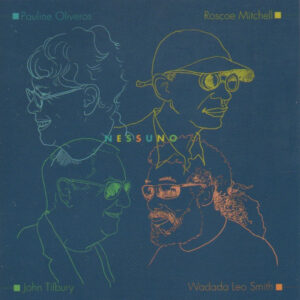
Pauline OLIVEROS + Roscoe MITCHELL + John TILBURY + Wadada Leo SMITH
“Nessuno”
Pauline Oliveros V-Accordion. Roscoe Mitchell alto & soprano saxophone, flute. John Tilbury piano. Wadada Leo Smith trumpet. music by Pauline Oliveros, Roscoe Mitchell, John Tilbury, Wadada Leo Smith.
“In 2011 Pauline Oliveros, Roscoe Mitchell, John Tilbury and Wadada Leo Smith opened the AngelicA Festival with 3 days of concerts… they performed solos and duets (Pauline and Roscoe; John and Wadada), and finally, for the first time ever, these 4 distinct musical voices performed together, as a quartet…
Over time AngelicA (which is 26 years old) has always tried to bring together different worlds, even ones that were very far apart from each other (although distance is nothing but an illusion if it is not prescribed by cultural boundaries): through the creative forces that come alive in these encounters, if possible, to re-discover spaces for expression beyond the original contexts… A vision that comes, takes over, and pushes you in that direction, which otherwise would be hard to explore… I am very thankful for the musicians who took up the invitation as a natural possibility…” Massimo Simonini (March 2016)
13,00€
In stock

CD
Christian WOLFF
“Angelica music”
Apartment House with Andrew Sparling, clarinet, voice, Gordon MacKay, violin,
Ruth Ehrlich, violin, Bridget Carey, viola, Anton Lukoszevieze, cello, Philip Thomas, piano.
Music by Christian Wolff (1934). “Exercise 13” (1974), “Exercise 10” (1973/1974), “Duo 7” (2005), “Keyboard Miscellany: Variation on Morton Feldman’s Piano Piece 1952” (1988), “Duo For Violins” (1950), “Keyboard Miscellany
6” (1997), “Edges” (1968), “Keyboard Miscellany
12” (1997), “Winter Exercise” (2013), “Berlin Exercise” (2000).
13,50€
In stock
CD
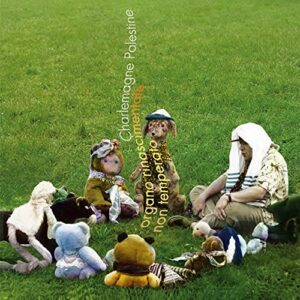
Charlemagne PALESTINE
“Organo rinascimentale non temperato”
Charlemagne Palestine organ. “Schlingen Blängen for Organo Rinascimentale Non Temperato” (2004).
“Through my desire to find a sound form that rivaled Abstract Expressionist painters like Rothko, Newman, Still, around 1965 I attempted with the help of a 19th century treatise by Helmholtz, “On the sensation of tone”, and my own exhaustive experimentation with the pipe organ and early electronic synthesizers, to develop a constantly changing molecule like organism as a continuous sound form.
By 1977 those investigations became Schlingen Blängen, a work for electronic oscillators or pipe organ that can last from an hour to several days nonstop in sonic constant chemical acoustic + architectural evolution + transformation in space.”
13,50€
Out of stock
CD
Jean-Luc PARANT
“Partir”
Textes of jean-luc Parant. “Dix chants pour tourner en rond” and“Les yeux CIII CXXV”. Music of Marie-Sol Parant (piano), with participation of Johnny T (violin).
13,00€
In stock

CD
Akio SUZUKI
“K7 box”
Recorded at Yokosuka Museum of Art on 9-10 January 2007. Sound artist Akio Suzuki’s brand new CD is released just now ! This CD is consisting of 9 tracks mainly his self-made sound object “Analapos” and “De Koolmees”, and 2 tracks of them are recorded for announce sound of opening and closing of Yokosuka Museum of Art. They are so clear and spacy. Booklet is written by himself, David Toop and others. Text in Japanese and English. ALM Records is well known label that has released many avant-garde LP titles in 70-80’s. Especially about Akio Suzuki, two LPs has been released - obscure
solo LP (limited 100 copies) and "New Sence of Hearing" with Kosugi.
27,00€
In stock
CD
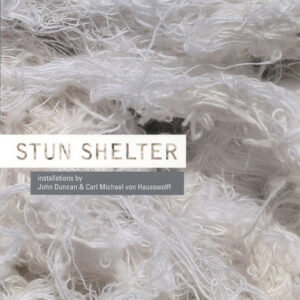
John DUNCAN & Carl Michael von HAUSSWOLFF
“Stun shelter”
50-pages catalogue with full color photos and audio CD in DVD plastic cover. Audio and still images from the Stun Shelter installation at Galleria Nicola Fornello, Prato.
Created and composed by John Duncan & Carl Michael von Hausswolff. Installation recording by Carl Michael von Hausswolff. Mastered at Scrutto by John Duncan. Catalogue text by Daniela Cascella.
From the text of the catalogue : “John Duncan’s See is a video installation made up of four separate and simultaneous projections of sequences taken from the John See Series, a series of adult movies he directed (...). In those moments in which the sound is softer, a voice emerges, whispering Japanese phrases until it is drowned once again by the wave of louder sounds. Carl Michael von Hausswolff’s Thinner & Low Frequency Bar / Glue & High Frequency Lounge consists of two bars made of steel and glass on which lie bottles and cans containing (...) glue and thinner. On the bar two oscillators produce frequencies varying in intensity, whose sound penetrates the ears altering normal perception levels. Both works fill the space perfectly, one by means of strong images (See), the other through the substances shown. Attention level is at its maximum in attempts to grasp the Japanese whispering (See) and the ghost-sounds of the oscillators (Thinner Bar...), defying the threshold of audibility as they act on the unconscious.” Daniela Cascella
15,00€
Out of stock
CD
John DUNCAN – Mika VAINIO – Ilpo VAÏSÄNEN
“Nine suggestions”
John Duncan: shortwave, processing. Mika Vainio: oscillators, processing. Ilpo Väisänen: oscillators, processing.
Composed by John Duncan, Mika Vainio and Ilpo Väisänen. Processed and mixed in Barcelona, Berlin and at Scrutto by John Duncan, Mika Vainio and Ilpo Väisänen. Mastered at Scrutto by John Duncan.
Composed by John Duncan, Mika Vainio and Ilpo Väisänen. Processed and mixed in Barcelona, Berlin and at Scrutto by John Duncan, Mika Vainio and Ilpo Väisänen. Mastered at Scrutto by John Duncan.
15,00€
Out of stock

CD
MUSICA ELETTRONICA VIVA
“Spacecraft – Unified patchwork theory”
The MEV group was formed in September 1966 by Alvin Curran, Richard Teitelbaum, Frederic Rzewski, Allan Bryant, Carol Plantamura, Ivan Vandor, and Jon Phetteplace. In the beginning they performed compositions by themselves and others which involved the use of electronic sound produced in real time, or "live" electronic music. In the summer of 1967 they began to work more with improvisation and less with determinate structures. MEV focus more on interpreting the moment, rather than constructing repeatable programs; creating meaningful rituals, not images; becoming involved with the process, the operation, and not with the result of it, or its effects on people. MEV music is highly eclectic, resisting ready classification by combining elements of improvised music, computer music, world music, jazz and classical composition, without being clearly definable as any one of them. For the realization of "Spacecraft", recorded in Koln in 1967, MEV were Frederic Rzewski (amplified glass and springs), Alvin Curran (electric percussion, trumpet, voice), Richard Teitelbaum (moog synthesizer), Allen Bryant (homemade synthesizer), Ivan Vandor (alto saxophone). In the collective work of MEV "Spacecraft" it was stereotypes that formed the material for the improvisation. The player imagined himself as trapped within a labyrinth, whose corridors were lined with images, learned formulas, taken from the past. This was the space which he occupied, and it was indeed a trap, but then it was also all that he had. It was occupied space, he was in it, but didn’t identify with it, and the work was to transform it into created space,
to make it his. He had to penetrate through the walls of the labyrinth, through the images, whether by magic, all at once, or over a longer duration, by work, in order to come out into the open, to discover a new space which was neither his nor another’s, but everybody’s. The secret of the labyrinth is that the way out is not left, right, forwards, or backwards, but up: to get free one must fly. To fly is to risk falling, to acept this risk. As long as you are afraid to take this risk, you’ll never get off the ground, you’ll run around bashing into walls and going through the movements of flight, uselessly flapping and flopping. You will fall into stereotypes. If you accept this, however, if you open yourself to whatever is happening, suspend judgement and fall into it completely and with grace, then you will fly, and it will be transformed. "Spacecraft" is a composition, in the sense that it is based on a particular combination of ideas. In order to play "Spacecraft" it was necessary to be more or less familiar with these ideas. The performers all knew each other. Every performance was the moment of a continuous process. This process then came to an end, as it were, and the rather esoteric techniques used in the maintaining it were abandoned in favour of others which were more open, more accessible to the casual visitor or listener. This CD also includes " Unified Patchwork Theory ", recorded in
Zurich at Rote Frabrik by MEV including Frederic Rzewski (piano), Alvin Curran (sampler, synths), Richard Teitelbaum (synths), Steve Lacy (soprano sax), Garrett List (trombone, voice, electronics). This CD is included in a beatiful digipack black and white sleeve with photos and liner notes. Also included is a 8 page booklet with an essay by Frederic Rzewski titled "Plan for Spacecraft", as well as “Some MEV Memories" by Richard Teitelbaum and the chronology the “Spacecraft” performances in Europe in 1967. New edition remastered by Giuseppe Ielasi.
to make it his. He had to penetrate through the walls of the labyrinth, through the images, whether by magic, all at once, or over a longer duration, by work, in order to come out into the open, to discover a new space which was neither his nor another’s, but everybody’s. The secret of the labyrinth is that the way out is not left, right, forwards, or backwards, but up: to get free one must fly. To fly is to risk falling, to acept this risk. As long as you are afraid to take this risk, you’ll never get off the ground, you’ll run around bashing into walls and going through the movements of flight, uselessly flapping and flopping. You will fall into stereotypes. If you accept this, however, if you open yourself to whatever is happening, suspend judgement and fall into it completely and with grace, then you will fly, and it will be transformed. "Spacecraft" is a composition, in the sense that it is based on a particular combination of ideas. In order to play "Spacecraft" it was necessary to be more or less familiar with these ideas. The performers all knew each other. Every performance was the moment of a continuous process. This process then came to an end, as it were, and the rather esoteric techniques used in the maintaining it were abandoned in favour of others which were more open, more accessible to the casual visitor or listener. This CD also includes " Unified Patchwork Theory ", recorded in
Zurich at Rote Frabrik by MEV including Frederic Rzewski (piano), Alvin Curran (sampler, synths), Richard Teitelbaum (synths), Steve Lacy (soprano sax), Garrett List (trombone, voice, electronics). This CD is included in a beatiful digipack black and white sleeve with photos and liner notes. Also included is a 8 page booklet with an essay by Frederic Rzewski titled "Plan for Spacecraft", as well as “Some MEV Memories" by Richard Teitelbaum and the chronology the “Spacecraft” performances in Europe in 1967. New edition remastered by Giuseppe Ielasi.
15,00€
In stock
CD
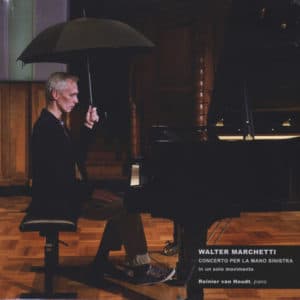
Walter MARCHETTI
“Concerto per la mano sinistra in un solo movimento”
The “Concerto for the left hand in one movement”, for piano, is the last unpublished composition of Walter Marchetti to be performed in public before the death of the author on May 12, 2015.
Performed by Reinier van Houdt, piano.
Composed in 1994, the “Concerto for the left hand” belongs to an ongoing series of works written between 1994 and 1997: “Con vista sui suoni”, “Eight or Nine Movements for String Quartet” and “La perdita del tempo” which develop from a preceding composition titled “Canonic Variations for Orchestra on Prolapsed Time From Development to Hiccup of Black Cherry Jam”. In these works Marchetti made a systematic and assertive return to conventional music notation, even while not excluding performative and installative practice and the use of pre-recorded “concrète” sounds which from the 60s had been his privileged field-of-action. A modality shared principally within the exquisitely iconoclast and desacratory activities of the ZAJ group.
What was particularly interesting to Marchetti in this recourse to musical writing is weakening the meaning of the rigid normative apparatus of a musical score with the purpose of annihilating the factual potential of his system of prescriptions.
The title alone is used to hide a paradox where the notes to the performer intervene to subvert the following paradigm: “The pianist is obliged to hold a black umbrella opened over his head in his left hand during the whole performance of this concerto”. From here the performer is confronted with two conceptually convergent possibilities in de-potentializing the apparatus of signs in the score: the restrictive imposition of the paradox where the music couldn’t manifest itself in case of respecting to the letter the enunciation which lead to the impossibility of the music’s ‘existence’ (i.e., the obligation of holding an open black umbrella in the same hand) or rather, transgressing this encumbrance, the implicit possibility of playing the score with the right hand and, definitively, the condition of the music subjected to its own manifestation to no longer be able to coincide with its own realization: “a magic made free from the lie of being truth”.
Limited to 300 copies.
CD in digipak sleeve with a full-colour booklet including photos as well as liner notes by Gabriele Bonomo.
Performed by Reinier van Houdt, piano.
Composed in 1994, the “Concerto for the left hand” belongs to an ongoing series of works written between 1994 and 1997: “Con vista sui suoni”, “Eight or Nine Movements for String Quartet” and “La perdita del tempo” which develop from a preceding composition titled “Canonic Variations for Orchestra on Prolapsed Time From Development to Hiccup of Black Cherry Jam”. In these works Marchetti made a systematic and assertive return to conventional music notation, even while not excluding performative and installative practice and the use of pre-recorded “concrète” sounds which from the 60s had been his privileged field-of-action. A modality shared principally within the exquisitely iconoclast and desacratory activities of the ZAJ group.
What was particularly interesting to Marchetti in this recourse to musical writing is weakening the meaning of the rigid normative apparatus of a musical score with the purpose of annihilating the factual potential of his system of prescriptions.
The title alone is used to hide a paradox where the notes to the performer intervene to subvert the following paradigm: “The pianist is obliged to hold a black umbrella opened over his head in his left hand during the whole performance of this concerto”. From here the performer is confronted with two conceptually convergent possibilities in de-potentializing the apparatus of signs in the score: the restrictive imposition of the paradox where the music couldn’t manifest itself in case of respecting to the letter the enunciation which lead to the impossibility of the music’s ‘existence’ (i.e., the obligation of holding an open black umbrella in the same hand) or rather, transgressing this encumbrance, the implicit possibility of playing the score with the right hand and, definitively, the condition of the music subjected to its own manifestation to no longer be able to coincide with its own realization: “a magic made free from the lie of being truth”.
Limited to 300 copies.
CD in digipak sleeve with a full-colour booklet including photos as well as liner notes by Gabriele Bonomo.
15,00€
Out of stock
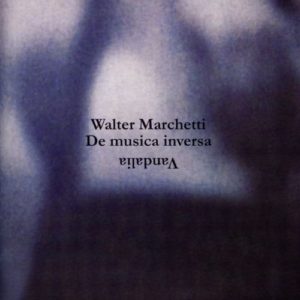
CD
Walter MARCHETTI
“Vandalia”
“alga marghen very proudly presents the only authorized reissue of all Walter Marchetti original recordings previously released by Cramps Records. With “Vandalia” Walter Marchetti is focusing his concrete and radical themes. Also including an homage to John Cage. Action Music! “Vandalia”, includes “Perpetuum mobile” (1981), “Song for John Cage” (1985) and “Le secche del delirio” (1989). The 8 page booklet presents the photo of the “Perpetuum mobile” performance at Musicalia in 1981, the score of “Song for John Cage”, the photos of two “Musica da camera” installations, as well as the reproduction of the original “Vandalia” CD layout. All texts are published both in English and Italian. First included in an LP sized 4CD box set together with other 3 CDs titled “La caccia”, “In terram utopicam” and “Natura morta”, plus the new book by Walter Marchetti titled “De musica inversa”, an instruction manual of both theory and practice for the proper and improper use of music, this CD is also available now, separately from the complete box set, in a very limited number of copies.” label info
15,00€
Out of stock
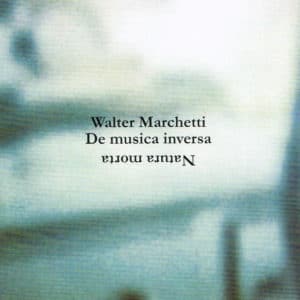
CD
Walter MARCHETTI
“Natura morta”
“alga marghen very proudly presents the only authorized reissue of all Walter Marchetti original recordings previously released by Cramps Records. “A very simple sequence of piano accidents, according to Robert Ashley the one of the most beautiful piano music ever recorded. “Natura Morta”, includes the piece with the same title from 1980. The 8 page booklet reproduces original photos of the performance at Milanopoesia in 1988, as well as the text titled “In my music”. All texts are published both in English and Italian.
First included in an LP sized 4CD box set together with other 3 CDs titled “La caccia”, “In terram utopicam” and “Vandalia”, plus the new book by Walter Marchetti titled “De musica inversa”, an instruction manual of both theory and practice for the proper and improper use of music, this CD is also available now, separately from the complete box set, in a very limited number of copies.” label info
First included in an LP sized 4CD box set together with other 3 CDs titled “La caccia”, “In terram utopicam” and “Vandalia”, plus the new book by Walter Marchetti titled “De musica inversa”, an instruction manual of both theory and practice for the proper and improper use of music, this CD is also available now, separately from the complete box set, in a very limited number of copies.” label info
15,00€
Out of stock
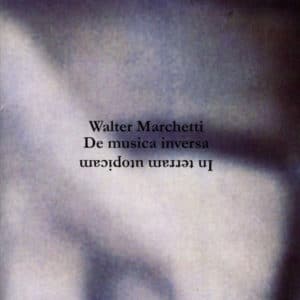
CD
Walter MARCHETTI
“In terram utopicam”
“alga marghen very proudly presents the only authorized reissue of all Walter Marchetti original recordings previously released by Cramps Records. Walter Marchetti is one of the most original and controversial pre-Fluxus authors. In this work he frees all of his sophisticated poeticism. “In terram utopican”, includes “J’aimerais jouer avec un piano qui aurait une grosse queue” (1974/75) and “Per la sete dell’orecchio” (1981). The 16 page booklet presents the original score of “J’aimerais jouer”, photos of the performances in Milano and at the Venice Biennale, and the reproduction of the original “In terram utopicam” LP layout. All texts are published both in English and Italian. First included in an LP sized 4CD box set together with other 3 CDs titled “La caccia”, “Natura morta” and “Vandalia”, plus the new book by Walter Marchetti titled “De musica inversa”, an instruction manual of both theory and practice for the proper and improper use of music, this CD is also available now, separately from the complete box set, in a very limited number of copies.” label info
15,00€
Out of stock
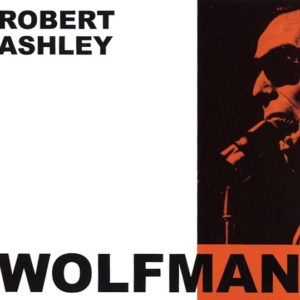
CD
Robert ASHLEY
“The wolfman”
New remastered CD edition of Robert Ashley “The Wolfman”. This edition introduces us to the most extreme experimental side of the famous American composer.
The program starts with “The Fox” (1957), the first electronic music work by Robert Ashley which already displays the future electronic music theatre style. Dark atmospheres and primitive tape collage techniques recorded at home, mixing the electronic tape and the voice in a single ’live’ pass. The title track, ’The Wolfman’, was composed in early 1964 and first performed on Charlotte Moorman’s festival of the avant-garde in New York in the fall of the same year, gaining considerable reputation as a threat to the listener’s health. For the occasion instigated by Feldman, Robert Ashley composed a piece of tape music, “The Wolfman Tape”, to be played along with the vocal performance of “The Wolfman”. The idea of a tape composition, which is to come out of the same loudspeakers as the voice and the feedback (the main sound source for this composition), is to fill-in the ongoing performance sound and to transform the performance into an elaborate version of the ’drone’ under the influence of electronics. The choice of what sounds should be on the tape is determined by the need to have the whole range of frequencies brought into the feedback, but to give those sounds a short duration-in other words, a blizzard of very short sounds across the whole frequency range-so that the illusion of the sounds coming from all parts of the room is preserved. For the performance of ’The Wolfman’ recorded here, produced at the University of California at Davis, Robert Ashley used an earlier (1960) tape composition entitled ’The 4th of July’. That composition changes gradually from a parabolic-microphone documentation of a backyard party into a layering of tape loops and tape-head feedback. ’The Wolfman Tape’ (1964) is, as descibed above, a tape composition made for a short performance of ’The Wolfman’. It uses tape-speed manipulation and mixes of many layers of ’found’ sounds, both from AM radio and from recordings made using different kinds of microphones. ’The Bottleman’ was composed in 1960 as music for an experimental film by George Manupelli. The 40 minutes long version preseted here involves contact microphones on a surface that holds a loudspeaker some six feet away. The loudspeaker is broadcasting open-circuit ’hum’ (at the American standard of approximately 60 hertz). That pitch is raised slightly through tape manipulation and the result is mixed with vocal sounds and other ’found’ sounds played back at various tape speeds. All compositions previously unreleased. The digipak CD comes with a 12 pages booklet including liner notes written by the composer and the complete score of ’The Wolfman’, first issued in Source magazine."
The program starts with “The Fox” (1957), the first electronic music work by Robert Ashley which already displays the future electronic music theatre style. Dark atmospheres and primitive tape collage techniques recorded at home, mixing the electronic tape and the voice in a single ’live’ pass. The title track, ’The Wolfman’, was composed in early 1964 and first performed on Charlotte Moorman’s festival of the avant-garde in New York in the fall of the same year, gaining considerable reputation as a threat to the listener’s health. For the occasion instigated by Feldman, Robert Ashley composed a piece of tape music, “The Wolfman Tape”, to be played along with the vocal performance of “The Wolfman”. The idea of a tape composition, which is to come out of the same loudspeakers as the voice and the feedback (the main sound source for this composition), is to fill-in the ongoing performance sound and to transform the performance into an elaborate version of the ’drone’ under the influence of electronics. The choice of what sounds should be on the tape is determined by the need to have the whole range of frequencies brought into the feedback, but to give those sounds a short duration-in other words, a blizzard of very short sounds across the whole frequency range-so that the illusion of the sounds coming from all parts of the room is preserved. For the performance of ’The Wolfman’ recorded here, produced at the University of California at Davis, Robert Ashley used an earlier (1960) tape composition entitled ’The 4th of July’. That composition changes gradually from a parabolic-microphone documentation of a backyard party into a layering of tape loops and tape-head feedback. ’The Wolfman Tape’ (1964) is, as descibed above, a tape composition made for a short performance of ’The Wolfman’. It uses tape-speed manipulation and mixes of many layers of ’found’ sounds, both from AM radio and from recordings made using different kinds of microphones. ’The Bottleman’ was composed in 1960 as music for an experimental film by George Manupelli. The 40 minutes long version preseted here involves contact microphones on a surface that holds a loudspeaker some six feet away. The loudspeaker is broadcasting open-circuit ’hum’ (at the American standard of approximately 60 hertz). That pitch is raised slightly through tape manipulation and the result is mixed with vocal sounds and other ’found’ sounds played back at various tape speeds. All compositions previously unreleased. The digipak CD comes with a 12 pages booklet including liner notes written by the composer and the complete score of ’The Wolfman’, first issued in Source magazine."
15,00€
Out of stock

CD
Philip CORNER
“More from the Judson years Vol. 2”
Yet not to forget that extraordinary place where so much of the new and exciting performances at that most interesting time in New York, took place. There was a Theater there; and a place for the first Happenings. An Art Gallery... and later the famous Judson Dance Theater.
There was Philip Corner first performance. The concert was in early 1962, January 2nd, to be exact. Handwritten change on typescrpt: Yoko Ono’s studio, changed at the last moment to Judson Church. A lot of players; and a lot of pieces. Some of my old friends, like Toshi Ichiyanagi or Richard Maxfield. And a lot of new names from California, Dick Higgins and Alison Knowles, the connection between the old New York and this new scene.
The creation of the Dance Theater: Philip Corner involvement with it from the beginning. (that participation documented on Alga Maghen cd "On tape, from the Judson Years", as most of Corner electronic music was made for dancers associated to the Judson).
Excerpts from the liner notes of Volume Two, written by Philip Corner:
"Everything Max Has" (1964), Max Neuhaus solo, recorded at the ONCE Festival, 1965. "A performance of Max’s taking down all of his stuff; tons of equipment filling entire stages".
"Big Trombone" (1963), Jim Fulkerson improvisation over tape collage. "Over an electronic reworking of the raw material presented by a rock band, absorbing its rhythmic vigour without falling into its banality, the trombone indulges in an orgy of uninhibited outbursts".
"Homage to Revere" (1962) for ensemble of copper-bottom kitchen utensils. "How not to use, for other than cooking, that great wedding gift of copper bottom pots, casseroles, skillets, and their covers... all sounding so good as if made for music".
"Punkt" (1961) for ensemble of staccato sounds. "Since the critics were calling us the plink plunk school, I contributed a composition favoring only those punkts for centuries having defined and inhibited Western music".
"Passionate Expanse of the Law" (1959) for ensemble, recorded at the Composers’ Forum, NY, 1972. Full lenght version.
"Expressions in Parallel" (1958) for ensemble. "From my earlies compositions I have been more enticed by an opening out towards greater possibilities, than in cheap and arbitrary limits of stylistic unity. Nevertheless, the mix here of expressively implicative phrases in no way destroys inner coherence".
Digipack first press of 1000 copies, including a 12 pages booklet with liner notes, scores and original documentation.
There was Philip Corner first performance. The concert was in early 1962, January 2nd, to be exact. Handwritten change on typescrpt: Yoko Ono’s studio, changed at the last moment to Judson Church. A lot of players; and a lot of pieces. Some of my old friends, like Toshi Ichiyanagi or Richard Maxfield. And a lot of new names from California, Dick Higgins and Alison Knowles, the connection between the old New York and this new scene.
The creation of the Dance Theater: Philip Corner involvement with it from the beginning. (that participation documented on Alga Maghen cd "On tape, from the Judson Years", as most of Corner electronic music was made for dancers associated to the Judson).
Excerpts from the liner notes of Volume Two, written by Philip Corner:
"Everything Max Has" (1964), Max Neuhaus solo, recorded at the ONCE Festival, 1965. "A performance of Max’s taking down all of his stuff; tons of equipment filling entire stages".
"Big Trombone" (1963), Jim Fulkerson improvisation over tape collage. "Over an electronic reworking of the raw material presented by a rock band, absorbing its rhythmic vigour without falling into its banality, the trombone indulges in an orgy of uninhibited outbursts".
"Homage to Revere" (1962) for ensemble of copper-bottom kitchen utensils. "How not to use, for other than cooking, that great wedding gift of copper bottom pots, casseroles, skillets, and their covers... all sounding so good as if made for music".
"Punkt" (1961) for ensemble of staccato sounds. "Since the critics were calling us the plink plunk school, I contributed a composition favoring only those punkts for centuries having defined and inhibited Western music".
"Passionate Expanse of the Law" (1959) for ensemble, recorded at the Composers’ Forum, NY, 1972. Full lenght version.
"Expressions in Parallel" (1958) for ensemble. "From my earlies compositions I have been more enticed by an opening out towards greater possibilities, than in cheap and arbitrary limits of stylistic unity. Nevertheless, the mix here of expressively implicative phrases in no way destroys inner coherence".
Digipack first press of 1000 copies, including a 12 pages booklet with liner notes, scores and original documentation.
15,00€
Out of stock

CD
Philip CORNER
“More from the Judson years Vol. 1”
Yet not to forget that extraordinary place where so much of the new and exciting performances at that most interesting time in New York, took place. There was a Theater there; and a place for the first Happenings. An Art Gallery... and later the famous Judson Dance Theater.
There was Philip Corner first performance. The concert was in early 1962, January 2nd, to be exact. Handwritten change on typescrpt: Yoko Ono’s studio, changed at the last moment to Judson Church. A lot of players; and a lot of pieces. Some of my old friends, like Toshi Ichiyanagi or Richard Maxfield. And a lot of new names from California, Dick Higgins and Alison Knowles, the connection between the old New York and this new scene.
The creation of the Dance Theater: Philip Corner involvement with it from the beginning. (that participation documented on Alga Maghen cd "On tape, from the Judson Years", as most of Corner electronic music was made for dancers associated to the Judson).
Excerpts from the liner notes of Volume One, written by Philip Corner:
"Passionate Expanse of the Law" (1959), extract from the first NY performance, featuring Charlotte Moorman, Philip Corner, Malcolm Goldstein. "I wrote this on an Army cot in Texas, in the Fall of 1959; a continuation of and a major development my exploration of maximum disjuction. It expresses the dynamic unity of the active and static forces in the universe, a characteristic in some degree of all my work".
"Air Effect" (1961), first performance, featuring Philip Corner, Alison Knowles, Malcolm Goldstein. "From 1961 already my music became characterised more and more by attention to the continuous quality of sound. A chamber ensemble, dedicated to directness of breathing. The rhythms and tone modulations of life-sustaining air, as projected through wind instruments bent back from an excess of art to express better a refinement more perfectly attuned to the basics of nature".
"OM emerging" (1971). "I have adopted the Hindu term OM as generic for all the variety of ways I have formulated possibilities of performances based on the prolongations of a single tone". This time it served as prelude to a contrasting form of expression, or "Lovely Music" (1962), "a piece were I let myself go all the way into an indulgence of gorgeous and voluptuous sounds".
"As pure to begin" (1963), Philip Corner, piano with preparations, objects and amplification. "The purety of keyboard sounds turn prograssively noisy, effected by the strings themselves being touched, and touched by objects which are then laid on them and magnified by microphones".
"Music, reserved untill now" (1963), recorded at Judson, 1965 and featuring A-yo, David Behrman, Philip Corner, Malcolm Goldstein, Dick Higgins, Joe Jones, Alison Knowles, Jackson Mac Low, Charlotte Moorman, Nam June Paik, Chieko Shiomi. "A score for non-traditional sound sources. Rough material becomes shaped into sense. A precarious edge where beauty passed out of control".
"Composition with or without Beverly" (1962), recorded at ONCE Festival in 1963; Philip Corner, piano with prepared tape sounds. "I have here extracted the piano improvisation I put over prerecorded tape sounds already derived from piano, and very bashy Korean gongs, all in all a quite marvellous mess".
Digipack first press of 1000 copies, including a 12 pages booklet with liner notes, scores and original documentation.
There was Philip Corner first performance. The concert was in early 1962, January 2nd, to be exact. Handwritten change on typescrpt: Yoko Ono’s studio, changed at the last moment to Judson Church. A lot of players; and a lot of pieces. Some of my old friends, like Toshi Ichiyanagi or Richard Maxfield. And a lot of new names from California, Dick Higgins and Alison Knowles, the connection between the old New York and this new scene.
The creation of the Dance Theater: Philip Corner involvement with it from the beginning. (that participation documented on Alga Maghen cd "On tape, from the Judson Years", as most of Corner electronic music was made for dancers associated to the Judson).
Excerpts from the liner notes of Volume One, written by Philip Corner:
"Passionate Expanse of the Law" (1959), extract from the first NY performance, featuring Charlotte Moorman, Philip Corner, Malcolm Goldstein. "I wrote this on an Army cot in Texas, in the Fall of 1959; a continuation of and a major development my exploration of maximum disjuction. It expresses the dynamic unity of the active and static forces in the universe, a characteristic in some degree of all my work".
"Air Effect" (1961), first performance, featuring Philip Corner, Alison Knowles, Malcolm Goldstein. "From 1961 already my music became characterised more and more by attention to the continuous quality of sound. A chamber ensemble, dedicated to directness of breathing. The rhythms and tone modulations of life-sustaining air, as projected through wind instruments bent back from an excess of art to express better a refinement more perfectly attuned to the basics of nature".
"OM emerging" (1971). "I have adopted the Hindu term OM as generic for all the variety of ways I have formulated possibilities of performances based on the prolongations of a single tone". This time it served as prelude to a contrasting form of expression, or "Lovely Music" (1962), "a piece were I let myself go all the way into an indulgence of gorgeous and voluptuous sounds".
"As pure to begin" (1963), Philip Corner, piano with preparations, objects and amplification. "The purety of keyboard sounds turn prograssively noisy, effected by the strings themselves being touched, and touched by objects which are then laid on them and magnified by microphones".
"Music, reserved untill now" (1963), recorded at Judson, 1965 and featuring A-yo, David Behrman, Philip Corner, Malcolm Goldstein, Dick Higgins, Joe Jones, Alison Knowles, Jackson Mac Low, Charlotte Moorman, Nam June Paik, Chieko Shiomi. "A score for non-traditional sound sources. Rough material becomes shaped into sense. A precarious edge where beauty passed out of control".
"Composition with or without Beverly" (1962), recorded at ONCE Festival in 1963; Philip Corner, piano with prepared tape sounds. "I have here extracted the piano improvisation I put over prerecorded tape sounds already derived from piano, and very bashy Korean gongs, all in all a quite marvellous mess".
Digipack first press of 1000 copies, including a 12 pages booklet with liner notes, scores and original documentation.
15,00€
In stock
CD
Max NEUHAUS
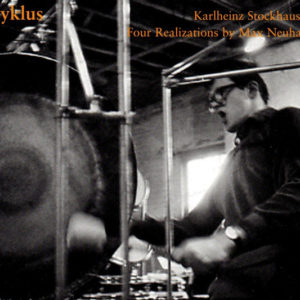
“Four realizations of Stockhausen’s Zyklus”
Zyklus was written in 1959 and is one of the first solo pieces to utilize such a large nember of percussion instruments (twenty one). When Neuhaus first started to play this piece there were only three percussionists in the world who could play it. Stockhausen’s idea was that a performer would play the piece spontaneosly, making its complex decisions n the fly. No one played it this way; it was too difficult. Everyone wrote out his own version of the score and played from it. Coming from the world of jazz Neuhaus decided he wanted to take up the challenge of playing it spontaneously. At that time percussionists generally played only one instrument at a time. Playing twenty one siultaneously was unheard of. Neuhaus quickly realized that the only way to do it, in fact, was to think of all them together as just one instrument, one multi-surfaced bank of timbre.
Neuhaus decided to travel to Europe and go to Darmstadt where Stockhausen was teaching. He wanted to talk to him about the piece. Stockhausen was interested in the idea that the twenty one instruments had to be physically formed into one instrument and that so much work had been done already. So he offered Neuhaus the big opportunity to perform Zyklus on the first American tour.
Stockhausen came over to New York to hear Neuhaus play, but he wasn’t satisfied with the improvisation version. It was too long. Neuhaus was determined to teach himself how to do it for this tour. He had another six months. He got down to seven minutes; and he was still improvising, not writing it out. He was ready to play that piece, and played it like nobody had ever heard it before.
Each of these four recorings is a document of a true solo performance, one person and two hands, with no additional live help and no overdubbing. This cd also offers four different kinds of beauty, four proofs that the latitude that Stockhausen allowed, when capitalized on by a performer with creative imagination, could validate Stockhausen as a composer and an entire aesthetec of freedom and control.
This edition includes a 12 pages booklet with original photos of both official concerts and performances for invited audinces, Max Neuhaus’ own comments on the original score and an editorial note by John Rockwell. Digipack first press of 1000 copies.
Neuhaus decided to travel to Europe and go to Darmstadt where Stockhausen was teaching. He wanted to talk to him about the piece. Stockhausen was interested in the idea that the twenty one instruments had to be physically formed into one instrument and that so much work had been done already. So he offered Neuhaus the big opportunity to perform Zyklus on the first American tour.
Stockhausen came over to New York to hear Neuhaus play, but he wasn’t satisfied with the improvisation version. It was too long. Neuhaus was determined to teach himself how to do it for this tour. He had another six months. He got down to seven minutes; and he was still improvising, not writing it out. He was ready to play that piece, and played it like nobody had ever heard it before.
Each of these four recorings is a document of a true solo performance, one person and two hands, with no additional live help and no overdubbing. This cd also offers four different kinds of beauty, four proofs that the latitude that Stockhausen allowed, when capitalized on by a performer with creative imagination, could validate Stockhausen as a composer and an entire aesthetec of freedom and control.
This edition includes a 12 pages booklet with original photos of both official concerts and performances for invited audinces, Max Neuhaus’ own comments on the original score and an editorial note by John Rockwell. Digipack first press of 1000 copies.
15,00€
Out of stock
CD
Max NEUHAUS
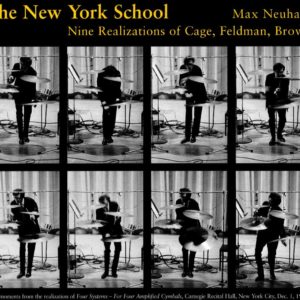
“The New York school. Nine realizations of Cage, Feldman, Brown”
The term “New York School” refers to a circle of composers in the 1950’s who orbited around John Cage: Morton Feldman, Earle Brown, Christian Wolff and David Tudor above all. Their music paralleled the music and events of the Fluxus group, and drew its name from the New York School of mostly Abstract Expressionist painters who had got their start in the 40’s: Motherwell, Pollock, de Kooning, Rothko, Kline. What brought these artists together was a faith in the liberation of the unconscious and an excitement drawn from the street energies of Manhattan.
This compact disc offers multiple realizations by the solo percussionist Max Neuhaus of scores by three key members of the New York School: Earle Brown (three realizations of "Four Systems - For Four Amplified Cymbals", recorded between 1964 and 1968), Morton Feldman (three realizations of "King of Denmark", recorded between 1965 and 1968) and John Cage (one realization ’64 and two realization ’65 of 27’10.554"). All three composers conformed to the ethos of the 60’s, not to the blend of hippie mysticism and pop commercialism that defined that decade towards its end, but to a broader notion of personal liberation. In this context Max Neuhaus was allowed to express himself, to revel in timbral color (including the use of electronics, as in the amplification of the cymbals in the Brown performances, or in the use of a FM tuner, of a self-built electronic mini-instrumet or of a tape with concrete sounds in the Cage performaces) and in giddy dialogues between notated compositional intention and performed expression. Each of the realizations on this disc is a valid response to the scores, yet each is different, almost a new piece of music.
This edition includes a 16 pages booklet with original photos and concert programs, Max Neuhaus’ own comments on the original scores, an editorial note by John Rockwell, reviews by Malcolm Goldstein and Theodore Strongin. Digipack first press of 1000 copies.
This compact disc offers multiple realizations by the solo percussionist Max Neuhaus of scores by three key members of the New York School: Earle Brown (three realizations of "Four Systems - For Four Amplified Cymbals", recorded between 1964 and 1968), Morton Feldman (three realizations of "King of Denmark", recorded between 1965 and 1968) and John Cage (one realization ’64 and two realization ’65 of 27’10.554"). All three composers conformed to the ethos of the 60’s, not to the blend of hippie mysticism and pop commercialism that defined that decade towards its end, but to a broader notion of personal liberation. In this context Max Neuhaus was allowed to express himself, to revel in timbral color (including the use of electronics, as in the amplification of the cymbals in the Brown performances, or in the use of a FM tuner, of a self-built electronic mini-instrumet or of a tape with concrete sounds in the Cage performaces) and in giddy dialogues between notated compositional intention and performed expression. Each of the realizations on this disc is a valid response to the scores, yet each is different, almost a new piece of music.
This edition includes a 16 pages booklet with original photos and concert programs, Max Neuhaus’ own comments on the original scores, an editorial note by John Rockwell, reviews by Malcolm Goldstein and Theodore Strongin. Digipack first press of 1000 copies.
15,00€
Out of stock

CD
Luc FERRARI
“Éphémère I & II”
“Presented here for the first time, "Ephemere I & II" (for tape, or to be played with various instruments) are two previously unpublished masterpieces which represent for several reasons a very specific moment in the creative life and catalogue of Luc Ferrari. Even if Luc Ferrari’s perfect skill in creating some of the most beautiful sonic works ever is now well known to the large audience appreciating his music, the undetermined character marking the two work present here for is quite surprising. Luc Ferrari was tempted in the mid-1970s by the idea of leaving the final realization of these pieces open to the performers intervention (a perspective he decided not to develop in future researches). "Exercises d’Improvisation", a score conceived in 1977 and unreleased for almost 35 years (first recorded this year by the GOL collective with Brunhild Meyer-Ferrari for an LP soon to be issued on PLANAM), directly comes from the two works presented here. "Ephemere I" (or "L’ordinateur ça sert à quoin?" i.e. "What’s the use of computers") is a 27 minutes piece for tape only created in 1974, conceived as a kind of electronic drone superimposed by fragments of multi-language whispered voices that creates the thrilling effect of a "sea-like" continuum. "Ephemere II" (or "Lyon 75" after the only recorded realization) is a 51 minutes tape piece with guitar improvisation. The electronic repetitive structure reminds some of the most radical works of American composer Terry Riley, while the guitar sounds, first resulting as live manipulated pointillistic impulses, develop into a blues sonority superimposing the tape drone and creating a heavy psychedelic atmosphere of the most sublime kind. The end of this long suite lead us back into more abstract and live-electronic sonorities. This very intense work can be placed in a context between scored music and totally improvised music. First press limited to 500 copies in tri-folded digipack sleeve. Please note: these 2 previously unpublished pieces revealing a hidden part of Luc Ferrari poetics are not included in the INA 10CD boxset. Only available on this CD edition.” label info
15,00€
Out of stock
CD
Jacques BERROCAL
“Catalogue”
“Catalogue released in 1979 in a limited edition on his own d’avantage label, catalogue, with its overt theatricality is every bit as wild as the previous paralleles. not really jazz, not rock, having nothing to do with contemporary music either, catalogue it’s a kind of sonic postcard which features not the group of the same name but instead numerous Berrocal associates including Potage (co-founder of the d’avantage label in 1976), Parle, Ferlet, Pauvros and recording engineer Daniel Deshays, plus many musicians from the french underground collective scene of the 1970s. first compact disc edition with the integral documentation. Graphics reproducing the special layout of the original lp record, with photo collages by Berrocal. Digipak first edition limited to 1000 copies.”
15,00€
In stock
CD
Jacques BERROCAL
“Parallèles”
“Jacques Berrocal has been very active since the beginning of the 1970s. No one in France could mix jazz, improvisation, rock’n’roll, punk, no wave, spoken words and industrial music like him. He also had a central position in the creation of d’Avantage, a collective record label that issued some of the most particular sessions of the mid-late Seventies. At the same time he was working on never ending sessions for records that were never issued. Jac and his band were the Apostles of the non-urgency, enjoying recording in unusual situations, with no rules, improvising on undefined structures or using non-musical material mixed with ethnic instrumental solos. In 1976 d’Avantage issued a wonderful record LP titled Parallèles featuring, among the others, Bernard Vitet, Roger Ferlet, Pierre Bastien, Michel Potage, Daniel Deshays, with the intervention of Vince Taylor, the dark diamond of rock’n’roll who inspired David Bowie’s Ziggy Stardust. Just a couple of years later Berrocal collaborated with Steven Stapleton to create the first Nurse with Would record LP. Parallèles features very different styles; acoustic solo and duo for trombone and cornet as well as a large ensemble 25 minutes long piece dedicated to the futurist Russolo (again, two years later, Mr.Stapleton dedicated his first NWW record to the same italian artist). Also to mention are ’Post-Card’, recorded in a Pigsty in 1976, and the legendary ’Rock’n’roll Station’, a mini-concert for voice (Vince Taylor), double bass (Roger Ferlet) and bicycle (Jac Berrocal). The remastered CD also includes five previously unreleased tracks that were actually left out of the original record: ’Villa Povera Naturale’ (1972) is a short piece for pocket trumpet and various concrete elements; ’Occupè’ by Michel Potage is an excerpt taken from an LP that d’Avantage never issued; ’Shorten’ and ’Lisylis Pavillon’ are the first experiments using electronics and ’Cryptea IV’, taken from the sessions of the early Futura LP. Thirty years later Jacques Berrocal is still there, where nothing is waiting for him, totally outside the rules, out of fashion thus indémodable. A digipack CD edition including a folded insert with very nice original photos and scores.”
15,00€
Out of stock
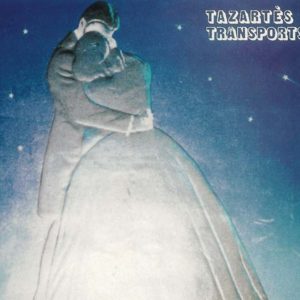
CD
Ghédalia TAZARTÈS
“Transports”
New remastered version ! New bonus tracks !
New remastered CD edition of “Tazartès’ Transports”, Ghédalia Tazartès second LP, presented here with new bonus tracks. Also included are “Assassins 1 to 4” (previously issued as “Les danseurs de la pluie” miniCD), as well as “Elie” featuring Ghédalia in duo with his daughter (previously issued on “Tazartès’ Transports” 1997 first CD edition).
“Tazartès' Transports” is the incredible second album by autodidact and outsider composer Tazartès. Originally released on vinyl in 1980, it probably represents the most original example of the artist's poetical and personal approach to sound organization. The tracks for “Tazartès' Transports” were recorded in 1977 at Ghédalia’s own studio in Paris, strafing stream-of-conscious between rippling electro rhythms to outer-national singing styles, collaged field recordings and musique concrete, to chants, tape loops and exotic atmospheres with a perpetual sense of drift and magical imagination. We're spellbound from the first to last, through the deeply evocative peal of church bells and swirling synthetic textures in track 2, via humid sci-fi scenes and alien avian chatter on track 5 and the lost zones of the closing stages.
Also included on this CD are four “Assassins” tracks previously issued as “Les danseurs de la pluie”. The first two tracks were recorded around the “Eclipse totale” sessions in 1977 and consist of banking guitar feedback, unhinged hollers, and an unsettling piece of children's screams looped against droning synth tones and electronic pulses. The other two were recorded in 2005. “Assassin 3” is a mystical piece of ecstatic ululations and plangent electric guitar riffs, while part 4 feels more opulent, plush synth pads set against strange, strafing distortion, rhythmic exhortations and percussions with a surreal cinematic quality. Yet again, Ghédalia provides us with some of the most compelling, weirdly life-affirming music we've heard in ages.
The disc concludes with "Elie", a charming piano piece performed in duo with the composer's young daughter.
New remastered CD edition of “Tazartès’ Transports”, Ghédalia Tazartès second LP, presented here with new bonus tracks. Also included are “Assassins 1 to 4” (previously issued as “Les danseurs de la pluie” miniCD), as well as “Elie” featuring Ghédalia in duo with his daughter (previously issued on “Tazartès’ Transports” 1997 first CD edition).
“Tazartès' Transports” is the incredible second album by autodidact and outsider composer Tazartès. Originally released on vinyl in 1980, it probably represents the most original example of the artist's poetical and personal approach to sound organization. The tracks for “Tazartès' Transports” were recorded in 1977 at Ghédalia’s own studio in Paris, strafing stream-of-conscious between rippling electro rhythms to outer-national singing styles, collaged field recordings and musique concrete, to chants, tape loops and exotic atmospheres with a perpetual sense of drift and magical imagination. We're spellbound from the first to last, through the deeply evocative peal of church bells and swirling synthetic textures in track 2, via humid sci-fi scenes and alien avian chatter on track 5 and the lost zones of the closing stages.
Also included on this CD are four “Assassins” tracks previously issued as “Les danseurs de la pluie”. The first two tracks were recorded around the “Eclipse totale” sessions in 1977 and consist of banking guitar feedback, unhinged hollers, and an unsettling piece of children's screams looped against droning synth tones and electronic pulses. The other two were recorded in 2005. “Assassin 3” is a mystical piece of ecstatic ululations and plangent electric guitar riffs, while part 4 feels more opulent, plush synth pads set against strange, strafing distortion, rhythmic exhortations and percussions with a surreal cinematic quality. Yet again, Ghédalia provides us with some of the most compelling, weirdly life-affirming music we've heard in ages.
The disc concludes with "Elie", a charming piano piece performed in duo with the composer's young daughter.
15,00€
Out of stock
CD
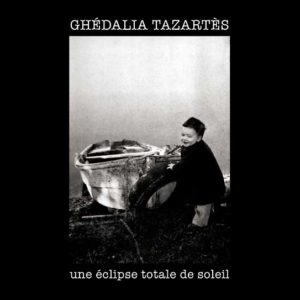
Ghédalia TAZARTÈS
“Une éclipse totale de soleil”
“The first record released by Ghédalia Tazartès in 1979. Far away from contemporary music intellectualisms or from synthetical noise purists, this was certainly one of the most original and creative records of the 70s featuring a new form of musical expression... the value of this work was underestimated and only a few people had a chance to listen to its beautiful music. Now, due to the new growing interest, Alga Marghen has taken the decision to reprint all Tazartes records, starting with his first work. Originally conceived in two parts, Une Eclipse... has been remastered and is now integrated by a 25 minute new piece (’Part III’), composed expressly for this CD”.
15,00€
Out of stock

CD
Ghédalia TAZARTÈS
“Tazartès”
New catalogue number ! New remastered version ! New bonus tracks !
New remastered CD edition of “Tazartès”, Ghédalia Tazartès forth LP, presented here in its integral original length. Also included is the first CD edition of “Whatever Works Singing Wild My Rock Ghédalia” (previously issued as side B of “Granny Awards” LP), created in the early ‘80s in his anhydridic Paris.
Immersive, transporting and deeply arresting music from the revered autodidact and audio oddity. If you’ve never encountered Ghédalia before, this is an excellent place to start, welcoming you to a whole other world of exotic, electro and acoustic sounds, composed according to a genuinely far reaching and individual agenda.
The five bonus tracks opens to a comedic, exuberant vocal set to crackly 78 backing on “Whatever” and turns blind corners into ethno-noise trance-outs on “Singing”, hyper-rhythmic experiments on "Wild" and a jarring hardcore punk-out in “My Rock Ghédalia”. The freedom of expression and taste for exotic, arabesque tonalities is a mighty revelation and we assure you we’ll be digging much deeper into Ghédalia’s catalogue at the nearest opportunity.
New remastered CD edition of “Tazartès”, Ghédalia Tazartès forth LP, presented here in its integral original length. Also included is the first CD edition of “Whatever Works Singing Wild My Rock Ghédalia” (previously issued as side B of “Granny Awards” LP), created in the early ‘80s in his anhydridic Paris.
Immersive, transporting and deeply arresting music from the revered autodidact and audio oddity. If you’ve never encountered Ghédalia before, this is an excellent place to start, welcoming you to a whole other world of exotic, electro and acoustic sounds, composed according to a genuinely far reaching and individual agenda.
The five bonus tracks opens to a comedic, exuberant vocal set to crackly 78 backing on “Whatever” and turns blind corners into ethno-noise trance-outs on “Singing”, hyper-rhythmic experiments on "Wild" and a jarring hardcore punk-out in “My Rock Ghédalia”. The freedom of expression and taste for exotic, arabesque tonalities is a mighty revelation and we assure you we’ll be digging much deeper into Ghédalia’s catalogue at the nearest opportunity.
15,00€
Out of stock
CD
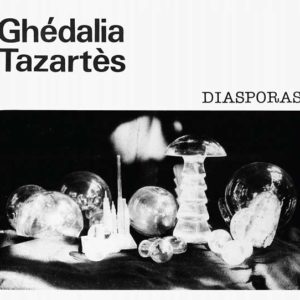
Ghédalia TAZARTÈS
“Diaspora”
New catalogue number! New remastered version! New bonus track!
New remastered CD edition of “Diasporas”, Ghédalia Tazartès first LP, presented here in its integral original length. Also included is the first CD edition of “Ferme ta gueule, Zarathustra” (previously issued as side A of “Granny Awards” LP), largely based on materials pre-dating Ghédalia debut LP “Diasporas”.
In “Ferme ta gueule, Zarathustra” Ghédalia Tazartès is freely connecting the garbled “voix d'enfant” of Raphaël Glucksmann with intoxicating, slow moving and sustained synth chords, before jump-cutting into bird calls, dissonant arabesque strings and eccentric vocalizations with a blinding sense of freedom.
Ghédalia Tazartès is a nomad. He wanders through music from chant to rhythm, from one voice to another. He paves the way for the electric and the vocal paths, between the muezzin psalmody and the screaming of a rocker. He traces vague landscapes where the mitre of the white clown the plumes of the sorcerer, the helmet of a cop and Parisian anhydride collide into polyphonic ceremonies… The greatest trips were made in the deep end of the throat: the extra-European music open the ear to Ghédalia’s intra-European exoticism. Where was music before music halls? Where was the voice before it learned how to speak? Ghédalia is the orchestra and a pop group all in one person: the self is multitude and others. The author and his doubles work without a net, freely connecting the sounds, the rhythms, his voice, his voices. The permanent metamorphosis is a principle of composition, it escapes control, refuses classification. To hell with the technocrats of noise and the purists of synthetic culture. All art like all true mythology use a double clavier, playing nature and culture, feeling and the distance of the flesh, death. Off limits!
New remastered CD edition of “Diasporas”, Ghédalia Tazartès first LP, presented here in its integral original length. Also included is the first CD edition of “Ferme ta gueule, Zarathustra” (previously issued as side A of “Granny Awards” LP), largely based on materials pre-dating Ghédalia debut LP “Diasporas”.
In “Ferme ta gueule, Zarathustra” Ghédalia Tazartès is freely connecting the garbled “voix d'enfant” of Raphaël Glucksmann with intoxicating, slow moving and sustained synth chords, before jump-cutting into bird calls, dissonant arabesque strings and eccentric vocalizations with a blinding sense of freedom.
Ghédalia Tazartès is a nomad. He wanders through music from chant to rhythm, from one voice to another. He paves the way for the electric and the vocal paths, between the muezzin psalmody and the screaming of a rocker. He traces vague landscapes where the mitre of the white clown the plumes of the sorcerer, the helmet of a cop and Parisian anhydride collide into polyphonic ceremonies… The greatest trips were made in the deep end of the throat: the extra-European music open the ear to Ghédalia’s intra-European exoticism. Where was music before music halls? Where was the voice before it learned how to speak? Ghédalia is the orchestra and a pop group all in one person: the self is multitude and others. The author and his doubles work without a net, freely connecting the sounds, the rhythms, his voice, his voices. The permanent metamorphosis is a principle of composition, it escapes control, refuses classification. To hell with the technocrats of noise and the purists of synthetic culture. All art like all true mythology use a double clavier, playing nature and culture, feeling and the distance of the flesh, death. Off limits!
15,00€
Out of stock
CD
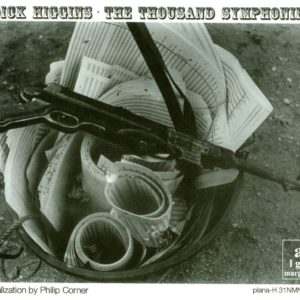
Dick HIGGINS
“The thousand symphonies”
“Alga marghen presents the first edition ever issued of Dick Higgins’ music. Fluxus founding member, in 1958 Dick Higgins studied Composition and Experimental Music with John Cage in his class at the New School for Social Research in New York together with, among others, La Monte Young, Richard Maxfield, Toshi Ichiyanaghi, George Brecht, Allan Kaprow, Al Hansen, Jackson Mac Low. In the Spring of 1968 Geoffrey Hendricks and Robert Watts told Dick Higgins of a project that was afoot at Douglass College, where both were teaching at the time, to organize a show around guns. At that time the USA police seemed to have nothing better to do than to chase down teenagers for possessing miniscule amounts of marijuana and throwing them in jail, thus ruining their lives. Dick Higgins decided it would be more worthy if one could set all the policemen in the USA to composing symphonies themselves. So he proposed that the beautiful music paper be machine gunned and that symphonies be derived from the result. Geoffrey Hendricks arranged for Captain Toby of the South Brunswick Police to do this, which duly happened with a 9mm MP40 Schmeisser submachine gun, filmed by Alison Knowles. A volunteer orchestra, conducted by Philip Corner and including Charlotte Moorman, performed nine of the resulting symphonies at Douglass College on December 9th. The Douglass concert was taped, but the only copy disappeared when the Ars Viva! Gallery in Berlin, Germany, went bankrupt in 1984. The whole situation was documented with photographs in Source Magazine in 1970. As Philip Corner, conductor of the recordings presented here, said: “Leave it to Dick Higgins to come up with the most spectacular way to generate a page of patternless notes. Once over this dramatic gesture with machine-gun bullets leaves a stack of paper full of holes. I had not thought of this before but there must have been a conscious connection to the social turmoil of the 60’s - all too unfortunately, come back around to high relevance these days”. First press limited to 500 copies with digipack sleeve, also including a 16 page booklet with full documentation presenting 2 texts by Dick Higgins from the 1960s as well as a Philip Corner testimony, original photos and original scores.”
15,00€
Out of stock
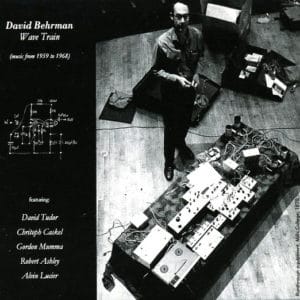
CD
David BEHRMAN
“Wave train”
New remastered CD edition of David Behrman “Wave Train” CD, featuring Sonic Arts Union. A digipak CD with David Behrman experimental music from 1959 to 1968. “The CD starts with the short piece called “Canons” a product of a 3 weeks stage in Darmstadt (summer 1959) featuring David Tudor on piano and Christoph Caskel playing percussions. ’Ricercar’ is a prepared piano piece made in 1961 and has the flexible form of the kind favoured by European composers in the early 1960s, but also reflecting the work of Cowell and Cage. “Wave Train” (1966) marked the moment when something radical happened, in which established techniques were thrown away. A powerful feedback piece live performed with Gordon Mumma. “Players with Circuits” (1966) is an exploration of raw materials, here a combination of live electronics and amplified acoustic sound. “Sounds for a Film by Bob Watts” for outdoor environment recording and homemade synthesizer, was recorded at Stony Point, the artists’ cooperative which John Cage, David Tudor, Sari Dienes and other friends had established. The last piece, “Runthrough” was made for performance by members of the sonic Arts Union: Alvin Lucier, Gordon Mumma, Robert Ashley and, of course, David Behrman; two of them working the dials and switches of homemade synthesizers, and two others distributing sound in space with homemade photocell mixers; Time Records released a different version of this piece in 1969. All others are previously unreleased. The edition includes a 12 page booklet”.
15,00€