
Out of stock

4 CD box
Joshua BONNETTA
“The Pines”
4xCDs housed in oversized digisleeves.
Hardcover slipcase.
12pp booklet with original text by Robert Macfarlane and foreward by jake moore
Sound artist and filmmaker Joshua Bonnetta wants to know what happens when a human listener exits a landscape. How might the soundscape differ? How is our presence affecting the recording? His ambitious long-form work The Pines I-IV, released on February 28, 2025 via Shelter Press and The Dim Coast, looks to interrogate some of these questions, capturing the sonic life of a single pine tree in upstate New York over the course of a year via remote recordings, edited into four hours of audio which will be released as a 4CD set with essay by acclaimed nature writer Robert Macfarlane and a foreword by curator jake moore, who suggests the forest knows when it is being listened to.
Macfarlane’s luminous essay proposes that this project offers an answer to the question of whether a tree in a forest makes any sound at all if nobody is there to hear it. Bonnetta turns that question around – entangling it in the surrounding environment, to ask what sort of noise it and other plants and animals make when there is no human listener; asking what sounds come to the fore when we step out of the frame, and in what ways a microphone might alter the way we listen in the environment.
A total of 8760 hours of audio were captured by a microphone strapped 10ft up a tree’s trunk in Tioga County, which was then reworked into a single hour of sound for each season, each of which captured events in and around the tree’s branches and immediate environment. We hear weather and wildlife; coyotes and owls; the creaking of branches under the weight of snow and ice – all act as a window into the sound of this place absent of humans; a time lapse of the audible world around the circumference of a single tree. The microphones used, and the methods of editing, are tech borrowed from conservation bioacoustics and passive acoustic monitoring, which offered Bonnetta a way to engage much more deeply than any standard field recording would.
The Pines I-IV is not bombastic sonic work, but is subtle, often contemplative and sometimes soothing, as when rushes of rain sweep over the landscape, or a flock of geese pass overhead. It is not about exotic renderings of place or or mythically veiled field recording, but about accessing a new way of listening to something familiar, by removing a human presence and extending the listening window beyond usual human capacities. Bonnetta purposefully chose a site he already knew, and which he had easy access to, but which might show itself differently when captured with durational sound recording technology. "For over a decade I taught in Ithaca" he says "and spent a lot of time exploring southern central New York, but never made any projects there. We decided to relocate to Munich a couple years back and before I left I wanted to document the sounds of this environment that I spent so much time in and had come to love. This technology afforded me the opportunity to be able to keep a record across a year and when I started to listen back I was surprised with results and began to devise a system to edit the work. There are several great bioacoustics applications which can analyze and interpret the data but I wanted to manually browse and edit the materials so that I could collect sounds outside of what the applications might traditionally identify: mainly weather and the sounds of the tree itself. The Dim Coast saw the potential in the work as an installation and publication and helped me realize that there might be a project outside of it just being a personal document."
He returned every few weeks to collect and replace storage cards and batteries, editing lengthy audio files using a combination of listening and looking at the visualized audio spectrum. He spent time listening to re-familiarize himself with the soundscape and then scanned the visual data for ‘events’ in the files, a method of analysis more typically used by scientists mapping bird and wildlife populations.
The draw of this type of recording Bonnetta locates in a childhood memory, of wolves captured on tape: “I grew up in a rural area in Ontario, and I have a very early memory of two brothers from our small school who had said they had made a recording of wolves, which were only rumoured to be as far south as we were. The previous evening they had taken their portable cassette recorder to the edge of their lane, which backed on to a large forest preserve, and claimed to have recorded wolves howling. They played it back at school the next day and I remember that the sound was primarily noise and hiss, but we were all listening intently and straining to hear something as they kept playing back the tape. Whether they were really there or this was just the collective imagination of a group of children, we started to hear wolves – or more likely coyotes. This project feels rooted in the initial wonder of that listening experience”.
45,00€
In stock

CD
Lucy RAILTON
“Blue Veil”
The first release to document the solo cello work of musician and composer Lucy Railton, the 40-minute composition Blue Veil recorded at Église du Saint-Esprit in Paris invites listeners into the realm of precision-tuned states of resonance: states made manifest through Railton’s careful traversal of her cello's most subtle acoustic characteristics as they harmonically interlock with mind’s embodied modalities of attention and imagination.
Blue Veil arises out of, is sustained in and finally dissolves back into Railton’s momentary presence with her intimate connection to the cello, a way of hearing that allows for a deeper engagement with harmonic resonance, one that opens a space for immediate encounters of mind and sound.
Railton’s exploratory practice of harmonic perception emerges from a focus on the physical qualities of intervallic and chordal sounds, their textural qualities, degrees of friction, and inner pulsations. Composing in the moment guided by resonances within the cello’s body, her own, and their shared vibrational space, Railton moves through Blue Veil by giving sounds what they ask for: sounds of pure texture manifesting as a move through temporal transparency, sounds of rough texture marking regions of dimensionally dense space.
Railton’s creative and highly refined use of just intonation harmony deforms sound's inner movements in ways that suggest a mode of listening that actively supplies imagery of sounds implied or completely absent rather than merely savouring those fully present. This active mode of “listening-with”, playfully and semi-metaphorically referred to by Railton as “sing-along music”, allows listening to reflexively participate in the music’s movement as it gradually passes through richly saturated domains of harmonic imagination. And just as the precision-tuned tones of Blue Veil lose their individuality when fusing multifaceted uniformity, listening’s structures of reference and recognition dissolve into nameless waves of intensity, continuously unfolding themselves upon and merging with the listener.
Blue Veil is the result of a deep exploration of the inner worlds of tuning, an undertaking in turn informed by and emerging out of Railton’s realisations of the music of Catherine Lamb and Ellen Arkbro, her collaborative work with Kali Malone and Stephen O’Malley as well as her interpretive practice in performing the work of Maryanne Amacher, Morton Feldman and others.
17,50€
Out of stock

CD
FANATIC (FNTC)
“Europe in Flames”
The word Fanatic comes from the Latin fanum, temple. A fanatic is someone possessed, by God or the Devil. From 1985 until 1989 Willem de Ridder, Hessel Veldman, Cora Emens and Nick Nicole were the members of post-art ensemble FANATIC (or later FNTC). Willem and Hessel already worked together in the late 70s and early 80s on various radio shows and performed with musicians like Alvin Curran, Francis Marie Uitti and Jon Rose. Together with Cora and Nick they started FANATIC to focus on field recordings, intimate happenings and theatrical storytelling.
As a multi-media project FANATIC was not just obsessed by sound but dedicated to live rituals, producing videos, cassettes and radio plays like Europe in Flames, the pinnacle of this album. It’s a multi-layered piece for which the foundation was recorded by Willem on a boat trip to England. One of his spontaneous field recordings that sounded more like an intricate studio production. In a house near the North Sea on a windswept Autumn evening in 1985 percussion, voices, synthesizer and sound effects were added and when their friend and collaborator William Levy arrived, he listened to the freshly recorded wall of sound, took a short poem from 1978 out of his pocket and started reciting. This final layer of sound complemented the audio perfectly and the result was published on the Neuropa cassette in 1986 and is still chillingly relevant in 2025.
Their haunting, meditative and immersive audio pieces and challenging performances evoke comparisons with groups like COUM Transmissions and Throbbing Gristle. Bleak and raw, but also sensual and poetic. FANATIC released 3 cassettes in the 80s with more material to be discovered in the EXART archives. In addition to the classic Europe in Flames, we dug up 2 unreleased pieces from 87 for a long overdue conspectus.
200 copies. CD wallet with 8 page booklet including photos from a scrapbook, found in Willem de Ridder’s archive.
14,50€
In stock

CD
The DEAD MAURIACS
“L’énigme Du Parc”
"The mechanical gate, a rattling turnstile, opened onto the park, enclosed by symbolic gates just under a metre high, lined with hedges. Inside the park, sounds underwent a strange metamorphosis: they seemed muffled, as if unable to penetrate, as if repelled by the gates, the trees and the groves.
Outside, fireworks bounced between the buildings. The short duration of the reverberation gave the sound a tremor that derealised it, a short, stuttering vibration that isolated it and gave it a cold splendour.
The clamour of a parade showed the same alterations; snatches of voices emerged, a syllable, a word. The horizon of sound spiked, bristled, underwent a choppy friction that the wind shaped into jagged, torn jerks."
Music, daylife sounds & artworks by Olivier Prieur.
13,00€
In stock

7 CD box
Meredith YOUNG-SOWERS
“Agartha: Personal Meditation Music”
Agartha, Personal Meditation Music is a 7CD box set, originally released on cassette in 1986, at the height of New Age, as an aid for meditation and alignment. Bringing to mind 20th century composers like Eliane Radigue, La Monte Young or even Brian Eno's Shutov Assembly, the time-stopping, enveloping, electronic music contained in this series sounds eerily modern, mysterious and moving. Characterized by deep analog drones, rising overtones, floating frequencies surfing on sine-waves and intervals with mystic modulation, this is truly moving, vibrational music.
In Agartha, the individual notes of each Harmonic Triad proceed in a fashion that is neither improvisational nor chance-based, nor is it generative. Instead the music flows outward as if being transmitted— or channeled — from a place outside human consciousness. There is a profound sense of cosmic depth expanding ever outward as the music fills the listener with waves of emotion, and a palpable somatic response is felt, although there are subtle differences with each unique Triad.
Each disc is individually packaged in original replica sleeves and housed in a heavy duty cardboard clamshell box. Digitized and remastered by Jessica Thompson. Liner notes include extensive instructions for use from the original text and an essay by library music scholar David Hollander.
The original edition of Agartha, Personal Meditation Music, featured one 30 minute track per tape repeated on both sides. Subsequent editions had unique Side B tracks on all but two of the 7 volumes. We have included all tracks in this boxed set.
48,00€
In stock

CD
NURSE WITH WOUND – SCANNER
“Contrary Motion”
A collaboration between Steven Stapleton (Nurse with Wound) and Robin Rimbaud (Scanner), exploring the darkest regions of the airwaves and live electronics.
It's an ominous trip into radio waves, processed voices, electronics, squeaky guitars and a mysterious labyrinth of echoing sonic disturbances.
15,50€
Out of stock

CD
NURSE WITH WOUND
“The Grave And Beautiful Name Of Sadness”
Featuring two archive mixes of the original 1984 recording. A 2007 epic variation recorded for possible inclusion in Peter Strickland's film 'Katalin Varga' and a unique 'psychedelic' version from 2012 which until now has never been heard.
14,00€
In stock

CD
Paul BRADLEY
“Vault”
ICR is delighted to release a 'new' CD from Paul, who has been quiet of late. And has been sorely missed. The origin of the music is detailed below, but suffice to say it's an excellent collection of what some might describe as 'cosmic'. That is to say that it's quite still, peaceful, droney but melodic, music to disappear into. Comes in a very nicely designed (by Jonathan Coleclough) 6-panel Ecopack. Highly recommended.
As the name suggests, 'Vault' is a collection of tracks that were recently discovered after languishing unheard for over a decade. Exactly when and why these were made is unknown, as unfortunately much of the details have been lost to time, however 'Anon' seems to be an edited version of a live performance that was part of Ciclo Herzios at La Clinica Mundana, Valencia in February of 2011 and 'Europa' might have been a rehearsal; so my best guess is that these tracks are from that time period as they all share an aesthetic.
Listening to the music with fresh ears I felt they should have an audience and the time seemed right to give them a little love.
The recordings were finessed a little and then sent to Colin Potter to get his input; he liked them and offered to release them. They were then polished up, mastered and well... here we are... a snapshot in time.
11,50€
In stock
CD
Jérôme NOETINGER
“Intensior corda sonus”
"In 2019, I was invited by Dylan Nyoukis and Karen Constance to play at the Colour out of Space festival in Brighton. A unique moment of incongruous music in a friendly international gathering of freaks of all kinds. Unforgettable. I played a solo on Revox B77 and then Dylan asked me to do a CD for his Chocolate Monk label. After some thought, I decided to offer three compositions rather than try to reproduce the past moment of an improvised concert. I'm talking here about the composition of fixed sounds (to quote Michel Chion) or musique concrète to use Pierre Schaeffer's original terminology. I think I've spent more time in my life improvising than composing, and no one has ever reproached me for it.
The Latin title refers to the equivalence between the tension of a string and the elevation of the sound, but also to the link between the intensity of the lived and of the musical. Will the intensity of the former influence that of the latter? But it's also the tension on the trigger and the intensity of the reaction to it. The tension-release form is one of the most classic in musique concrète, and even more so since the advent of computer-assisted music. In Les objets inaudibles [2018], I decided to politicise this form, to create a struggle between these elements. In Erase my head [2019], it is the accumulation, erasure and diversion of random fragments that is at play. Then in Eloge des ruines [2020], it's a return to the founding gesture of musique concrète, that of sampling existing material, in this case records from my personal record library.
This CD is dedicated to the memory of Kiko C. Esseiva."
- Jérôme Noetinger
“Les objets inaudibles”
Commissioned by INA-GRM, first played on 19th January 2019. Musique concrète in four parts composed in 2018 in the composer’s studio.
Starting with, a GRM commission received on 25th June 2018, and the urgent need to find a title. Ending with, a discursive journey through the art of concealment, with the discovery of unexpected voices in some of Pierre Schaeffer's Études aux Objets read at reduced speed, the use of Matthieu Saladin's application La Capture de l'Inaudible, an app which keeps only the frequencies removed by MP3 encoding (i.e. the inaudible, according to the ideology that governs this technology), the increase in police violence, the impact of a 357 Magnum, and not to mention the intense pleasure of destroying a piano.
“Erase my head”
A live-to-air performance originally commissioned for Radiophrenia, created in Glasgow on 19th May 2019.
30 minutes = 1 800 seconds and at the speed of 38 centimeters per second = 684 meters.
A loop of 570 cm, so that’s 15 seconds at the speed of 38 centimeters per second, i.e. a length of 2.85 meters. A mixing desk with several inputs like CD players, cassette players, radio… each played randomly. And then recording, processing, layering, erasing, hiss and tape delay on the live loop.
“Eloge des ruines”
Commissioned by Radio-France for Alla Breve by Anne Montaron. First broadcast on 30th August 2020. Musique concrète composed in the composer’s studio between January and May 2020. Dedicated to Sean Baxter (1970 - 2020).
A suite of five miniatures, each two minutes long, based on the idea of slowing down and collapsing, using sound samples taken from vinyl records, with the playback speed changed from 78 to 0 rpm, as well as accelerated playback of old magnetic tapes. The work on this material is the result of the accumulation, editing, mixing and filtering of all these materials.
Edition of 150
"Jérôme Noetinger delivers a haunting and immersive listening experience with this album, showcasing his expressive prowess with the humble Revox B77 reel-to-reel tape recorder. The album’s Latin title, which roughly translates to the sound of the heart becomes more intense, foregrounds the tensions and intensities contained on the three compositions featured on this release, blending musique concrète composition and improvisation via live tape manipulation.
It begins with “Les Objets Inaudibles”, a four-part suite that feels like a descent into a sonic abyss. Drawing from Pierre Schaeffer’s Études Aux Objets, Noetinger collages tape effects, gunshots and the violent destruction of a piano into a disquieting assemblage. Ghostly voices, filtered through an app that isolates the frequencies lost during MP3 encoding, mingle with slack piano wires and animalistic cries. Each movement ends with jarring gunshots, punctuating the chaos with a sense of finality. “Erase My Head” is a live performance from 2019, where Noetinger manipulates a tape loop in real time. Over 30 minutes, layers of sound accumulate, transform and are erased, creating a dynamic interplay of repetition and mutation. The piece shifts from violent, saturated noise to more spacious, delay-heavy textures, demonstrating Noetinger’s ability to craft effective structure from seeming randomness.
The album closes with “Eloge Des Ruines”, a suite of five two minute miniatures crafted from samples taken from vinyl records in Noetinger’s collection, often with the playback speed altered. Combined with the variable speed of the magnetic tape, these pieces revel in cacophonous jumble and temporal chaos. Across all three works, Noetinger creates evocative worlds as thought-provoking as they are sonically rich. “Les Objets Inaudibles” in particular, is a potent example of musique concrète at its most poetic and visceral."
- Leah Kardos, The Wire Magazine
16,00€
In stock

CD
Catherine Christer HENNIX
“Further Selections from the Electric Harpsichord”
Rediscovered and compiled for release shortly before her death in November 2023, Further Selections from the Electric Harpsichord presents a never-before-heard recording of composer and artist Catherine Christer Hennix’s early magnum opus. Originally debuted in 1976 at the festival Brouwer’s Lattice at Stockholm’s Moderna Museet, The Electric Harpsichord has steadily mystified fans and students of Western minimalist music for its implacable, transformative qualities, and the long-held, relative obscurity of its creator. Like the work of Hennix’s close friend La Monte Young, the piece is set in just intonation and focuses on the transcendental potentials of precise tuning, inspired by their studies with Pandit Pran Nath. Composed of bursts of oscillating, synthetic tones using a carefully retuned synthesizer and a tape-based system for feedback delay, the sounds swirl, twinkle, and appear to bend time, space, and perception. Additional, sustained chords on the sheng, most likely played by her Deontic Miracle bandmate Hans Isgren, are present at the opening of the piece and reemerge towards the end of the recording.
The release of Further Selections constitutes the most comprehensive original recording of this foundational work to date. Originally billed as The Well-Tuned Organ during its debut in Sweden, The Electric Harpsichord has developed a legendary reputation, predicated on a twenty-six minute fragment salvaged and circulated by Hennix’s friend Henry Flynt. Promoting its importance on multiple occasions, Flynt aired the work on WBAI radio, organized a pair of tape concerts at New York alternative arts spaces in 1970s, and later penned a 1998 essay which served as the liner notes to its eventual CD release in 2010. For him, this work not only represented a sterling milestone in minimal sonic aesthetics, but also spawned a new genre that he dubbed “hallucinogenic/ecstatic sound environments (HESE),” which in turn inspired his own drone-like compositions. Gradually, interest in the recording led to a spate of archival projects, public performances, and new compositions by Hennix in the 2010s, in turn drawing into focus her multifarious practice, which includes serious contributions towards mathematics, poetry, sculpture, Noh drama, philosophy, and light art.
17,00€
Out of stock

10 CD box
Florian HECKER
“Resynthese FAVN”
Resynthese FAVN is a ten-CD box set and publication presenting a new realization of Florian Hecker’s 2017 thirteen-channel installation of the same name. First exhibited at Kunsthalle Wien in the exhibition “Halluzination, Perspektive, Synthese,” and elaborating upon ideas first presented in the 2016 project FAVN, the ten works that comprise Resynthese FAVN present iterations of a synthetic timbre produced using machine-listening processes of analysis and further resynthesis —the sonification of a machine caught in the act of listening to itself. Accompanying the audio are three booklets containing three new essays offering critical and historical context for the work, developed in collaboration with the British publisher Urbanomic.
FAVN and its resynthesis point back to Stéphane Mallarmé’s 1876 poem “L’Après-Midi d’un Faun,” and its subsequent musical and choreographic interpretations by Claude Debussy and Vaslav Nijinsky. A faun, straddling reverie and reality, recounts a sensuous meeting with several nymphs. It is unclear whether the experience was an illusion; asks the faun, “Did I love a dream?” Hecker, in turn, asks listeners to examine their own sensory perceptions. What forms do our human minds make out of the algorithmic timbres and synthetic voices that unspool across the versions of Resynthese FAVN? Sound drags, ascends, chirps, warps, and growls with manic irregularity. Definite but indescribable differences emerge across the ten 53-minute tracks. Language—occasionally emerging through a synthetic voice, sourced from a libretto written by Robin Mackay—proves unstable within the hallucinatory textures set loose by Hecker’s composition. As chimeric shapes materialize and fade away, one might further ask: are we listening for the faun, or do we become faun through listening? Across the three newly published essays, Quentin Meillassoux contextualizes the character of the faun in Mallarmé’s poem; Noé Soulier assesses the embodied translation of “L’Après-Midi d’un Faun” in Nijinsky’s 1912 ballet; and Han Han and Vincent Lostanlen consider the trajectory of timbre, from the enlightenment to our computational present.
Florian Hecker is a German artist whose works across synthetic sound, installation, and performance consider sensory perception and the audience's auditory experience. He has collaborated with artists including Aphex Twin, Cerith Wyn Evans, Russell Haswell, Mark Leckey, and Yasunao Tone.
Written and produced by Florian Hecker, 2017/2024
Texture and voice analysis and resynthesis algorithms: Axel Röbel, and members of the Analysis/ Synthesis Team, IRCAM, Paris
Sound spatialization design: Alberto de Campo
Original FAVN libretto: Robin Mackay
Mastering: Rashad Becker
95,00€
Out of stock

5 CD box
Roland KAYN
“Elektroakustische Projekte & Makro”
Great news for fans of electronic music: Reiger Records Reeks is set to release a new 5-CD box set dedicated to Roland Kayn’s Cybernetic Music. The collection is based on the original recordings from the Lydia and Roland Kayn Archive, which were sensibly remastered by Jim O’Rourke,
The box set includes the tracks from legendary opuses MAKRO I, II, III, created at the Institute for Sonology, and Elektroakustische Projekte, featuring works like Cybernetic I, II, and III, which were recorded at the Studio di Fonologia in Milan, alongside Entropy PE31, Monades, and Eon. These pieces – previously available only on rare out-of-print vinyl editions – highlight both Kayn’s innovative approach to musical structures and his significant impact on the development of electronic and cybernetic compositions.
Roland Kayn poetically described Makro (1977) during an interview with Mark van de Voort: “Makro breathes in and breathes out, then it breathes in again before disappearing into the dark.” This imagery emphasizes the delicate balance and subtle transition through which the piece unfolds and eventually fades. The idea of the music “disappearing into the dark” suggests a soft, elusive conclusion, as if the sounds gradually dissolve into a space where they can no longer be heard, but still linger in some way.
This description also synthesizes the mystical and organic qualities of the piece: the music doesn’t end abruptly, but transitions smoothly into silence, like a clear picture gradually turning into shadow. Kayn’s reflection that he was never able to fully recapture this unique quality in his later works shows how Makro – a composition where sound, process, and silence merge in a single entity – was a special creature for him.
66,00€
In stock

2 CD
A HANDFUL OF DUST
“Dream Songs”
Another collaboration of Romain Perrot with Bruce Russell related projects. Liner notes are from Bruce Russell, those recordings have never been released before, those are the last ones before drummer Peter Stapleton passed away....
18,00€
Out of stock

3 CD box
Roland KAYN
“Simultan”
Die Schachtel, in collaboration with SZ Sugar, is finally able to make available in CD format (a deluxe 3CD boxed edition with a lavishly illustrated booklet) of the legendary vinyl-only edition of 2017, the first in a series named “K-Kybernetische Musik /Cybernetic Music” that documents the birth of Roland Kayn cybernetic music, remastered from the original analog master tapes.
One of the great pioneers of electronic, computer, and instrumental avant-garde music, for most of his life, the German composer Roland Kayn (1933 - 2011) remained almost entirely unknown, a founding member of the legendary ensemble, Gruppo di Improvvisazione Nuova Consonanza, heralded as a singular genius by a small number of figures like Jim O’Rourke, who is currently curating the archive of the artist.
While Kayn might be easily described as a composer of electronic, electro-acoustic, or computer music, most of his career was in fact largely dedicated to the revolutionary sculpting of an entirely new territory of sound - Cybernetic Music, a generative process of composition through programming. Simultan was among the first of the composer’s works to emerge from this process. Cybernetic Music grew from Kayn’s longstanding engagement and fascination with data processing theory, which far outweighed his interest in the work of other composers and the zeitgeists of the day - a fact which contributed to his being declared persona non grata by the avant-garde establishment, and ultimately his lasting obscurity. This territory of creativity was the composer’s attempt to allow sound to be self-self-sufficient, stripping away notions of harmony, melody and rhythm, as much as those of the composer and art, deploying complex networks of electronic devices - early computers, to follow his instructions, taking form through a system of signals and commands.
Created during the period in which Kayn was living in the Netherlands, and recorded with the assistance of electronic music legends Jaap Vink and Leo Küpper, Simultan is a work of astounding beauty – filled with a remarkable sense of humanity and touch – a strange incongruity considering the system through which it was made, doubling as an indication of the inherent power of sound which Kayn spent his life fighting to reveal. For fans of avant-garde electronic music, particularly those drawn to the work coming out of Utrecht and Groupe de recherches musicales (GRM), but who have not encountered Simultan, the work is likely to represent a towering revolution. It stands among the most striking works from the world of sound. Ranging from seductive ambiences, grinding swells of atonally and pure texture, to buried tone clusters, it does everything Kayn set forth in his ambitious project. It is an immersive image of what might be when sound organizes itself, and a metaphor for a way of being – the wonders which happen when we relinquish ego and control.
A stunning journey in sound and work of profound and intoxicating power, Simultan stands among the best of all avant-garde electronic works of its era, yet, like its composer, has never received its rightful due. Die Schachtel’s lovingly produced boxed edition, produced with a booklet with liner notes exploring the composer’s work and ideas at length, takes great strides to rectifying this sin – bringing this seminal work back into print for the first time in CD + digital edition in more than 35 years. Its reemergence has been long awaited by many and should be celebrated by all. Totally essential and not to be missed.
38,00€
In stock

CD
Asmus TIETCHENS + Alice FRESHMOUTH
“Lumières”
Asmus Tietchens is a sound artist and composer from Hamburg, Germany. He got interested in Musique Concrete by listening to a German radio programme when he was 10 years old. In 1965, at the age of 18, Asmus started experimenting with tape loops and turned them into musical collages. Soon, the use of synthesizers was added. In 1980 his debut album Nachtstücke was released, produced by Peter Baumann of Tangerine Dream. This was soon followed by a series of albums of electronic pop music for the Sky label, home of many Krautrock bands. Tietchens often uses special source materials for his compositions such as water (Seuchengebiete), human voices (Von Mund zu Mund), paper (Papier ist geduldig). He is associated with the Industrial music scene through his collaborations and releases on labels such as United Dairies, Esplendor Geometrico or Dom Records. Tietchens never studied composition, he has no academic background, everything he does is self taught or learnign by doing. Nevertheless, he was professor for sound design in Hamburg in recent years.
Alice Freshmouth is an anagram project by Tom Fleischhauer. Tom plays guitar and bass and has worked as producer, live sound engineer, booker, promoter and composer. Him and Asmus have been friends for over 40 years, they regularly meet in Hamburg, either as musicians or attending concerts. When Tom played Asmus his most recent musical compositions, the two decided that their work was not completely compatible, but shows enough similar approach to start a spontaneous collaboration. Soon afterwards first ideas were exchanged and half a year later an album was born. Both musicians think that there is equal measure of each of them to be heard on this CD.
13,00€
In stock

CD
DISTURBIO (NOETINGER, CASTELLO)
“Les Mauvaises Fréquentations”
Born April 1966, in Marseille, Jérôme Noetinger discovered experimental music under the influence of the Déficit Des Années Antérieures in Caen. He is a composer/improviser/sound artist working with electroacoustic devices. Composing sometimes musique concrete in the studio, and performing improvised music using electroacoustic devices such as: the reel to reel tape recorder Revox B77 and magnetic tape, analogue synthesizers, mixing desks, speakers, microphones, various electronic household objects and home-made electronica. Performing both solo and in ensembles, and collaborating often, and touring extensively internationally. Jerome also used to be the director of Metamkine, a non-profit organisation dedicated to the distribution of improvised and electroacoustic music, which has now been changed to Corticalart with a different personnel.
Angélica Castelló was born in Mexico City in 1972. She works as composer and sound artist. Her compositions concentrate on fragility, the dreamworld and the subconscious. Angelica performs continuously solo or in cooperations everywhere between Mexico City and Vienna. Numerous compositions for ensembles, radio works as well as installations that operate at the interface of music, performance and visual arts make up her body of work. She has several releases on labels like Interstellar records, Mikroton recordings or Monotype records.
In February 2023, Disturbio cross France and Switzerland for a series of nine concerts expressing their highly cinematic art of sound. And to spice up the tour, they invite other musician friends to join them on certain dates: Aude Romary, cello, Antoine Läng, voice and jaw harp, Mathias Forge, cello and cassettes, Natacha Muslera, voice. Four personalities, four captivating performances. The duo Disturbio lives as a constellation of samples and loops, radios and field recordings, on cassettes and tapes, with magical, diaphanous voices hidden away, not forgetting the tremors of a flute on magnetic captures.
Flute, Tapes, Electronics, Artwork – Angélica Castelló
Layout – Lisa Robotka
Mastered By – Taku Unami
Recorded By – Benjamin Ephise, Benjamin Pagier, Emmanuel Lalande
Revox, Tapes, Electronics, Recorded By, Edited By – Jérôme Noetinger
13,00€
In stock
2 CD
RLW
“C.D.”
Ralf Wehowsky is one of the most respected practitioners of radical music of our day. He was the founding member of the seminal German group P16.D4 and ran the legendary experimental label Selektion whose ground-breaking releases influenced many working in today's experimental music scene. Previous releases have seen him collaborate with such well known and diverse artists such as Merzbow, Andrew Chalk, Jim O'Rourke, Achim Wollscheid, Lionel Marchetti, Kevin Drumm, Kouhei Matsunaga and Bruce Russell.
Colonia Dignidad was the settlement of a German evangelical sect.
After being prosecuted for child abuse in Germany, the group fled to Chile in 1961. Like similar religious sects, it was characterized by the outward appearance of a unified, godly community with well-tempered cultural activities and social welfare, but inwardly and in its environment by oppression, sexual abuse, and exploitation. In the 1970s, it unquestioningly inserted itself into Pinochet's regime of terror, aiding in the imprisonment and torture of political prisoners, weapons production, etc. Since the end of the 1980s, there has been a legal reappraisal of the C.D.'s crimes in Chile. Its successor organization makes a living from tourism.
The C.D. project uses, on the one hand, a series of documentary recordings of contemporary witnesses, and on the other, a set of melodic improvisations (MIDI files), improvised in the spirit of the impressions of terror, tension, claustrophobia and fear associated with the Colonia. CD 2 (Knochenstückchen) directly reflects this atmosphere. CD 1 (Reue?) on the other hand, is characterized by the contradictory breadth of the statements found after the dissolution of the sect: Denial of atrocities to glorification of the C.D. by leaders who returned to Germany against the professed traumas of formerly abused inmates and exploited community workers.
For this purpose, the eyewitness recordings were sound-modified to a considerable extent. The MIDI files were played back with a variety of virtual instruments (piano, guitar, sax, turntable, lung machine, barrel organ, synths, etc.) in a multitude of modifications (speed, pitches, loops, harmonic and tonal variations), so that the 11 pieces from CD 1 and the 16 pieces from CD 2 each represent a closely interwoven overall composition.
17,00€
In stock
2 CD
COMPILATION
“Fluxus & Neofluxus: Keep Together (Part II)”
In April 2023, the first part of the Fluxus edition called Stolen Symphony was released. Now, in 2024, there is the second part, called Keep Together. At the center of this edition was a broken piano, acquired by the Opening Performance Orchestra for the purpose of making live and studio recordings. During this time other new works for this broken piano were written by diverse Fluxus and non-Fluxus composers. In the spring of 2022, the Opening Performance Orchestra and the broken piano participated in an event hosted by Mieko Shiomi. This was a new version of her early work Spatial Poem, documentation of which was presented at the 2022 Aichi Triennale in Tokyo. At present, the broken piano lies in the open air in Prague and is subject to gradual decay. This edition contains new and old pieces, live and studio recordings, finished pieces and scores to be performed, solos and pieces for ensemble, using classical and special instruments from 33 Fluxus artists, which have been played by ten soloists and four ensembles. There are new essays and articles from 15 writers on the theme Fluxus, as well as original photos and other documentation in the booklets. The Belgian label Sub Rosa provided technical support and a good place for the grand-scale release. The audio restauration and mastering were done by Gabriel Séverin at Laboratoire central, Brussels, and Kakaxa, 3bees, Prague. Archivio Conz in Berlin provided access to their extensive archives and Edizioni Conz provided co-production. Ursula and René Block made possible the realization of John Cage's historical composition "Mozart Mix" from the Edition Block archive. The photographic material comes from Marie Knízáková and Milan Knízák's private archive, the German photographer Wolfgang Träger, Archivio Conz's Fluxus archive, the private archives from diverse Fluxus artists and Opening Performance Orchestra's digital archive. Milan Knízák, Henning Christiansen, La Monte Young, Philip Corner, Bengt af Klintberg, George Maciunas, Takako Saito, Toshi Ichiyanagi, John Cage, Geoffrey Hendricks, Nam June Paik, Sara Miyamoto, Ken Friedman, Yoko Ono, Josef Anton Riedl, Giancarlo Cardini, Ay-O, and George Brecht.
20,00€
In stock
2 CD
Stefan PRINS
“Inhabit”
Inhabit, the second release by Stefan Prins on Sub Rosa, brings together four recent, large-scale compositions in which traditional instruments-from bass woodwind trio to electric guitar and symphonic orchestra-merge seamlessly with electronics, feedback, and field recordings. inhabit once again serves as a testament to how Prins, whose work is performed worldwide by some of the most celebrated musicians, ensembles, and orchestras, continues to stay attuned to the pulse of contemporary music. His compositions offer a refreshing, gripping, and consistently surprising exploration of the increasingly porous boundaries between the acoustic and electronic realms. The first disc of this double album, co-produced by Deutschlandfunk Kultur, opens with "Inhibition Space #1," a piece for amplified bass woodwind trio and feedback, delivered in a masterful performance by the Berlin-based Ensemble Mosaik. This exploration of instrumentally controlled feedback is juxtaposed with an acoustic chamber orchestra in the multidimensional "inhabit_inhibit," captured during a gripping live performance by Ensemble Kollektiv Berlin, conducted by Max Murray at Ultraschall Berlin in 2023. The second disc features Prins' provocative electric guitar concerto, "under_current," performed by the formidable Yaron Deutsch on electric guitar and the dream-team of the BBC Scottish Symphony Orchestra under the baton of conductor Ilan Volkov. In this expansive sonic landscape, ranging from delicate flageolet whispers to ear-splitting outbursts-the orchestra functions as an acoustic meta-amplifier for the electric guitar, enhanced by a range of effect pedals. The album concludes with "Mesh" for five instruments, feedback, electronics, and field recordings, in which the traditional boundaries between human, technology, and nature are completely deconstructed. In their place, Prins creates a world where unexpected sonic connections emerge and dissolve, like acoustic mirages. The Belgian Nadar Ensemble, which Prins co-directs, once again demonstrates why it is such a sought-after ensemble on the international concert stage, and one of Prins' principal musical ambassadors. Additionally, this release includes an exclusive, insightful 12-page booklet on these compositions by music journalist, researcher, and novelist Joep Christenhusz. This release is a co-production with Deutschlandfunk Kultur and BBC Radio 3 and was made possible by the generous support of the Flemish Community (Flanders State of the Art), the Nadar Ensemble, Ensemble Mosaik, and Ensemble Kollektiv Berlin, along with all the musicians involved.
16,00€

14 CD box
Éliane RADIGUE
“Œuvres électroniques”
2024 repress
With a 80 pages booklet (french/english).
Tracklist
CD1
1. Chry-ptus (version 2001) 24’01
2. Geelriandre 29’57
CD2
1. Chry-ptus (version 2006) 23’10
2. Biogenesis 21’06
3. Arthesis 25’40
CD3
1. Ψ 847 (version concert) 71’08
CD4
1. Adnos I 71’28
CD5
1. Adnos II 72’44
CD6
1. Adnos III 72’40
CD7 Les Chants de Milarepa
1. Mila’s Song in the Rain 19’10
2. Song of the Path Guides 21’01
3. Elimination of Desires 17’22
4. Symbols for Yogic Experience 19’29
CD8 Les Chants de Milarepa
1. Mila’s Journey Inspired by a Dream 62’22
CD9 Jetsun Mila
1. Jetsun Mila (première partie) 44’25
CD10 Jetsun Mila
1. Jetsun Mila (seconde partie) 39’57
CD11 Trilogie de la Mort
1. Kyema 61’07
CD12 Trilogie de la Mort
1. Kailasha 56’09
CD13 Trilogie de la Mort
1. Koumé 51’18
CD14
1. L’Île re-sonante 55’04
70,00€
Out of stock
15 CD box
Roland KAYN
“The Ortho-Project”
Available early september october! 2024.
Returning to the unreleased oeuvre of the master of cybernetic sound Roland Kayn, frozen reeds hereby unveils a new high watermark for longform electroacoustic composition, unfolding across 15 CDs in a luxurious gold-stamped boxed set.
In 1970, Roland Kayn began a decades-long period of research, development and creation at the Instituut voor Sonologie in Utrecht. In the mid to late 90s, he retired, relocated to the Dutch countryside, and began to realise new electronic works at Reiger Recording Studio – his modest home facility. “I finally came to the conclusion,” Kayn would later point out, “that I no longer needed studios to construct my own electronic music.” The working methods Kayn arrived at individually – without the room-filling synthesisers, mixing desks and signal-processing equipment of Sonology at his disposal – saw him turning his own career into a cybernetic process. From the hours of recorded sound amassed in prior decades, he began processing and assembling a mountainous quantity of new music. His works of this period are focused on reabsorbing and recontextualising his life’s work to produce yet another series of utterly alien landscapes.
From his retirement until his death in 2011, Kayn was wildly prolific, leaving an archive of dozens of finished electronic pieces. Earlier source material is often re-sculpted using the technology Kayn had available to hand, while other techniques such as sampling radio broadcasts or the plunderphonic quotation of others’ works occasionally intercede. No notes accompany any of this music – no word of explanation or expression of intent. Only the works and their titles remain, the latter often simply deepening the mystery. Their durations range from around 20 minutes to almost 18 hours. ‘The Ortho-Project’, presented here in its 14-hour entirety, is among the longest. At this scale, Kayn’s music is perhaps at its most immersive; the listener senses they are being invited to envelope themselves in a rich environment of diverse timbral physicality rather than a programmatic work. This is simply electronic music as you have never experienced it before.
With Jim O’Rourke applying his signature restorative touch to the audio, and Robert Beatty taking his cryptic cybernetics-inspired artwork several steps beyond the label’s previous Kayn box, ‘The Ortho-Project’ (2007) – in its 14-hour entirety – finally sees a fitting release.
110,00€
In stock

CD
NURSE WITH WOUND
“Stoned in Stockholm”
CD version with extra material in a Santini-designed sleeve. Recorded in Sweden in 2016. featuring Stapleton, Liles, Waldron & Potter, the chilly ambience of the performance reflects the icy conditions at the time of the shows.
14,00€
In stock

CD
NURSE WITH WOUND – BLADDER FLASK
“Backside”
New studio album featuring Bladderflask. Originally issued as a limited edition Lp lathe cut.
Contains 20 minutes extra material. New cover art by Babs Santini.
Nurse With Wound and Bladder Flask first crossed paths in 1980. The following year saw the release of NWW’s fourth album, Insect & Individual Silenced and Bladder Flask’s debut (and in fact only) album, One Day I Was So Sad That The Corners Of My Mouth Met & Everybody Thought I Was Whistling (Orgel Fesper Music.) The LP quickly came to the attention of Steven Stapleton who distributed it via United Dairies and had the following to say when later interviewed for The Wire’s Invisible Jukebox feature:
‘…I love the Bladder Flask album – and what a great title, perhaps my favourite ever…’
The fact that One Day I Was So Sad… was distributed via United Dairies gave rise to rumours that Bladder Flask was NWW working under an assumed name. However, Stapleton was soon to set the record straight. Although certain similarities are obvious, Bladder Flask’s work was a lot less refined than NWW, ‘…a seemingly random mix of Dada, Free Improvisation and Musique Concrete – with a big dollop of absurdism thrown in for good measure, sounding at times as though The Goons had somehow gained control of the BBC Radiophonic Workshop!…’
In 1981 there were plans for a second Bladder Flask album to be issued on United Dairies but (for various reasons) the project was shelved.
With the 40th anniversary of the One Day I Was So Sad… LP, Richard Rupenus approached Steven Stapleton with a view to him remixing/reworking some Bladder Flask material, an invitation which Stapleton was happy to accept. However, rather than merely remixing/reworking existing Bladder Flask, Stapleton has created a brand new work which magnificently fuses both artists’ sense of the absurd.
15,00€
In stock

CD
David JACKMAN
“A Cloud Of Light”
‘A Cloud Of Light’ is the fourth album in the David Jackman / Organum Electronics release series on Die Stadt, and the first under his own name. The work sees him returning to calmer fields of sound which could already be heard on the acclaimed D. Jackman ‘Herbstsonne’ (DS119) from 2019, and the following Jackman ‘Silence In That Time’ (DS123) from 2020. Again the sounds of Tampura, Organ, Piano, Bells and Crows are the chosen sound sources, overlaid and structured to form a tapestry of shifting textures. Recorded in 2023 and edited by Alan Jones at RMS Studios in South London, the CD comes in a 4-panel Digisleeve with graphic artwork by Jonathan Coleclough.
UK-based composer and visual artist David Jackman began his career in the late 1960s in the experimental group Scratch Orchestra, co‑founded by Cornelius Cardew. He started recording solo work in the late 1970s, mostly on self-released cassettes in very small numbers. In the early 1980s he established his main project, Organum, which eventually evolved into a new version under the name Organum Electronics in 2019. Since 2019 five albums were released by Japanese imprint Siren Records, followed by (so far) four albums on Die Stadt. This is the fourth of seven albums which are scheduled for release on Die Stadt until the end of 2024. Apart from several albums under the Organum Electronics moniker these will also include works under David Jackman’s own name.
14,50€
In stock

CD
ORGANUM ELECTRONICS
“Noughwhere”
Organum Electronics ‘Noughwhere’ is the third OE album for Die Stadt, and could almost be seen as a culmination of all previous OE albums in terms of denseness and intensity. Like with all these works it’s a return to the electronic sounds David Jackman already created at the very beginning of his Organum project about 40 years ago. Similar sets of particular sound sources, arranged in a variety of permutations and combinations, and a variety of structures, to create a range of variations. They “offer an experience of instant immersion and sustained immediacy” as one reviewer observed listening to OE ‘Quietude’ (DS128) and OE ‘Darcknes’ (DS130) which were released end of 2023. Recorded in 2023 and edited by Alan Jones at RMS Studios in South London, the CD comes in a 4-panel Digisleeve with graphic artwork by Jonathan Coleclough.
UK-based composer and visual artist David Jackman began his career in the late 1960s in the experimental group Scratch Orchestra, co‑founded by Cornelius Cardew. He started recording solo work in the late 1970s, mostly on self-released cassettes in very small numbers. In the early 1980s he established his main project, Organum, which eventually evolved into a new version under the name Organum Electronics in 2019. Since 2019 five albums were released by Japanese imprint Siren Records, followed by (so far) three albums on Die Stadt. This is the third of seven albums which are scheduled for release on Die Stadt until the end of 2024. Apart from several albums under the Organum Electronics moniker these will also include works under David Jackman’s own name.
14,50€
Out of stock
5 CD box
Iannis XENAKIS
“Electroacoustic Works”
2024 repress
The 5 CD box set „Electroacoustic Works“ celebrates the 100th anniversary of IANNIS XENAKIS (on May 29th, 2022), one of the most influential 20th century avantgarde composers. All tracks have been newly mixed by longtime zeitkratzer sound engineer MARTIN WURMNEST and mastered by RASHAD BECKER and finally reveal their full sonic range and dynamics. Booklet with English / German liner notes by REINHOLD FRIEDL (zeitkratzer) and rare photos from the Xenakis archive.
IANNIS XENAKIS (1922-2001) is one of the most important composers of the 20th century avantgarde whose influence on music can be traced to the present day – not only in the world of conservatory-trained composers but also in various streams of current non-academic underground aesthetics such as experimental electronic music, noise and industrial.
After he arrived in Paris in 1947, XENAKIS not only studied composition with MESSIAEN and later became a member of the famous GRM (Groupe de recherches musicales), he also worked as assistant to the famous architect LE CORBUSIER and realized a.o. the Philips Pavilion for the World Exhibition in Brussels 1958. His compositions often are based on mathematical principles which give his music an unprecedented aesthetic and “shocking otherness” (The Guardian).
Although XENAKIS also composed for orchestra (his most famous works are “Metastasis“, “Pithoprakta” and “Terretektorh”), electronic music became his way for exploring new ideas and concepts and to develop new techniques like a graphic interface for sound synthesis or later, when computers were easier accessible, his so-called "stochastic synthesis" (Gendy 3, S.709 > Disc V, Late Works).
XENAKIS’ first electroacoustic pieces (Disc I) like “Diamorphoses” or “Bohor” turned out groundbreaking works while the latter even caused, as MICHEL CHION put it, the “greatest scandal of electroacoustic music” on the occasion of its performance 1968 at the GRM in Paris.
His so-called „Polytopes“ (Discs II - IV) were overwhelming multimedia performances with especially designed architectures, laser and light shows etc. where sometimes up to several hundred loudspeakers were used to move the sounds in space. For example his most famous composition “Persepolis”, commissioned by the Persian Shah, premiered in 1971 in Shiraz-Persepolis (Iran) as a performance including light-tracks, laser beams, groups of children walking around with torches and 59 loudspeakers to project the music in an open-air situation.
The most radical aspects of sound can be found in Xenakis' late work and its merciless reduction to harsh, almost ruthless sound synthesis. In the early nineties, he devoted himself to the concept of a composing machine: a machine that designs everything independently and calculates the finished piece, the algorithm is the work.
For the first time, the complete electroacoustic works of XENAKIS are now available on record – the truly overdue testimony and legacy of a restless investigator and explorer of sound. Years of source studies and comparative research by zeitkratzer director REINHOLD FRIEDL, in collaboration with sound engineer MARTIN WURMNEST, made these critically reflected stereo mixes possible, which were appropriately mastered by RASHAD BECKER and which, in addition to the aspect of fidelity to the source, put the listener in the center. Xenakis' adventurous music can now finally be enjoyed in its full sonic range and dynamic.
To quote The Wire’s review from May 2018:
“This is the definitive Persepolis“
45,00€
In stock
CD
Phill NIBLOCK – Anna CLEMENTI – Thomas STERN
“Zound Delta 2”
A new piece by minimalist / experimental composer Phill Niblock (1933 – 2024), co-composed and performed by Anna Clementi & Thomas Stern. Intense, menacing layers of thick drones and alien sounds.
In summer 2022, within just a few weeks and by pure coincidence, 2 proposals regarding Phill Niblock albums arrived: one suggesting an overdue vinyl reissue of a CD release (more on that when the time has come for it), the other email was from Anna Clementi saying she and Thomas Stern were working on new pieces that Phill Niblock has written for her … when „Zound Delta 2“ was complete, Phill sent photographs for the two artworks, we met twice to discuss details, but unfortunately he died unexpectedly early january this year so the album now is, sad as it is, a posthumous release … an intense goodbye from one of 20th century most iconic composers.
Anna Clementi: voice
Thomas Stern: slide guitar, bass and soundprocessing
14,00€
In stock
CD
Reinhold FRIEDL / Martin SIEWERT
“Lichtung”
Reinhold Friedl (piano) meets Radian member Martin Siewert (guitar, electronics): three spontaneous sonic explorations – subtle and explosive!
With over a dozen releases on Karlrecords, and a total output of more than 100 albums in general, Reinhold Friedl doesn’t need much of an introduction to anyone interested in contemporary music / avantgarde: his ensemble zeitkratzer is as respected as it is feared for its radical approach on music, and it seems redundant to mention all collaborators and projects. Friedl is known for his unique piano sound, his advanced techniques, and his musical intensity paired with precise exuberant sound constructions and consistent compositional thinking. He cooperated with musicans from Phil Niblock to Lou Reed, Mario Bertoncini (Gruppo di Improvvisazione Nuova Consonanza) to Whitehouse, Laurie Anderson to Rashad Becker and works as guest professor at various universities across Europe. The “multi-talented renaissance man” (as Naut Human turned it) is also known as a specialist for Iannis Xenakis, and curates the Perihel series on Karlrecords.
„Lichtung“ is the collaboration of Friedl and no other than Vienna-based Martin Siewert, himself a highly prolific and reputated innovative guitar player and producer in groups like Radian or Trapist. Martin Siewert played with the who is who in experimental and improvised music and celebrated his strong musical identity in international collaborations with Otomo Yoshihide to Oren Ambarchi, Meg Stuart to Christian Fennesz, Sainkho Namtchylak to The Necks. Siewerts guitar play at the intersection of acoustic / electronic generated sounds is unique, evoking echoes of krautrock and musique concrete to electronic jazz and avantgarde.
“Lichtung” was recorded in Vienna: Several studio meetings condensed to three intense tracks, a statement and musical adventure between noise and silence, subtle and explosive! Two musicians, who couldn’t be more diverse, here – in every sense – they act in concert.
14,00€
In stock
CD
MERZBOW + Nicolas HORVATH
“Pia-Noise”
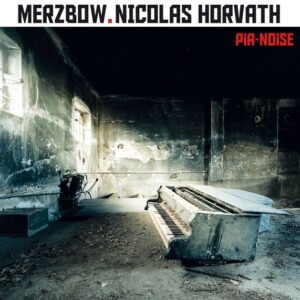
Even the most experienced ear will not come out of Pia-Noise unscathed. Consecrating the meeting of two consummate artists, this release confronts their universe like a massive head-on shock in the eye of a sound storm. Masami Akita (Merzbow) has been surveying the territories of noise music for more than forty years, directing all sorts of instrumentaria, analogical or digital, instrument or software-based. For this record he relied on his favorite combination, a mix of various effects pedals and noise generators. Nicolas Horvath is a pianist of exceptional sensibility. More than well-versed in the classical repertoire, he also is fundamentally curious and multifaceted, as evidenced by his rescuing works and composers from oblivion, championing them on stage and patiently, carefully recording them. Nicolas Horvath also improvises and composes electronic music. Since the early 2000s, he has been active in the experimental and underground scene under many different names, especially Dapnom. A collaboration with Merzbow had already been considered some fifteen years ago. In the midst of forced isolation, it was all the more tempting to meet symbolically, following the ways of the World Wide Web. Pia-Noise is actually a project born from the health crisis and lockdowns, carried out from different homes in days of anguish and uncertainty. Both artists thus projected their worries about the ongoing crisis and today's ecological disaster. The music produced took on the shape of a constant struggle between, on the one hand, Merzbow's continuous release of energy, saturated sounds, masses, stridencies, powerful granulations, surrounding textures, chaotic rhythms and organized chaos, and on the other, Nicolas Horvath's improvisations, sometimes lyrical, sometimes harmonic, always deeply rooted in his classical culture and personal pantheon, like a memory of a golden age forever lost. No listener will escape it as they lend a careful and sometimes all but desperate ear to the raging soundwaves. The two continuous musical lines often collide and even seem to ignore each other every so often, but they also meet and complete each other, helping the compositions breath. This confrontation generates a great opulence of sound calling for an extremely active form of listening. In the midst of a global wreck and a period of upheaval, two artists still manage to communicate from one digital raft to another, and render the poetry of a moment. Comes in four-panel digipack with eight-page booklet.
13,50€
In stock

CD
COMPILATION
“Women In Turkish Electronic Music”
After the release of the Anthology of Turkish Experimental Music 1961-2014 (SR 390CD, 2016), this new series of recordings unveils the diverse creativity of young Turkish female artists. The majority of these compositions were crafted between 2021 and 2024. The anthology presents works from 15 Turkish female artists, each contributing to the album's beauty through their multifaceted creations. It encompasses various styles, ranging from purely formal music to innovative electronica, incorporating remnants of Turkish harmonies, as well as pieces with conceptual or political undertones, varying in intensity from subtle to overt. Featuring Aslz Kobaner, Eda Er, Elif Yalvaç, Eylül Deniz, Fulya Uçanok, Gökçe Uygun, Gülce Özen Gürkan, Güls¸ah Erol, KAOSMOS, MelteM Ural, Mine Pakel, Pervin Güzeldere, Senem Pirler, Seinemis, and Zeynep SarÏkartal.
13,50€
In stock
CD
Jean-Luc FAFCHAMPS
“Ensemble(s)”
Seen from the outside, Ensemble(s) is in a sense a kind of compilation of unreleased or rare pieces covering nearly three decades. Five essential pieces that count in the evolution of the Jean-Luc Fafchamps' writing. Post-spectral works that definitively position Fafchamps as one of the important European composers. It also weaves subtle links between him and Jean-Paul Dessy and Musiques Nouvelles, once created by Henri Pousseur. This disc is undoubtedly the best introduction to his work. Performed by Musiques Nouvelles. Conducted by Jean-Paul Dessy.
"At the instigation of Jean-Paul Dessy, the Musiques Nouvelles ensemble initiated all sorts of configurations to which I was often associated, and glad to be. This album is the journal of these criss-crossing collaborations: sometimes as part of the ECO (European Contemporary Orchestra) project, through which Musiques Nouvelles met the Ensemble Télémaque (from France) and Orkest de ereprijs (from the Netherlands) in a large orchestral formation; sometimes for a project produced with Art Zoyd (France); sometimes as a string ensemble or with Claire Bourdet as a soloist. I am glad to present, united in one album, such different periods, contrasting collaborations and multiple encounters not merely due to coincidence but also to affinities. May my style, and the story of my questionings, give a certain consistency to this ensemble of beautiful collaborations." --Jean-Luc Fachamps
13,00€
In stock
2 CD
Baudouin De JAER
“Five Traces: Geomungo Compositions Vol. III”
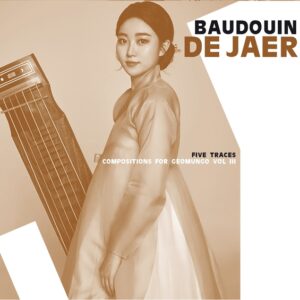
Five Traces is a wordless opera in three acts. Its sound includes words and images. The notes must speak: "This wordless opera is certainly my most daring experiment with text in sound. Over the ten years I spent discovering the majestic Geomungo, the six-string Korean bass zither played with a suldae plectrum, working on Héros de la pensée gave soft, poetic, melodious and appeasing sounds. Some of my studies continued the reduction process I had started for the piano and the violin (and then for the Gayageum), in the compositions I wrote between 1986 and 2023, attempts at extreme reducing and simplifying down to lines, music stated on one and single note (with exceptions). Lines allows the interpreter to express themselves within the scope of rhythm, nuance, vibratos, stresses and attacks, and to show the many unheard orchestral possibilities at the root of this unique instrument. In stark contrast, Chanson Cubique (Vol II) or Trace III include moments with an excessive variety of notes driving the instrument into a corner. With the warm timbres of the recordings featuring on the first two CD volumes, the listener is an accomplice to the interpreter, standing in the wings while they rub strings on fret, prepare their fingers and release the strings, tune the instrument while playing, etc. On the other hand, 'Traces' (once every five of them have been listened to) offers a more panoramic view, a look at the geometric structures of the compositions. Vol I was my doorway to the geomungo, while the compositions gathered in Vol II were explorations (experiments, studies) with a more technical aspect, in preparation for the writing of Five Traces." --Baudouin De Jaer
16,00€