
Out of stock

2 LP
Ragnar JOHNSON
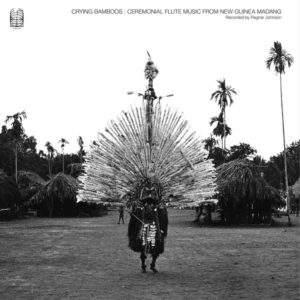
“Crying Bamboos: Ceremonial Flute Music from New Guinea Madang”
Recorded by Ragnar Johnson. Notes by Ragnar Johnson and Jessica Mayer. Photographs by Ragnar Johnson. Tape to digital transfer and mastering by Dave Hunt at Dave Hunt Audio, London. Cut by Rashad Becker at Dubplates and Mastering, Berlin.Crying Bamboos is a translation of the pidgin description of the sound of sacred flutes: “Mambu i cry, i cry, i cry”.Sacred flutes are blown to make the cries of spirits by adult men in the Madang region of Papua New Guinea. Pairs of long bamboo male and female flutes are played for ceremonies in the coastal villages near the Ramu River. There are seven male initiation flute cries from Bosmun, four flute cries from Bak: Borai with occasional single garamut percussion and two flute cries from Kaean, one with vocals and hand drums. The flute players were of the last generation to have learned this skill during a complete cycle of male initiation. These previously unreleased recordings were made in 1979.
23,00€
Out of stock
2 CD
Ragnar JOHNSON
“Crying Bamboos: Ceremonial Flute Music from New Guinea Madang”
Crying Bamboos is a translation of the pidgin description of the sound of sacred flutes: “Mambu i cry, i cry, i cry”.Sacred flutes are blown to make the cries of spirits by adult men in the Madang region of Papua New Guinea. Pairs of long bamboo male and female flutes are played for ceremonies in the coastal villages near the Ramu River. There are seven male initiation flute cries from Bosmun, four flute cries from Bak: Borai with occasional single garamut percussion and two flute cries from Kaean, one with vocals and hand drums. The flute players were of the last generation to have learned this skill during a complete cycle of male initiation. These previously unreleased recordings were made in 1979.Recorded by Ragnar Johnson. Notes by Ragnar Johnson and Jessica Mayer. Photographs by Ragnar Johnson. Tape to digital transfer and mastering by Dave Hunt at Dave Hunt Audio, London. Cut by Rashad Becker at Dubplates and Mastering, Berlin.
18,00€
Out of stock

LP
ELODIE
“Vieux Silence”
Music by Andrew Chalk & Timo van Luijk with Tom James Scott - piano, Jean-Noël Rebilly - clarinette, Daniel Morris - guitare pedal steel. Mastered & cut by Rashad Becker at Dubplates & Mastering, Berlin 0417.
“Having been entranced by both Andrew Chalk’s work with Mirror (and back to his solo works as Ferial Confine, plus multiple collaborations with David Jackman, The New Blockaders, Daisuke Suzuki, etc) and Timo van Luijk (as Af Ursin, In Camera, La Poupée Vivante, and collaborations with Kris Vanderstraeten and others) for many years, I was naturally intrigued to hear about and hear their duo project Elodie. The project formed in 2010, and has spanned eleven beautiful albums already, to date. “Vieux Silence” for Ideologic Organ is their first release presented outside of their own record publishing nook, Faraway Press & La Scie Dorée. However this is not the first encounter between Ideologic Organ & Elodie, they performed at a night in London I curated in February 2012, alongside Jessika Kenney & Eyvind Kang. Elodie’s performance was among the most delicately engaging and savant I have witnessed… so very quiet, with snow falling in London outside Cafe Oto’s windows, the audience palpably entered a high intensity listening focus. The impression of this vivid memory is striking, considering how spare each of the individual elements present that night were. “Vieux Silence”, and Elodie in general provoke a visual imagination in an instant, perhaps filtered through aged watercolour, tape grain, antique lenses, forgotten levels of listening and observational patience. Each detail carefully considered and colouring step by step, like an impressionist watercolour.” Stephen O’Malley, Les Lilas 2017
15,00€
Out of stock
LP
Norbert MÖSLANG
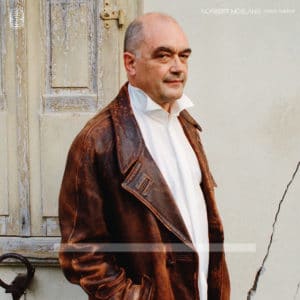
“Indoor_outdoor”
A: indoor_outdoor (2005). Recording and processing by Norbert Möslang.
Mixed by Norbert Möslang at zackstudio. Mastered by Pierre Bendel at zackstudio.
B: hot_cold_shield (2012). Toshimaru Nakamura: no-input mixing board. Norbert Möslang: cracked everyday-electronics. Recorded by Eric Mattson at “Manif d’art” at Espace 400e Bell, Québec 12 May 2012. Mastered by Toshimaru Nakamura. Vinyl cut by Rashad Becker at Dubplates & Mastering, Berlin October 2012.
“Absolute deep electric-rain-forest sound atmosphere that the listener will hear on this record is the tip of the iceberg of a same rich and elaborate work process. For over 30 years, Norbert Möslang is making the world sounding. He does not play with things, but he allows things’ sounding. His art installations, sound performances and music records are deeply involved in the hidden world of vibrations to convert them into loud sounds and thick textures. Living simultaneously in spheres of inside/outside, micro-vibrations, spacial structures, underground music venues, art galleries, underwater, glass windows, body movement, precise equalizers, insects microcosm and electronic devices; Möslang constructs fascinating untrammeled worlds of both philosophical and physical power. Möslang’s music meet clearly Brian Eno’s words about : “the idea of music as a highly physical, sensual entity - music free of narrative and literary structures, free to be pure sonic experience. And the idea of music as a highly intellectual, spiritual experience.” But this does not mean to be earnest.
The “Everyday Cracked-Electronics” are a kind of poetry, a celebration of the banality in all of his greatness, which link Voice Crack to the other amazing Swiss duo Fischli/Weiss. In the movie “The Way the Things Go”, also made in the mid-80s, you see a chain reaction of every day objects that activate each others in a kind of huge fresco of absurdity. The film was shoot without sound. The sound track was added in post production by a Foley artist. Thus again the sound was made by the use of other everyday objects. In the mid 80s, without knowing each others, both Voice Crack and Fischli/Weiss made the banality meeting with the marvelous. Instead of having historically unified art and musical movements, Switzerland generated very idiosyncratic bands or individuals as key figures. Think of Celtic Frost, The Young Gods, Samael, Günter Müller, Grauzone, Yello, Lilliput, Les Reines Prochaines, Christian Marclay or Braintickets, among others. Voice Crack are certainly part of this dream list! This country is like an fractured and exploded megapolis scattered in many small parts. Here you find as many underground venues and music festivals in industrial buildings of urban areas as ancient castles basements and old vineyard cellars of peripheries of urban cities.
In this context, I attempted to a Voice Crack gig when I was 21 in a city of 35000; in the Middle Ages bulwark of the city of Fribourg existed the annual experimental arts festival. The concert was a path-clearing musical experience. Möslang and Voice Crack opened to me both the ways to experimental noise music as well as sound art performance. These doors never closed and allowed to drift again and again into a continually larger and deeper endlessness; worlds of sounds and noises. But the Swissness stops here. Voice Crack and Möslang belong to a international underground current. When looking through the rear-view mirror it’s clear that in late 70s and early 80s there weren’t many artists working with harsh noise, a list which now read as “classics” : The New Blockaders, Whitehouse and Throbbing Gristle in UK; Hijokaidan, Merzbow, Incapacitants in Japan; NON, The Haters in the states, among only few others.
Since the break up of Voice Crack in 2002, Norbert Möslang enlarged his practice to cover all noise and experimental practices, from lo-fi Everyday-Cracked-Electronics”, saturation/overdrive work, performance and improvisation, field recordings and multi layered ambientnoise composition. Through interconnecting heterogeneous everyday objects; linking the outside sound environment into a quiet art museum by fixing microphones to its windows; filming the underwater Venice’s canal in order to set off never ending imagery flux; allowing a movie to play its own sound track by triggering photo-sensors; Möslang proves to our entire nervous system that the world we inhabit is no more than infinite continuum. To talk about “indoor_outdoor” specifically, again Möslang music drives us from nothing to everything. A field recording in the water of a swiss harbour close from his house is then processed and composed these files in a studio. The second track “hot_cold_shield” is a collaborative duo with Toshimaru Nakamura, the influential member of the Onkyokei scene in Japan, a brutal live improvisation recorded at “Manif d’art” in Québec this year.” Balthazar Lovay. Deborence, September 2012.
15,00€
Out of stock
LP
Jessica KENNEY & Eywind KANG
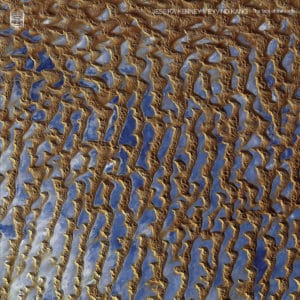
“The face of the earth”
Eyvind Kang (viola, setar, electronics). Jessika Kenney (voice, percussion, electronics). The second beautiful album by the duo of Jessika Kenney - a vocalist known for her haunting timbral sense, as well as her profound interpretation of Persian vocal traditions, and Eyvind Kang - a violist for whom the act of music and learning is a spiritual discipline. “The compositions on this album are about drawing the binary from the unary, like reflections from a mirror, and its inverse, the concealed unity. Listener/reader, translation/composition, memory/imagination- reflecting each other, they open up a current which flows in a sudden oscillation. Here we have followed a geological image; in the expression of the face of the earth (from Pr. "rokh-e khåk"), a new spectrum of binaries is revealed. In the Classical Persian traditions, this can be found in the dynamic multiplicity exemplified by the term ’radif’, used in both poetry and music, as both poeme and matheme. We would invite the listener as reader, by making our "reading cards" in the insert, to become a participant in the creation
of meaning, including translation processes which seek corresponding musical atmospheres, for example: The Central Javanese Wangsalan is a kind of riddle(two lines, 12 syllables each, divided 4 and 8), sung by the female vocalist in the gamelan, often using images of natural phenomena alongside descriptions of human characteristics, invoking atmospheres of primordial knowledge, humor, heightened sensation, philosophy, with much hidden wordplay and reference.” JK/EK. All tracks composed by Jessika Kenney & Eyvind Kang. Tavaf composed by JK based on a ghazal by Attar (12th c.). Tavaf and Ordered pairs II recorded by Randall Dunn at ADA studios, Istanbul July 2012. Ordered pairs I, Mirror stage and The face of the earth recorded by Mell Dettmer at Studio Soli, Seattle, June 2012 & St. Bartholomeo’s, Bologna. Kidung and Mirror stage recorded by Mell Dettmer at Dympna’s, Seattle 2012. Vinyl cut by Rashad Becker at Dubplates & Mastering, Berlin October 2012. Ideologic Organ curation and art direction by Stephen O’Malley. Manufactured and distributed by Editions Mego.
of meaning, including translation processes which seek corresponding musical atmospheres, for example: The Central Javanese Wangsalan is a kind of riddle(two lines, 12 syllables each, divided 4 and 8), sung by the female vocalist in the gamelan, often using images of natural phenomena alongside descriptions of human characteristics, invoking atmospheres of primordial knowledge, humor, heightened sensation, philosophy, with much hidden wordplay and reference.” JK/EK. All tracks composed by Jessika Kenney & Eyvind Kang. Tavaf composed by JK based on a ghazal by Attar (12th c.). Tavaf and Ordered pairs II recorded by Randall Dunn at ADA studios, Istanbul July 2012. Ordered pairs I, Mirror stage and The face of the earth recorded by Mell Dettmer at Studio Soli, Seattle, June 2012 & St. Bartholomeo’s, Bologna. Kidung and Mirror stage recorded by Mell Dettmer at Dympna’s, Seattle 2012. Vinyl cut by Rashad Becker at Dubplates & Mastering, Berlin October 2012. Ideologic Organ curation and art direction by Stephen O’Malley. Manufactured and distributed by Editions Mego.
15,00€
Out of stock
2 LP
GRAVETEMPLE
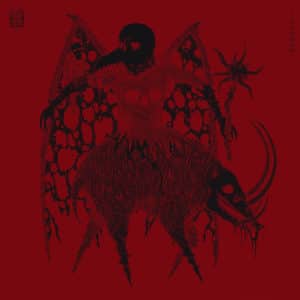
“Ambient-Ruin”
Attila: chants & percussion & Fuji sounds recorded on location in Kamakura May 08. Stephen: guitars & korg polysix recorded in Paris & Saalfelden June 08. Matt: drums were recorded at 3 Phase studios, Melbourne by Sam Johnson March 06. Oren: guitars, motorised cymbal, electronics, bells, tympani, atmos recorded at Jerker House, Melbourne & BJB, Sydney 06-08. Track IV live recordings: Levontin 7, Tel Aviv by Kostya Gervis July 06. A/D Editing & Mix by Oren June 08 at Jerker House. Mastered by Joe Talia at Chinatown, Melbourne November 012.
Cut by Rashad Becker at Dubplates & Mastering, Berlin February 013.
Gravetemple was formed in 2006 as a side-project of the band Sunn O))) by Oren Ambarchi, Stephen O’Malley and Attila Csihar. The group formed initially to tour in Israel summer 06, creating several recordings which eventually became “The Holy Down” album, which was released on Southern Lord recordings in 2007. At the time of the Israel tour, the Lebanon War started and was in action. In Summer 08 the trio reformed together with the addition of Australian drummer Matt "Skitz" Sanders for a short European tour culminating at a headlining performance at Supersonic Festival in Birmingham. In late 2009 the original trio reconvened for a special one-off concert at London’s Institute of Contemporary Arts. April 2013 marks the first set of live action since that period, and a new chapter in the ongoing system of the related network. “Ambient/Ruin” was created with the 2008 quartet, elements of tape collage, concrete, field recordings blend within a strong geographically diverse (parts were recorded in Japan, Australia, Paris and Israel) suite of heavy minimalist/maximalist music, black/death metal and drone. The culmination of these efforts become the music, literally, of Sadistik Exekution meeting Phill Niblock.
Gravetemple clearly adapted the aspects more abstract and experimental related to Sunn O))) and has continued from that point, with continued ongoing focus on metaphysical construction of free music and will. The music became a geographically and metaphysically based effort.
19,00€
Out of stock
CD
ELODIE
“Vieux Silence”
Music by Andrew Chalk & Timo van Luijk with Tom James Scott - piano, Jean-Noël Rebilly - clarinette, Daniel Morris - guitare pedal steel. Mastered & cut by Rashad Becker at Dubplates & Mastering, Berlin 0417.
“Having been entranced by both Andrew Chalk’s work with Mirror (and back to his solo works as Ferial Confine, plus multiple collaborations with David Jackman, The New Blockaders, Daisuke Suzuki, etc ) and Timo van Luijk (as Af Ursin, In Camera, La Poupée Vivante, and collaborations with Kris Vanderstraeten and others) for many years, I was naturally intrigued to hear about and hear their duo project Elodie. The project formed in 2010, and has spanned eleven beautiful albums already, to date. “Vieux Silence” for Ideologic Organ is their first release presented outside of their own record publishing nook, Faraway Press & La Scie Dorée. However this is not the first encounter between Ideologic Organ & Elodie, they performed at a night in London I curated in February 2012, alongside Jessika Kenney & Eyvind Kang. Elodie’s performance was among the most delicately engaging and savant I have witnessed… so very quiet, with snow falling in London outside Cafe Oto’s windows, the audience palpably entered a high intensity listening focus. The impression of this vivid memory is striking, considering how spare each of the individual elements present that night were. “Vieux Silence”, and Elodie in general provoke a visual imagination in an instant, perhaps filtered through aged watercolour, tape grain, antique lenses, forgotten levels of listening and observational patience. Each detail carefully considered and colouring step by step, like an impressionist watercolour.” Stephen O’Malley, Les Lilas 2017
“Having been entranced by both Andrew Chalk’s work with Mirror (and back to his solo works as Ferial Confine, plus multiple collaborations with David Jackman, The New Blockaders, Daisuke Suzuki, etc ) and Timo van Luijk (as Af Ursin, In Camera, La Poupée Vivante, and collaborations with Kris Vanderstraeten and others) for many years, I was naturally intrigued to hear about and hear their duo project Elodie. The project formed in 2010, and has spanned eleven beautiful albums already, to date. “Vieux Silence” for Ideologic Organ is their first release presented outside of their own record publishing nook, Faraway Press & La Scie Dorée. However this is not the first encounter between Ideologic Organ & Elodie, they performed at a night in London I curated in February 2012, alongside Jessika Kenney & Eyvind Kang. Elodie’s performance was among the most delicately engaging and savant I have witnessed… so very quiet, with snow falling in London outside Cafe Oto’s windows, the audience palpably entered a high intensity listening focus. The impression of this vivid memory is striking, considering how spare each of the individual elements present that night were. “Vieux Silence”, and Elodie in general provoke a visual imagination in an instant, perhaps filtered through aged watercolour, tape grain, antique lenses, forgotten levels of listening and observational patience. Each detail carefully considered and colouring step by step, like an impressionist watercolour.” Stephen O’Malley, Les Lilas 2017
12,50€
Out of stock
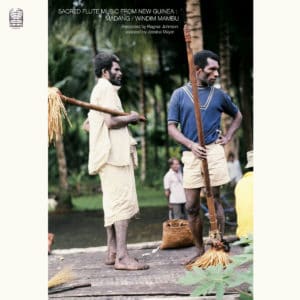
2 CD
Ragnar JOHNSON assisted by Jessica MAYER
“Sacred Flute Music from New Guinea: Madang – Windim Mambu”
Recorded by Ragnar Johnson & assisted by Jessica Mayer, Papua New Guinea, April-August 1976.
Tape to digital transfer by Dave Hunt at Dave Hunt Audio, London 0715.
Mastered & cut by Rashad Becker at Dubplates & Mastering, Berlin 0815.
Notes and photographs by Ragnar Johnson & Jessica Mayer.
Thanks to Dave Hunt for transferring the original magnetic tape recordings onto digital media and to Stephen O’Malley, David Toop and Evan Parker for assistance.
Sacred flutes are blown (“Windim Mambu”) to make the cries of spirits by adult men in the Madang region of Papua New Guinea. Pairs of long bamboo male and female flutes are played for ceremonies in the coastal villages near the Ramu River. The Ravoi Flutes from Bak are accompanied by two garamut carved wooden slit gongs. The Waudang Flutes from Manam Island are accompanied by two large and two small slit gongs and six singers. The Jarvan Flutes from Awar are accompanied by a shell rattle. The Mo-mo resonating tubes were recorded in the Finisterre Range. There are the cries of six different pairs of flutes and one pair of conch shells from the Ramu coast, two pairs of Waudang Flutes from Manam Island with singing and Mo-mo resonating tubes from the Finisterre Range. Occasional percussion is provided by wooden slit gongs and hand drums.
These recordings were made in 1976.
Originally released on LP 1977 as !Quartz 001 & 1979 as !Quartz 002.
Publications by David Toop with the assistance of Sue Steward, Evan Parker, Robert Wyatt and Alfreda Benge.
Re-released on CD 1999 as Rounder Records 5154 & 5155.
18,00€