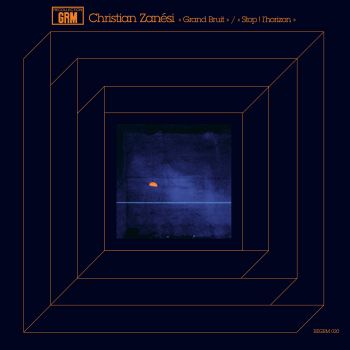
Christian ZANÉSI
“Grand Bruit – Stop! l’horizon”
15,50€
Out of stock
“Grand Bruit” (1991).
The great mobile sound bodies have an ordinary yet amazing ability to place the listener-traveller within, as if he or she was inside a giant double bass, in this case a train stroked by a double bow: the rails and the air.
In 1991, I explored this phenomenon during my daily commute from the studio to my home. I used only a 21 minutes recording and treated it as a single sound object. I then processed and enhanced it as a photographer would have done, immersing it in successive ‘baths’. The title I chose for this singular form was Grand Bruit.
“Stop ! l’horizon” (1983).
Saturday morning, nine o’clock as I reach the studio. No one here. I only turn on the spotlights as the fluorescent tubes are too noisy. I switch the power on, shut the door, unplug the telephone. I then switch the mixing desk on, which sends an electronic impulse into the amps. The four speakers react individually with a very brief and low hiss. A kind of presence. I haven’t listened to anything since the evening before and my ear is refreshed by a night’s sleep.
I feed the original mix into the master recorder and sit down in the centre.
Remote control: PLAY. With the first sound I close my eyes. The studio instantly vanishes. Another place, a much larger space opens up. I enter it. I have the very distinct feeling that music is merely a “great noise”, chiselled inside with a thousand details. It opens up like a living organism to let my hearing wander across it. A magnetic relation quickly occur and all the sounds that constitute this great noise draw me towards the East. I accept this direction. Later, much later, I reach a distant point on the horizon which pulls me towards it.
“Grand Bruit” (1991)
Les grands corps sonores mobiles ont la propriété banale et pourtant étonnante de placer l’auditeur-voyageur à l’intérieur, comme s’il se trouvait dans une gigantesque contrebasse qui, dans le cas du train, est frottée par un archet double : les rails et l’air. En 1991 j’ai utilisé ce phénomène dans la durée exacte du parcours que je faisais chaque jour en RER pour me rendre du studio à mon domicile. Un seul enregistrement de 21 minutes a été utilisé que j’ai considéré comme un seul objet sonore. J’ai alors traité et enrichi à la manière d’un photographe, c’est-à-dire par bains successifs, cette forme remarquable que j’ai appelée Grand Bruit.
“Stop ! l’horizon” (1983)
Samedi matin, j’arrive au studio, il est neuf heures.
Il n’y a personne.
Mettre la lumière, seulement les spots et pas les néons qui font du bruit. Ouvrir la force technique, fermer la porte, couper le téléphone. J’allume la console de mixage qui envoie dans les amplis une impulsion électronique, les quatre haut-parleurs répondent séparément par un bruit bref de souffle très grave.
Il y a comme une présence.
Je n’ai rien écouté depuis hier soir, mon oreille est intacte, préparée par le sommeil de la nuit.
Je mets le mixage original sur le magnétophone master et m’assois au centre.
Télécommande : PLAY.
Au premier son je ferme les yeux. Instantanément le studio disparaît.. Un autre lieu, un autre espace bien plus grand vient de s’ouvrir.
J’y pénètre.
J’ai la sensation très nette que la musique n’est qu’un « grand bruit », sculpté à l’intérieur de mille détails. Il s’ouvre comme un organisme vivant pour que mon écoute puisse s’y déplacer en tous sens. Très vite une relation magnétique s’établit et tous les sons constituant le grand bruit m’attirent vers un orient. J’accepte cette direction.
Plus tard, bien plus tard, je rejoins un point très éloigné dans l’horizon qui m’aspire.
Related products
In stock

In stock

In stock
In stock