AMM
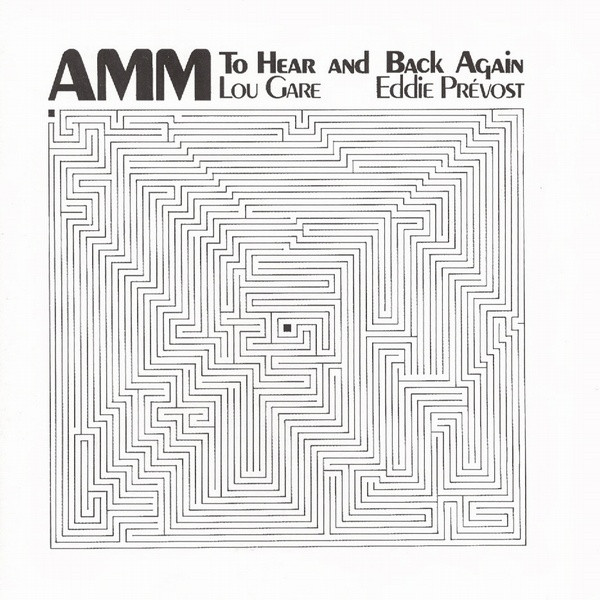
“To hear and back again” (1973-75)
12,00€
Out of stock
Lou Gare (tenor sax) and Eddie Prévost (drums).
“1. And Back to Hear Again.
The music herein, like most of the vital music of the last thirty years, is totally improvised. Such non hierarchic and non idiomatic music is beyond pigeon holes, even though it usually gets pigeon holed as abstract and/or jazz.
Of course, all music is essentially abstract. Even such relatively realistic pieces as Charles-Valentin Alkans LE CHEMIN DU FER and Meade Lux Lewis HONKY TONK TRAIN BLUES do not necessarily reveal what they are depicting unless one knows the title. (They certainly do not have any extra appeal to railway buffs!). The analogy to the visual arts is usually raised to justify calling improvisation “abstract”. Visual arts are called abstract if they do not resemble the real world out there. If any music resembles the sound sequences of the real world out there (apart from trains) it is surely totally improvised music, making it the least abstract of all. If one thinks in terms of the real susbstance of music, which is arguably its emotional content (whatever that may be), then total improvisation gives musicians the most unrestricted scope of expressing their emotions, so once again it is the least abstract of musics since it allows for the fullest expression of the substance.
The most succinct definition of jazz that I have come across is that of Peter Riley Afro-American group instrumental part improvised music. Total improvisation hardly fits in with this, especially as so few Afro-Americans seems to have taken any part or interest in it, and since it contains virtually nothing of the Afro-American tradition that permeates all of jazz. Most total improvisation is inherently non idiomatic or pan idiomatic, and therefore should really not be lumped together with any particular idiom. Some improvisation, like that on this disc, does sound somewhat like jazz, but then so do some of the compositions of George Gershwin and Igor Stravinsky. In both cases the methodology – either total improvisation or total composition – is decidedly non jazz.
It is true that jazz was a major influence on the world of total improvisation, and many (perhaps most) of the practitioners came from a jazz background. However, other musics also had important inputs. For instance, there is the area of music usually known by such egocentric names as classical, legitimate, serious and straight, as if there was nothing else worthwhile. (Since this is by far the most popular area of music worth listening to, I usually refer to it as popular music) Shortly after the middle of this century, several composers were producing scores that amounted to improvise but pay me royalties. Groups like AMM decided, quite reasonably, to improvise and keep any royalties themselves, rather than give them to any absentee composer. The musicians became both the composers and the interpreters, and the recordings became the score preserving the music – recorded sound having made scores somewhat redundant. It should also be remembered that AMM has included musicians who were otherwise composers (Cornelius Cardew and Christian Wolff) or interpreters (Rohan de Saram and John Tilbury) of classical, legitimate, serious, straight music.
2. Back And Again Hearing Two In 1963, Lou Gare answered a saxophonist wanted advertisement in a then music trade paper, and as a result became a member of Eddie Prévost’s Band. He later joined Mike Westbrook’s band, which at that time also included Keith Rowe and Lawrence Sheaff. Meanwhile, Gare, Rowe and Sheaff also began to make music with Prévost, and in 1965 they left Westbrook, called themselves AMM, and were subsequently joined by Cornelius Cardew. Virtually all the resemblances to a jazz group were soon discarded as more and more emphasis was placed on total group improvisation – they being one of the very first groups to take this direction. There was a decided preference for bowing and live electronics (including radios) in which the overall sound was so unified that it was often impossible to isolate any individual contributions.
Sheaff’s tenure with the group ended in 1967 (after which he dropped out of music making altogether), and AMM became the quartet it remained for a further four years, sometimes augmented either by Christopher Hobbs or Christian Wolff. By 1970, the electronics had been dropped by everyone except Rowe, who alone was left to create the dense mass of sound that seeped around the others contributions. This became a sort of sonic cushion and/or springboard, rather like (in their very different ways) a baroque continuum or a jazz rhythm section.
At the end of 1971, Cardew and Rowe departed for other things leaving just the tenor saxophone and percussion of Gare and Prévost – an acoustic duo in the age of electronics they had presaged. The absence of Rowe’s swirling veil meant that this duo was the most naked version of AMM – there was nothing for Gare and Prévost to hide behind or amongst. It was also the AMM with the most jazz like sound, revealing that this highly original pair of individuals had long absorbed their early influences of Sonny Rollins and Max Roach. However, as before, the methodology was unlike jazz – absolutely nothing (melody, harmony, rhythm, tempo) was predetermined. (Even the use of Gare’s beautiful tune BURNISHED GOLD at the start of BACK AGAIN was improvised on the whim of the moment.)
The two 1974 recordings are unique in that they include natural unedited AMM silences. These were an integral part of the music of both this duo and the preceding quartet – an influence (like the use of radios, not used by this duo) of John Cage (who was probably the first to package silence). In this era when every space is stuffed with noise (sometimes called disco, muzak or internal combustion engines), these silences will probably be the most difficult part of this music for most people. One needs to stop to think whether it is really necessary to say something when there is nothing to say. (And whether the world would be a much better place if all jukeboxes and all muzak tapes were full of recordings of 4’33”).
By contrast, in between the silences, the music sometimes reaches the ferocity usually associated with the more energetic varieties of free jazz, but without that genre’s all too frequent loss of balance. Things never get out of control, and one is always aware of the saxophone’s melodic lyricism and the percussion’s arhythmic propulsion. Gare and Prévost were (and are) superb exponents of the art of creating something substantive of out nothing.
It was not always tenor and percussion, however. Every so often, Gare would produce and bow a gong (lying on its belly and filled with large stones) and other little instruments would appear. An example of this different area of exploration (also related to certain aspects of the earlier, larger AMM) can be heard on one of the three previously unissued performances include herein.
In 1976, Cardew and Rowe rejoined AMM for some rehearsals that were not very successful. This time it was Cardew and Gare that left, leaving Prévost and Rowe to form the second AMM duo. They were eventually joined by John Tilbury to make the trio that has been the nucleus of AMM ever since. Other musicians who have augmented this trio include Rohan de Saram, Ian Mitchell and, from 1989 to 1991, Lou Gare. With hindsight, the 1971-76 duo of Gare and Prévost can be seen as a unique version of AMM that continued the magnificent tradition of constantly evolving AMMmusic in an untypically Roweless manner.
And To Gain A Hearback In common with virtually all writings about music, the above probably reveals more about the writer than about the music. But then music as good as this speaks for itself.” Martin Davidson 1993
Enregistré entre 1973 et 1975 où AMM se limitait au duo Lou Gare (saxophone ténor) et Eddie Prévost (batterie).
Related products
Out of stock
Out of stock
Out of stock
Out of stock
Out of stock
Out of stock
Out of stock
Out of stock