Morton FELDMAN
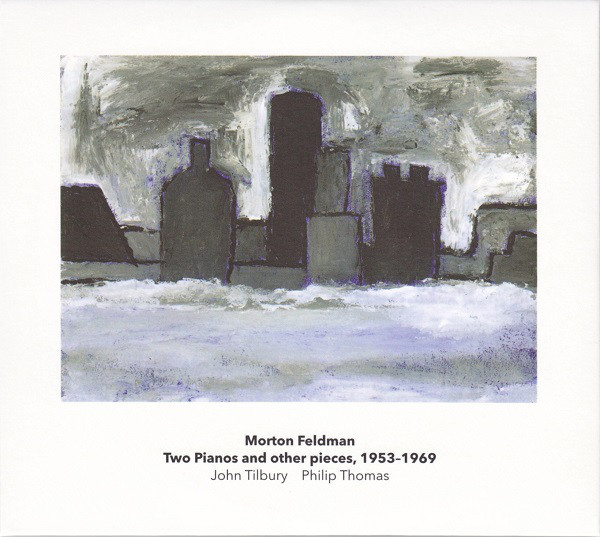
“Two pianos and other pieces, 1953-1969”
23,00€
Out of stock
A 2 CD of music for multiple pianos from what is arguably the most experimental and interesting period of Morton Feldman’s development as a composer. Some of the pieces have been very rarely performed or recorded, and have probably never been in better hands.
John Tilbury, Philip Thomas, Catherine Laws & Mark Knoop, pianos. Anton Lukoszevieze & Seth Woods, cellos. Mira Benjamin & Linda Jankowska, violins. Rodrigo Constanzo & Taneli Clarke, percussion. Barrie Webb, trombone. Naomi Atherton, horn.
“Two Pianos (1957). “Four Instruments” (1965). “Vertical Thoughts 1” (1963), “Between Categories” (1969), “Piece for Four Pianos” (1957). “Piano Four Hands” (1958). “Intermission 6” (1953), “De Kooning” (1963), “Two Pieces for Three Pianos” (1966), “Piano Three Hands” (1957), “False Relationships and the Extended Ending” (1968), “Two Pianos second version” (1957).
Notes on Morton Feldman’s “Two Pianos and other pieces” by Philip Thomas. The music featured on these two discs testifies to the intensity of Feldman’s experimentation with notation and sound during the 1950s and 60s. Considering the works chronologically one senses the composer trying out, teasing and developing means of notation to get close to his desired elasticity of time and duration. His experiments with indeterminacy of pitch – whereby Feldman specified only the register (high, middle, low) of sound rather than the exact notes themselves – do not feature here; after trying this method in a series of works in the early 1950s he abandoned the technique, with a few notable exceptions straying into the 1960s, because he was too ‘attached’ to the pitches he wanted.
All notes are specified exactly in the pieces on these discs – the experiments are instead with duration and time. Durations of sounds are variously free, dependent upon the decay of the sound, worked out in coordination with other players, as well as at times exactly and complexly notated within a specific tempo. Sometimes the freedoms of notating time are worked through in combination with listening closely to the sounds of other players, allowing patterns to emerge without forcing the situation, whilst at other times different ways of notating time are combined, creating false alignments in the score and thus placing greater emphasis upon the individual performer’s journey.
The piano is an inherently indeterminate instrument – any given note will have a very different afterlife dependent upon the touch of the performer, the register of the note, the type and size of the piano, the acoustic of the space in which the piano is situated, and so forth. Put six or seven of these notes together as a chord and the situation becomes complex. In all these pieces Feldman specifies the dynamics to be quiet, or as quiet as possible, or very quiet. However the notion that Feldman’s music is ‘about’ quiet-ness is a misconception: the subject is sound, and in order for that subject to be properly attended to those sounds are quiet. The range of pieces presented here depict very many different types of quietness – from the delicate sounds of Piano Three Hands and Piano Four Hands to the massed complexities of Two Pieces for Three Pianos. Quietness in Feldman’s piano music is a performance instruction which is everything to do with touch and the desire to really hear the instrument. As such these recordings are a celebration of the piano (its tone and its decay) and piano playing, for all its frustrations and challenges – an instrument which is at the heart of Feldman’s music.
Un ensemble de compositions de Morton Feldman avec un ou plusieurs pianos qui correspondent à ces œuvres les plus expérimentales au niveau de la notation et du son.“Two Pianos (1957). “Four Instruments” (1965). “Vertical Thoughts 1” (1963), “Between Categories” (1969), “Piece for Four Pianos” (1957). “Piano Four Hands” (1958). “Intermission 6” (1953), “De Kooning” (1963), “Two Pieces for Three Pianos” (1966), “Piano Three Hands” (1957), “False Relationships and the Extended Ending” (1968), “Two Pianos second version” (1957).
Interprètes : John Tilbury, Philip Thomas, Catherine Laws & Mark Knoop, pianos. Anton Lukoszevieze & Seth Woods, violoncelles. Mira Benjamin & Linda Jankowska, violons. Rodrigo Constanzo & Taneli Clarke, percussion. Barrie Webb, trombone. Naomi Atherton, cor.
Related products
Out of stock

Out of stock

Out of stock

Out of stock

Out of stock